Impact of Duty Free Import Policies on Domestic Pulse Farmers
Source:The Hindu ↗
Why It Matters
The issue highlights a classic conflict between consumer inflation management (via cheap imports) and farmer income security (via MSP). It provides a concrete case study on how trade policies and inadequate government procurement can render MSP ineffective, a recurring theme in GS Paper 3 agriculture and economy modules.
Summary
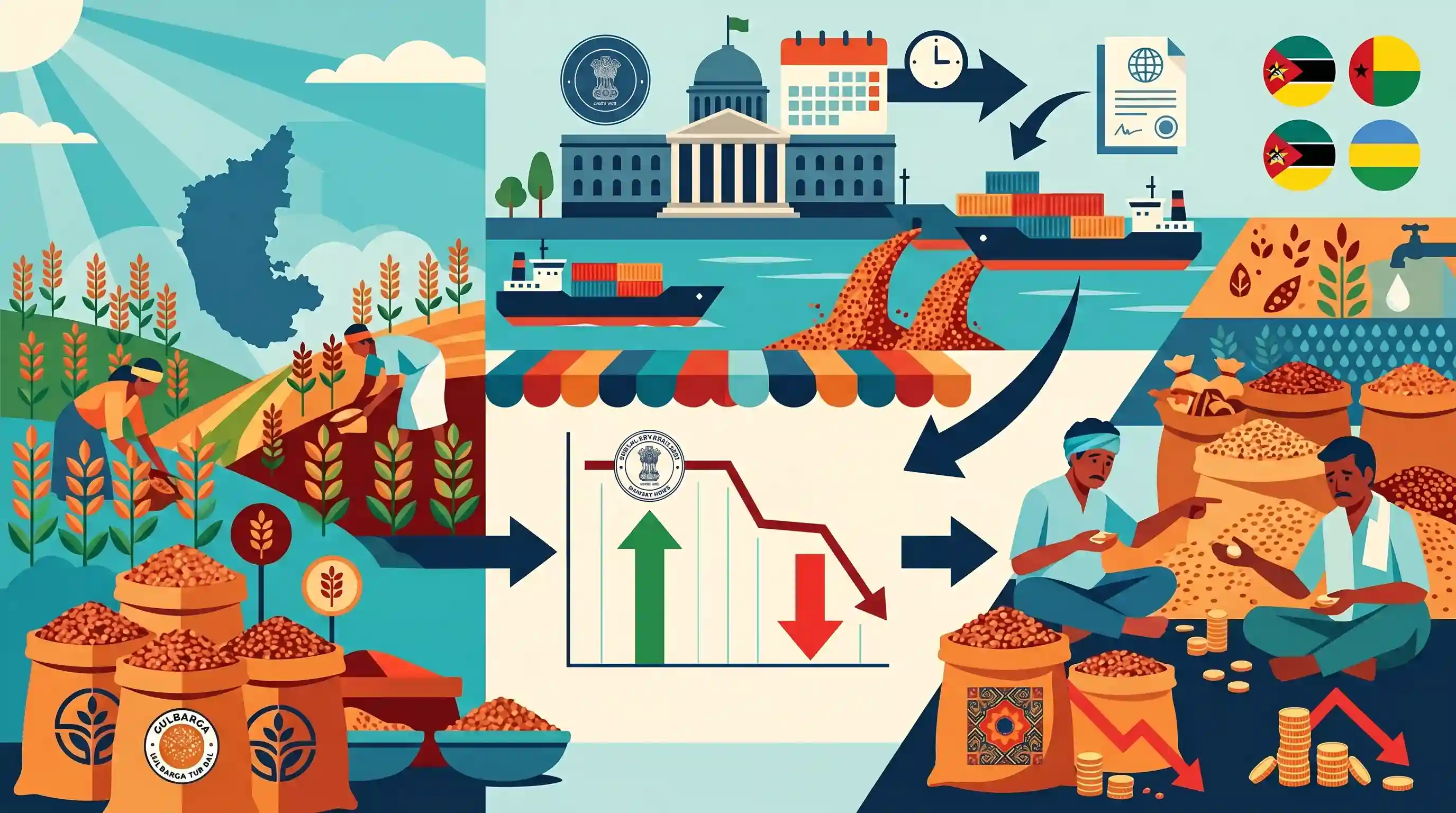
The Central Government's duty-free import policy for red gram has caused distress among farmers in Karnataka, the largest producer of the crop in India. With duty-free imports extended until March 2026 and international MoUs (such as with Mozambique) facilitating foreign supply, domestic market prices have crashed well below the Minimum Support Price (MSP). Despite the CACP recognizing the high cost of cultivation, low government procurement levels have forced farmers in regions like Kalaburagi—famous for its GI-tagged 'Gulbarga Tur Dal'—to sell their produce at a significant loss.
Key Points
- Karnataka is India's largest producer of red gram, with the Kalaburagi district alone accounting for 40% of the state's yield and holding a GI tag for 'Gulbarga Tur Dal'.
- The Central Government's decision to extend duty-free imports of red gram until March 2026 has severely depressed domestic market prices.
- Despite a declared Minimum Support Price (MSP) of ₹8,000 per quintal, farmers are being forced to sell at around ₹6,250 due to an influx of imported dal and low government procurement (less than 10% of total production).
- While the CACP acknowledged the state's proposed MSP of ₹16,548 based on high production costs, the Centre fixed it significantly lower, further straining farmers' incomes.
Important Terms
Minimum Support Price (MSP)

A guaranteed floor price at which the government procures crops from farmers, intended to prevent distress sales and provide a safety net against market price fluctuations.
UPSC context
GS Paper 3: Agricultural pricing and subsidies; crucial for understanding farmer distress and food security mechanisms.
Commission for Agricultural Costs and Prices (CACP)
An attached office of the Ministry of Agriculture that recommends MSP for 23 mandated crops by analyzing production costs, market trends, and inter-crop price parity.
UPSC context
GS Paper 3: Institutional framework of agriculture; tests knowledge of bodies involved in price fixation and policy recommendations.
Duty-free import policy
A trade policy allowing the entry of foreign goods without customs duties; currently extended until March 2026 for pulses like Tur dal to stabilize domestic food inflation.
UPSC context
GS Paper 3: Issues related to direct and indirect farm subsidies; impacts of international trade on domestic agricultural markets.
Gulbarga Tur Dal (GI Tag)
A specific variety of pigeon pea from Karnataka granted intellectual property protection in 2019, renowned for its high protein, calcium, and potassium content due to regional soil.
UPSC context
GS Paper 1 & 3: Geography and IPR; highlights regional agricultural specialties and legal protections for traditional produce.
Red Gram (Tur Dal)
A major protein-rich kharif legume (pigeon pea) primarily grown in rain-fed regions; India is the world's largest producer and consumer, with Karnataka being a leading state.
UPSC context
GS Paper 3: Major cropping patterns; essential for topics on food security, crop diversification, and self-sufficiency (Atmanirbharta).
Prelims Trap
"MSP declaration ensures that private traders cannot legally buy red gram below the announced price."
MSP is a government procurement guarantee, not a statutory minimum price. When state procurement is negligible, private market prices routinely crash below the announced MSP.
Static Concepts Connected
What are the different cost formulas evaluated by the CACP for recommending MSP?
- A2 Formula: Covers direct out-of-pocket expenses incurred by farmers on seeds, fertilizers, pesticides, hired labour, and fuel.
- A2+FL Formula: Includes actual paid costs (A2) plus an imputed value of unpaid family labour. This is the baseline formula currently used by the government.
- C2 Formula: A comprehensive cost that includes A2+FL along with imputed rent and interest on owned land and fixed capital assets, frequently demanded by farmer unions.
What are the key geographical and agronomic characteristics of pulse cultivation in India?
- Seasonal Distribution: Gram (chickpea) is a dominant Rabi crop accounting for ~40% of output, while Tur (red gram) is the primary Kharif pulse.
- Rainfed Dependency: A vast majority of pulses in India are grown in rainfed conditions, making their yields highly vulnerable to monsoon fluctuations and climatic stress.
- Soil Enrichment: As leguminous crops, they fix atmospheric nitrogen (except Rajma), improving soil fertility and making them essential for sustainable crop rotation.
Cross-Topic Patterns
Inflation targeting vs. Agrarian Income
Duty-free imports to manage retail food inflation often conflict directly with the broader agrarian policy mandate of ensuring remunerative prices and doubling farmers' incomes.
Food Security and African Diplomacy
India's long-term MoUs with nations like Mozambique to import Tur dal highlight how domestic food inflation and supply-side constraints actively drive South-South diplomatic engagements.
GI Tags and Market Realization
Despite holding a Geographical Indication tag ('Gulbarga Tur Dal'), a lack of robust state procurement networks prevents farmers from realizing the premium market value of specialized crops.

Expect a Prelims 2026 statement-based question contrasting Kharif/Rabi pulse production hubs and the CACP's A2+FL vs. C2 cost formulas.
Linked PYQs · 4
Linked PYQs · 4
- 2018MainsGS3
What do you mean by Minimum Support Price (MSP)? How will MSP rescue the farmers from the low income trap?
- 2017MainsGS3
How do subsidies affect the cropping pattern, crop diversity and economy of farmers? What is the significance of crop insurance, minimum support price and food processing for small and marginal farmers?
- 2020PrelimsGS1
With reference to pulse production in India, consider the following statements: 1. Black gram can be cultivated as both kharif and rabi crop. 2. Green-gram alone accounts for nearly half of pulse production. 3. In the last three decades, while the production of kharif pulses has increased, the production of rabi pulses has decreased. Which of the statements given above is/are correct?
- 2019PrelimsGS1
Among the agricultural commodities imported by India, which one of the following accounts for the highest imports in terms of value in the last five years?
