India UK FTA Rules of Origin and Foreign Direct Investment
Source:The Hindu ↗
Why It Matters
FTAs and their specific provisions (like Rules of Origin) are a recurring theme in GS-3 (Economy - Trade and Investment) and GS-2 (International Relations). This article demonstrates how trade policy can be strategically wielded not just to boost exports, but to actively protect domestic markets from dumping (e.g., Chinese goods) while forcing foreign capital to invest directly in 'Make in India' manufacturing infrastructure.
Summary
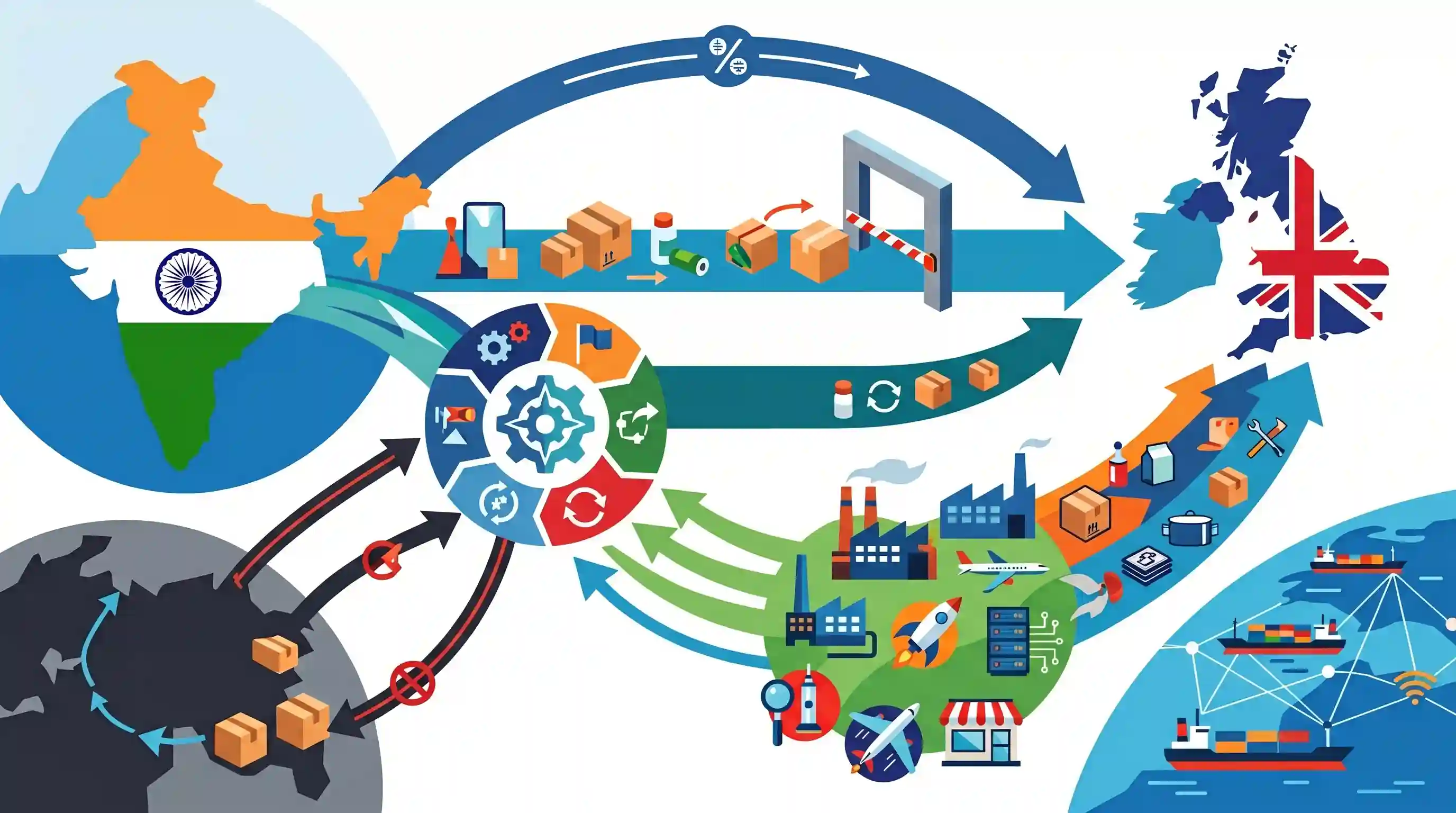
India and the United Kingdom recently signed the Comprehensive Economic and Trade Agreement (CETA), a landmark Free Trade Agreement (FTA) that opens up 99% of UK tariff lines to Indian goods. A critical strategic component of the deal is its strict 'Rules of Origin' chapter. It stipulates that products must undergo significant transformation in India to qualify for zero or reduced tariffs, effectively thwarting attempts by third nations like China to dump goods via routing or mere repackaging. Economically, this local sourcing mandate turns CETA into a powerful tool for attracting Foreign Direct Investment (FDI) into India's manufacturing sector. Eager to access the lucrative UK market duty-free, foreign original equipment manufacturers (OEMs) and engineering companies are heavily incentivized to build authentic production infrastructure in India. Experts predict this will foster deep integration into global supply chains, drive technology transfers, and significantly boost sectors like precision engineering, aerospace, IT, and MSMEs.
Key Points
- India and the UK signed the Comprehensive Economic and Trade Agreement (CETA) on July 24, 2025, in London.
- A key pillar of CETA is the 'Rules of Origin' chapter, which mandates that goods must be substantially processed or wholly obtained in either country to qualify for reduced tariffs.
- This strict origin clause is designed to prevent third countries (like China) from routing or merely repackaging goods through India to gain duty-free access to the UK.
- With the UK opening 99% of its tariff lines, the FTA is expected to be a major catalyst for Foreign Direct Investment (FDI) into India's manufacturing sector.
- Foreign companies will be incentivized to set up local production in India to leverage the preferential export access, boosting integration into global value chains.
- Sectors like precision engineering, industrial instrumentation, process automation, IT, and aerospace are poised for significant investments, joint ventures, and technology transfers.
Important Terms
India-UK Comprehensive Economic and Trade Agreement (CETA)

The formal name for the 2025 India-UK Free Trade Agreement, targeting 99% tariff elimination on Indian exports and doubling bilateral trade to USD 120 billion by 2030.
UPSC context
GS Paper II: Bilateral agreements involving India; GS Paper III: Effects of liberalization and trade policy on the economy.
Rules of Origin (RoO)
Legal criteria used to determine a product's national source, preventing third-party countries from bypassing tariffs through simple repackaging or routing (trade circumvention).
UPSC context
GS Paper III: Indian Economy and issues relating to planning, mobilization of resources, and international trade.
Rolls-Royce
A British aerospace and engineering multinational expanding its Indian manufacturing and R&D footprint, leveraging the FTA to double sourcing and enhance "Make in India" integration.
UPSC context
GS Paper III: Changes in industrial policy and their effects on industrial growth; Global supply chain integration.
Grant Thornton Bharat
A major professional services firm that tracks bilateral investment trends through the "Britain Meets India" report, analyzing UK corporate expansion and FDI in India.
UPSC context
GS Paper III: Investment models and analysis of foreign direct investment (FDI) corridors.
General Instruments Consortium
A premier Indian manufacturing group specializing in precision instrumentation; a key player in engineering exports set to benefit from the FTA's duty-free access.
UPSC context
GS Paper III: Indigenization of technology and the role of MSMEs/domestic industries in global trade.
Prelims Trap
Goods shipped from an FTA partner country automatically qualify for duty-free access under the agreement.
Preferential tariffs require strict adherence to 'Rules of Origin'. Goods must undergo substantial transformation or value addition locally; mere transshipment or repackaging by third countries does not qualify.
Static Concepts Connected
What are 'Rules of Origin' (RoO) in International Trade?
- Core definition: Criteria used to determine the exact national source of a product for customs, quotas, and preferential trade purposes.
- Main objective: To prevent trade deflection, ensuring non-partner nations (like China) cannot exploit an FTA by routing and dumping goods via a partner country.
- Key criteria: Typically requires a minimum threshold of domestic value addition (e.g., 35-40%) or a 'Change in Tariff Classification' (CTC) post-processing.
How do comprehensive agreements (CETA/CEPA) differ from standard FTAs?
- Standard FTA: Primarily focuses on reducing or eliminating customs duties (tariffs) on a specified list of traded goods between partner countries.
- CETA/CEPA: A much broader pact covering not just goods, but also trade in services, investments, intellectual property, government procurement, and regulatory cooperation.
Cross-Topic Patterns
Rules of Origin + PLI Schemes
Strict RoO clauses in FTAs combine with India's Production Linked Incentive (PLI) schemes to force foreign manufacturers to genuinely localize supply chains rather than merely assembling imported parts.
China Plus One + Global Supply Chains
The India-UK CETA provides the guaranteed export market access needed to make India a viable "China Plus One" manufacturing hub for global OEMs, especially in precision engineering and aerospace.

Expect a 2026 Prelims multi-statement question defining 'Rules of Origin' and distinguishing CEPA/CETA from standard FTAs.
Linked PYQs · 3
Linked PYQs · 3
- 2013MainsGS3
Discuss the impact of FDI entry into Multi-trade retail sector on supply chain management in commodity trade pattern of the economy.
- 2017MainsGS3
Account for the failure of manufacturing sector in achieving the goal of labour-intensive exports. Suggest measures for more labour-intensive rather than capital-intensive exports.
- 2020MainsGS2
The judicial systems in India and UK seem to be converging as well as diverging in recent times. Highlight the key points of convergence and divergence between the two nations in terms of their judicial practices.
