CBIC Links Customs Duty Cuts to Local Manufacturing and Growth
Source:Indian Express ↗
Why It Matters
The article connects fiscal policy (customs duties) directly to industrial growth and self-reliance. It is crucial for GS-3 answers regarding the Make in India initiative, trade protectionism, and how tax rationalization resolves inverted duty structures to boost domestic manufacturing.
Summary
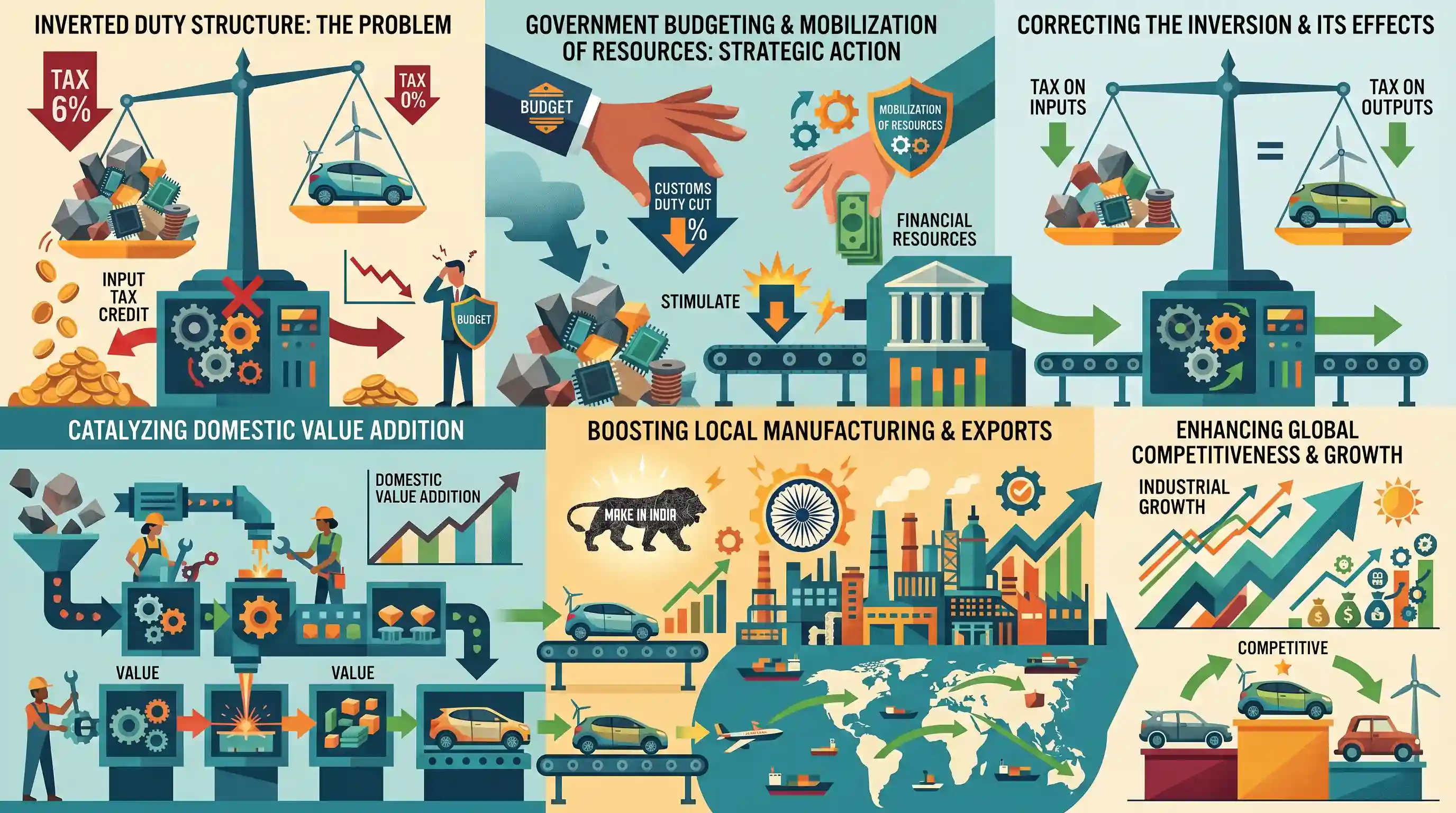
The CBIC Chairman has emphasized that customs duty cuts on raw materials and components must not be evaluated solely through the lens of foregone revenue. Instead, these strategic reductions are intended to correct inverted duty structures, stimulate local manufacturing, and enhance India's global competitiveness. By lowering input costs, the government aims to catalyze domestic value addition, boost exports, and support the broader goals of the 'Make in India' and 'Aatmanirbhar Bharat' initiatives.
Key Points
- Recent customs duty reductions are strategically designed to resolve inverted duty structures and lower input costs for domestic manufacturers.
- The CBIC Chairman stated that these duty cuts should be viewed as a catalyst for local industry growth rather than a mere loss of tax revenue (revenue foregone).
- Lowering import duties on critical raw materials and components enhances global competitiveness and supports India's export growth.
- These strategic tariff realignments are a core component of the 'Make in India' and 'Aatmanirbhar Bharat' initiatives aimed at building long-term industrial capacity.
Important Terms
CBIC (Central Board of Indirect Taxes and Customs)

A statutory body under the Ministry of Finance's Department of Revenue that formulates and administers policies for GST, Customs, and Excise duties.
UPSC context
GS Paper II (Statutory Bodies) and GS III (Economy); relevant for taxation reforms and administrative structures.
Make in India
A flagship national program launched in 2014 to transform India into a global design and manufacturing hub by boosting investment and innovation across 27 sectors.
UPSC context
GS Paper III (Industrial Policy); central to discussions on FDI, ease of doing business, and employment.
Aatmanirbhar Bharat
A mission launched in 2020 to achieve a "self-reliant India" through five pillars (Economy, Infrastructure, Systems, Demography, Demand) and a large economic stimulus package.
UPSC context
GS Paper III (Economic Development); tested regarding indigenization, supply chains, and global competitiveness.
Inverted Duty Structure
A fiscal anomaly where import duties on raw materials or intermediate goods are higher than those on the finished product, discouraging domestic manufacturing.
UPSC context
GS Paper III (Taxation/Industrial Growth); tests understanding of trade barriers and manufacturing competitiveness.
Customs Duty
An indirect tax levied by the government on the import or export of goods across international borders to generate revenue and protect local industry.
UPSC context
GS Paper III (Government Budgeting); key for understanding fiscal policy and international trade dynamics.
Prelims Trap
"An inverted duty structure occurs when the import duty on finished products is higher than on raw materials."
This describes a normal, progressive tariff structure. An 'inverted' structure is the exact opposite: duties on raw materials are higher than on finished goods.
Static Concepts Connected
What is an Inverted Duty Structure (IDS)?
- Definition: A tax structure where the import duty (or GST) on raw materials and inputs is higher than the tax on the finished goods.
- Economic Impact: It discourages domestic value addition, as importing finished goods becomes cheaper than producing them locally, thereby hurting manufacturing.
- Remedial Measures: The government corrects it by reducing customs duties on inputs or providing input tax credit refunds (under GST).
What is 'Tax Expenditure' in Government Budgeting?
- Concept: It refers to 'revenue foregone' or the potential tax revenue the government loses due to exemptions, deductions, or strategic duty cuts.
- Objective: It functions as an indirect fiscal subsidy designed to promote specific economic goals, such as boosting local manufacturing, exports, or savings.
- Budget Document: The Union Budget publishes a 'Statement of Revenue Impact of Tax Incentives' (formerly Statement of Revenue Foregone) for transparency.
Cross-Topic Patterns
IDS + PLI Scheme synergy
Correcting inverted duty structures operates in tandem with Production Linked Incentives (PLI) to make electronics and semiconductor manufacturing commercially viable in India.
Tariff cuts + Global Value Chains
Slashing raw material tariffs aligns with the Economic Survey's push for integrating India into Global Value Chains (GVCs), shifting focus from pure import substitution to export competitiveness.

Expect a multi-statement question in 2026 linking Inverted Duty Structure mechanics with its impact on Global Value Chain integration.
Linked PYQs · 2
Linked PYQs · 2
- 2023MainsGS3
Faster economic growth requires increased share of the manufacturing sector in GDP, particularly of MSMEs. Comment on the present policies of the Government in this regard.
- 2025MainsGS3
India aims to become a semiconductor manufacturing hub. What are the challenges faced by the semiconductor industry in India? Mention the salient features of the India Semiconductor Mission.
