Social Media Influencer Arrest and Free Speech Limits
Source:Indian Express ↗
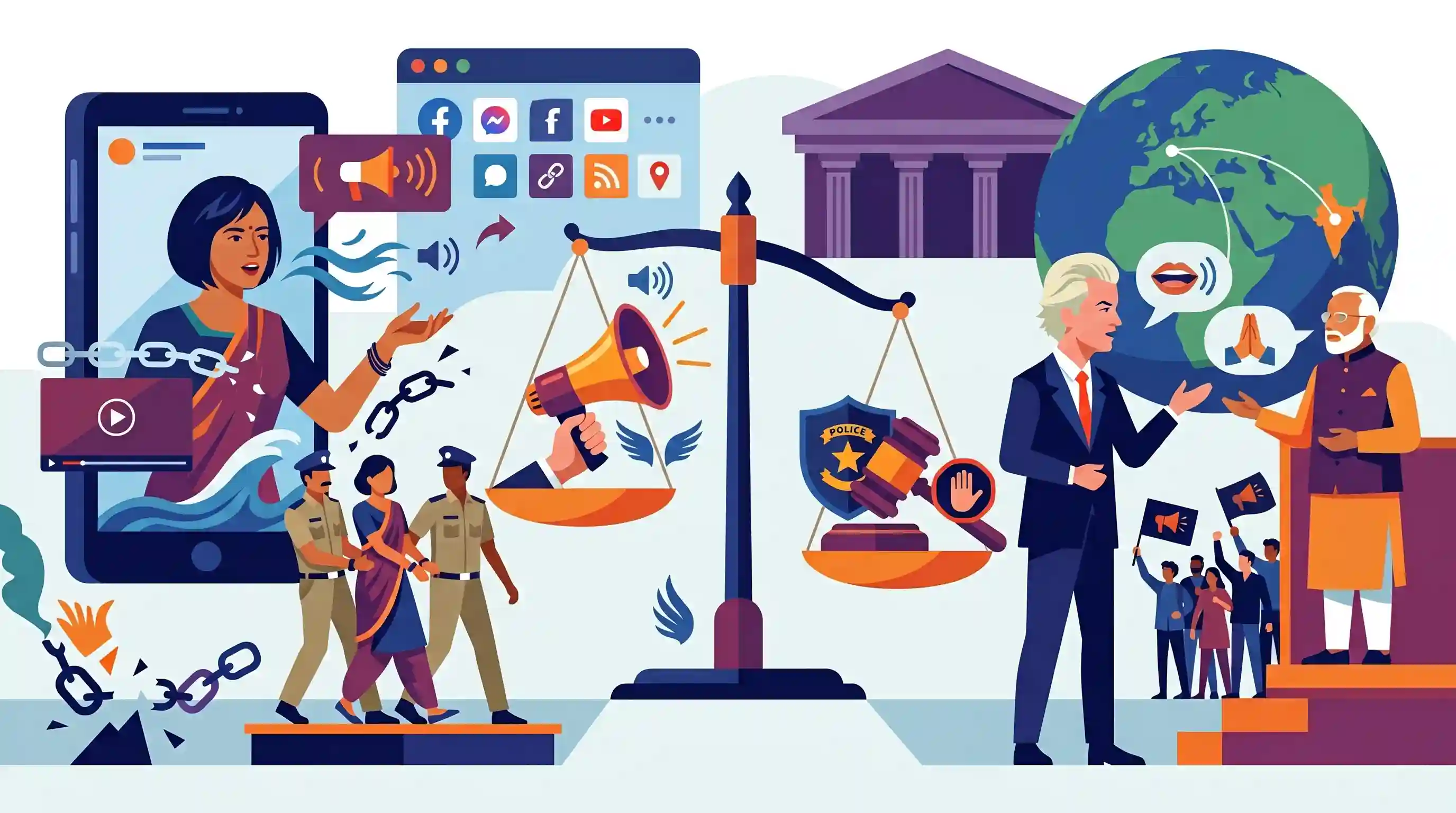
Why It Matters
The issue serves as a contemporary case study on the friction between Fundamental Rights (Article 19) and public order/hate speech laws. It also illustrates how social media amplifies domestic incidents into national security and diplomatic talking points.
Summary
An Indian social media influencer, Sharmistha Panoli, was arrested by Kolkata Police in Gurugram on charges of promoting enmity and outraging religious feelings following a controversial video she posted and later deleted. The arrest triggered political outrage from the BJP and international commentary from Dutch MP Geert Wilders, who appealed to PM Modi to intervene, citing free speech. The incident underscores the ongoing debate over the limits of freedom of speech, the application of hate speech laws, and the regulatory challenges surrounding social media platforms.
Key Points
- Law student and social media influencer Sharmistha Panoli was arrested by Kolkata Police for a video containing alleged communal remarks.
- She faces charges related to promoting enmity between groups and outraging religious feelings, despite having deleted the video and issued a public apology.
- Dutch MP Geert Wilders intervened via social media, urging PM Narendra Modi to secure her release and defending her right to free speech.
- The incident has sparked domestic political tension between the BJP, which alleges unfair targeting, and the TMC, while raising questions about the boundaries of Article 19(1)(a).
Important Terms
Freedom of Speech and Expression (Article 19)

A fundamental right under Article 19(1)(a) of the Indian Constitution, guaranteeing citizens the right to express views freely through speech, writing, or media.
UPSC context
GS Paper II (Polity); foundational for understanding civil liberties and the impact of social media on democracy.
Reasonable Restrictions
Constitutional grounds under Article 19(2) allowing the State to limit free speech in interests like public order, religious harmony, and national security.
UPSC context
GS Paper II; tests the balance between individual rights and State authority in maintaining social harmony.
Bharatiya Nyaya Sanhita (BNS)
The comprehensive legal code that replaced the Indian Penal Code (IPC) in 2024, containing updated provisions for criminal offences like promoting enmity (Section 196).
UPSC context
GS Paper II (Governance/Law); critical for current affairs regarding India's criminal justice system overhaul.
Hate Speech
Speech or expression intended to insult, degrade, or incite hatred against a group based on identity; often regulated under BNS Sections 196 and 299.
UPSC context
GS Paper II & IV (Polity/Ethics); concerns the regulation of communal disharmony and digital ethics.
Public Order
A ground for restricting fundamental rights to maintain communal peace and prevent violence, frequently invoked in cases of provocative social media content.
UPSC context
GS Paper II & III; vital for questions on internal security and the police's role in law enforcement.
Operation Sindoor
Refers to India's April 2024 military counter-strike against terror launchpads following the Pahalgam attack, which served as the contextual trigger for the influencer's remarks.
UPSC context
GS Paper III (Internal Security); relevant for understanding the impact of national security events on public discourse.
Prelims Trap
The term "hate speech" is explicitly defined as a ground for restriction under Article 19(2) of the Constitution.
The Constitution does not define "hate speech". Article 19(2) provides broader grounds like "public order" and "incitement to an offence," which are operationalized by statutory laws like the BNS.
Static Concepts Connected
What are the grounds for restricting Freedom of Speech under Article 19(2)?
- Sovereignty and Integrity: Restrictions to protect India's mere existence and territorial unity against secessionist threats.
- Public Order & Security: To prevent local riots, state overthrow, or direct incitement to commit criminal offences.
- Friendly Foreign Relations: To prevent malicious speech that could severely damage diplomatic relations with foreign states.
- Decency, Contempt, Defamation: To protect the courts from contempt, individuals from defamation, and society from obscenity.
How did Shreya Singhal (2015) distinguish forms of speech regarding Article 19(1)(a)?
- Discussion: Mere discussion or expression of unpopular, controversial, or offensive ideas is constitutionally protected.
- Advocacy: Promoting a specific cause or viewpoint remains protected as long as it does not trigger violence.
- Incitement: Speech loses protection only when it reaches the threshold of directly inciting an offence or public disorder.
Cross-Topic Patterns
Foreign commentary and Indian sovereignty
Frequent foreign intervention on domestic issues via social media forces MEA responses, blending GS2 International Relations with internal constitutional and sovereignty debates.
Inter-state arrests and federalism
A state police arresting a citizen in another state tests federal boundaries, triggering BNSS inter-state transit remand rules and highlighting the weaponization of state police forces.

Expect a GS2 Mains question on balancing digital-era free speech with public order, specifically citing the new BNS provisions.
Linked PYQs · 2
Linked PYQs · 2
- 2014MainsGS2
What do you understand by the concept "freedom of speech and expression"? Does it cover hate speech also ? Why do the films in India stand on a slightly different plane from other forms of expression ? Discuss.
- 2024MainsGS3
Social media and encrypting messaging services pose a serious security challenge. What measures have been adopted at various levels to address the security implications of social media? Also suggest any other remedies to address the problem.
