Durga Puja Boosts Informal Economy and Livelihoods in West Bengal
Source:news-abplive ↗
Why It Matters
Crucial for understanding the socio-economic impact of West Bengal's biggest cultural festival on local livelihoods and the informal economy, highly relevant for state-level civil services examinations.
Summary
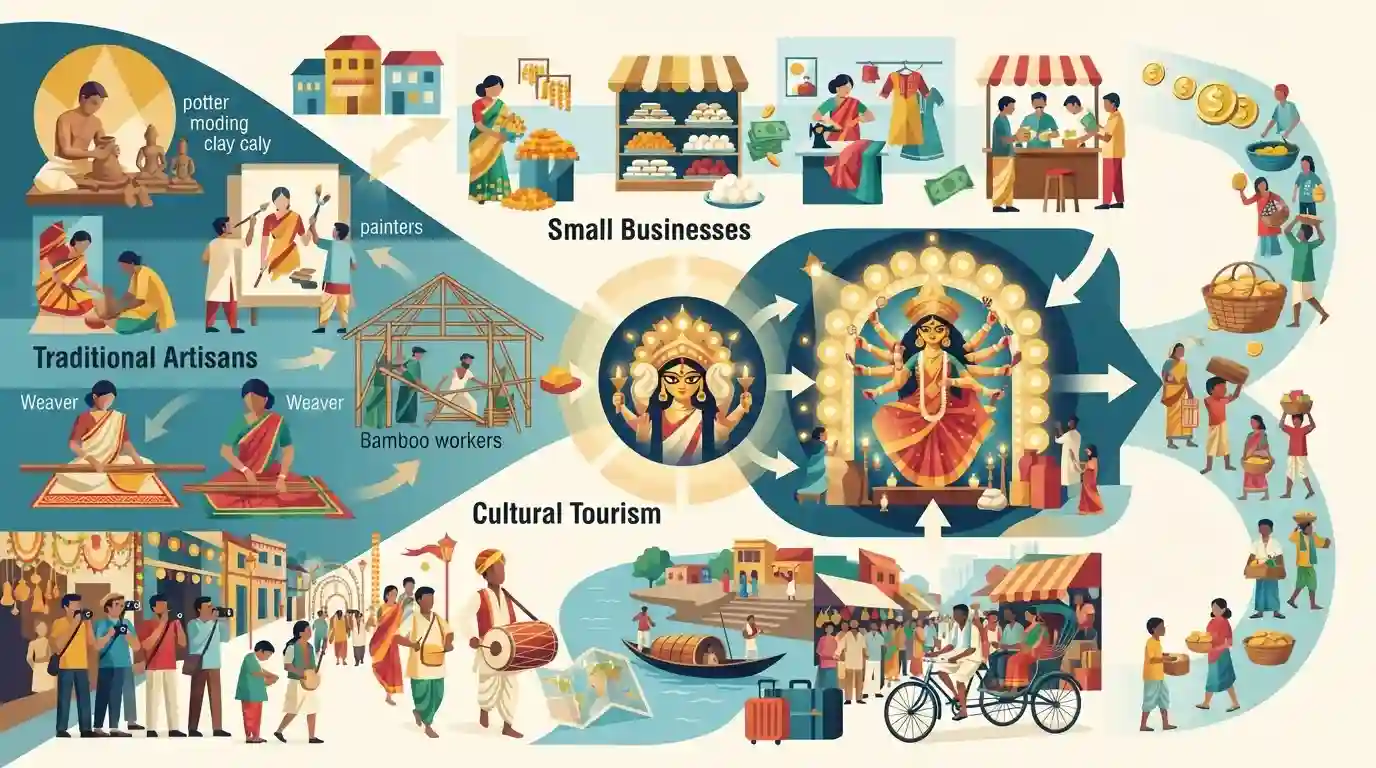
An analysis of how Durga Puja drives the informal economy and creates vital livelihoods across Kolkata and West Bengal, encompassing traditional artisans, small businesses, and cultural tourism.
Key Points
- Durga Puja significantly boosts Kolkata and West Bengal's informal economy and livelihoods, spanning artisans, decorators, caterers, and small vendors.
- The festival acts as a major economic engine, driving employment and income generation across diverse creative and traditional sectors.
- UNESCO Intangible Cultural Heritage recognition has further amplified its global and economic profile.
Important Terms
UNESCO Intangible Cultural Heritage

The United Nations Educational, Scientific and Cultural Organization inscribed Kolkata's Durga Puja on its Representative List of the Intangible Cultural Heritage of Humanity in December 2021.
UPSC context
WBCS Paper I/III (Culture & Heritage, West Bengal Economy): Tests knowledge of international recognitions of Bengal's festivals and their socio-economic impacts.
Prelims Trap
Durga Puja generates over ₹32,000 crore, which represents the total tax revenue collected by the West Bengal government during the festival.
The British Council study estimated the creative economy output at over ₹32,000 crore (around 2.58% of state GDP), while recent broader economic assessments have scaled that up toward ₹65,000 crore. Aspirants often confuse the baseline study figure with total state revenue.
Static Concepts Connected
What are the key institutional and economic dimensions of Durga Puja's UNESCO Intangible Cultural Heritage recognition for West Bengal?
- UNESCO Status: Inscribed on the UNESCO Representative List of the Intangible Cultural Heritage of Humanity in December 2021 (the first festival from Asia to receive this distinction).
- Economic Impact: A 2019 British Council study pegged the festival's economic footprint at ₹32,377 crore (~2.58% of West Bengal's GDP), driven by creative industries, tourism, and micro-enterprises.
- Collaborative Study: Involves a collaborative institutional framework including the British Council, IIT Kharagpur, and the Government of West Bengal for cultural mapping and valuation.
Cross-Topic Patterns
Intangible Heritage meets State GDP Economics
UNESCO Intangible Cultural Heritage listing combines soft power diplomacy with local heritage economics, directly linking cultural tourism to state-level GDP growth in West Bengal.
Rural Artisans and Urban Informal Commerce
Informal sector livelihoods during mega-festivals bridge rural artisan production (Kumartuli) with urban commercial consumption in Kolkata.

Expect a statement-based question combining the British Council economic valuation of Durga Puja with its UNESCO ICH listing details.
Linked PYQs · 2
Linked PYQs · 2
- 2024WBCS_PRELIMSGS1
East Kolkata Wetland has been declared as
- 2024WBCS_PRELIMSGS1
In West Bengal, silk industry is famous in:
