West Asian Conflict threatens UAE Economic Stability and Hub
Source:Indian Express ↗
Why It Matters
The Middle East is the linchpin of India's energy security and home to a massive Indian diaspora. Understanding the geopolitical balancing act of key players like the UAE helps aspirants analyze the broader implications of shifting alliances and regional conflicts on global stability and India's national interests.
Summary
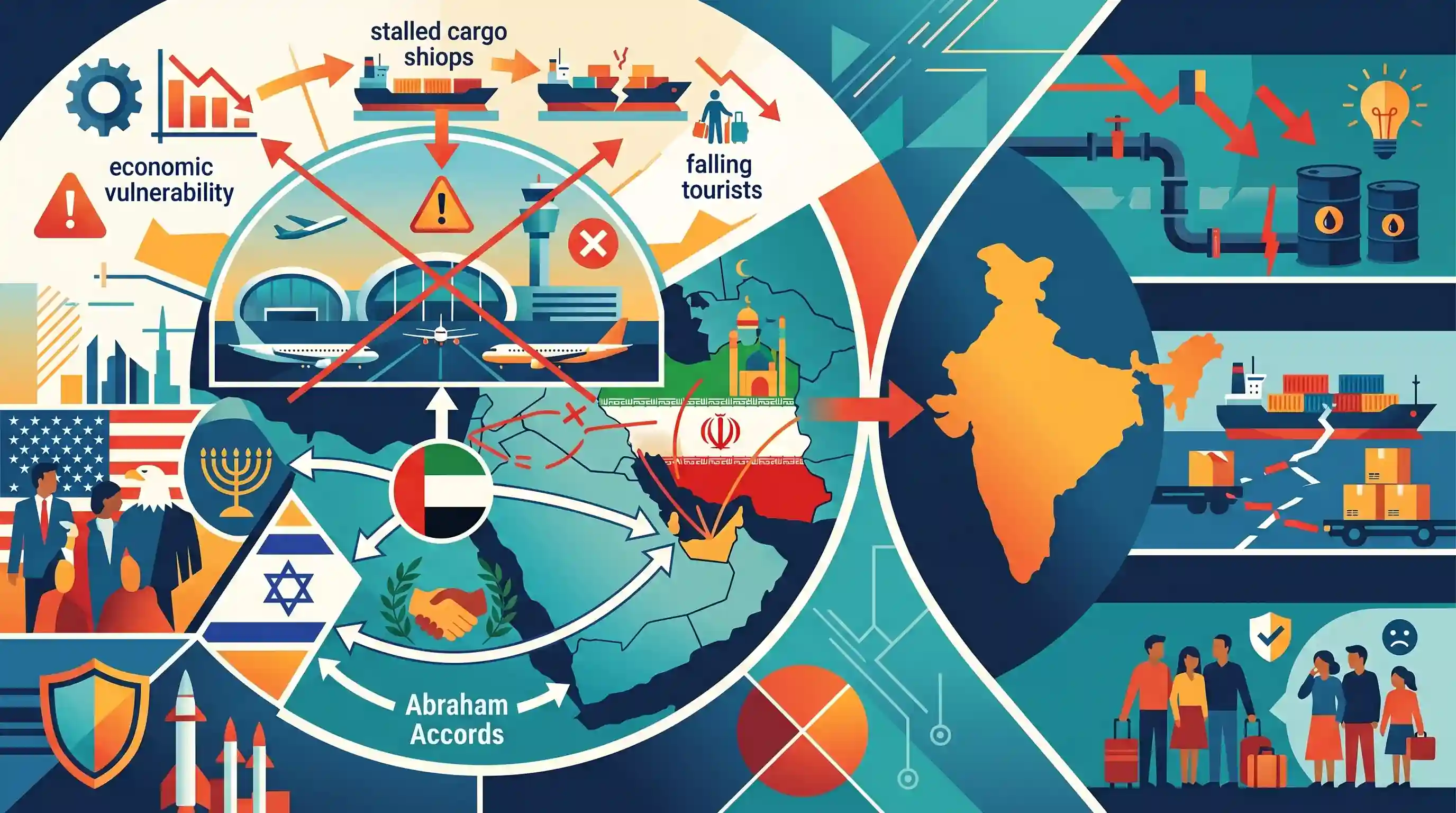
The temporary closure of Dubai International Airport amid escalating Israel-US-Iran tensions highlights the deep economic vulnerabilities of Gulf nations to regional warfare. The UAE faces a critical geopolitical challenge: balancing its strategic defense ties with the US and normalized relations with Israel under the Abraham Accords against its geographic proximity and vital economic links with Iran. As a premier global transit and commercial hub, the UAE\'s economy—driven by aviation, trade, and tourism—is highly susceptible to regional instability. For India, these developments are of paramount concern, as prolonged conflict in the Middle East threatens energy security, global supply chains, and the welfare of millions of Indian expatriates.
Key Points
- The closure of Dubai International Airport underscores the vulnerability of global transit and economic hubs to escalating geopolitical conflicts in the Middle East.
- The UAE is forced to navigate a precarious strategic balance, maintaining its security partnership with the US and normalized ties with Israel, while preserving essential economic relations with Iran.
- A direct confrontation between Israel, Iran, and the US threatens the UAE\'s core economic pillars, which rely heavily on aviation, tourism, and uninterrupted global trade.
- Regional instability poses severe risks to global supply chains and energy markets, directly affecting India\'s strategic interests, including energy security and the safety of its large diaspora in the Gulf.
Important Terms
Abraham Accords

A series of 2020 normalization agreements between Israel and several Arab nations (UAE, Bahrain, Sudan, Morocco) brokered by the US, shifting West Asian geopolitics toward economic and security cooperation.
UPSC context
GS Paper II (International Relations); tests diplomatic shifts in West Asia and India's ability to engage with both Israel and Arab partners.
India's Extended Neighbourhood
Geopolitical regions beyond India's immediate borders, including West Asia and Southeast Asia, where India maintains vital strategic, economic, and cultural interests.
UPSC context
GS Paper II (Foreign Policy); tests understanding of regional stability's impact on India's national interest and economic integration.
Energy Security
The uninterrupted availability of energy sources at an affordable price; critical for India due to its high dependence on oil and gas imports from West Asia.
UPSC context
GS Paper III (Economy/Security); tests awareness of energy supply chains, price volatility, and the strategic importance of the Persian Gulf.
Strategic Autonomy
The principle of a nation making independent foreign policy and defense decisions based on its own interests without being constrained by external pressures or military alliances.
UPSC context
GS Paper II (International Relations); tests India's multi-alignment strategy in balancing ties with rival powers like the US, Israel, and Iran.
Indian Diaspora
The community of Indian citizens and people of Indian origin living abroad, who contribute significant remittances and act as a bridge for cultural and economic ties.
UPSC context
GS Paper II (International Relations); tests the socio-economic role of overseas Indians and the government's response to their safety during regional crises.
Prelims Trap
The Abraham Accords normalized diplomatic relations between Israel and all Gulf Cooperation Council (GCC) nations.
The Accords only include the UAE and Bahrain from the GCC. Major regional players like Saudi Arabia, Qatar, Kuwait, and Oman are not signatories.
Static Concepts Connected
What are the key Middle Eastern maritime chokepoints for India's energy imports?
- Strait of Hormuz: Connects the Persian Gulf to the Gulf of Oman. It is the world's most critical oil transit chokepoint, heavily utilized for India's crude oil imports.
- Bab-el-Mandeb: Connects the Red Sea to the Gulf of Aden. It is crucial for maritime trade routes heading toward the Suez Canal and Europe.
What is the I2U2 initiative formed in the wake of the Abraham Accords?
- Member Nations: Comprises India, Israel, the UAE, and the USA. It is often referred to as the 'West Asian Quad' or the Indo-Abrahamic bloc.
- Geo-economic Focus: Focuses exclusively on geo-economic cooperation in six key areas: water, energy, transportation, space, health, and food security. It explicitly lacks a military mandate.
Cross-Topic Patterns
Gulf Remittances & Balance of Payments
The 4-million-strong Indian diaspora in the UAE drives massive inward remittances, crucial for offsetting India's merchandise trade deficit and stabilizing the broader Current Account and Balance of Payments.
IMEC Corridor Geopolitical Vulnerability
Escalations between Iran, Israel, and the US directly threaten the viability of the proposed India-Middle East-Europe Economic Corridor (IMEC), which fundamentally relies on stable transit hubs in the UAE and Saudi Arabia.

Expect a 2026 prelims question linking Abraham Accords, I2U2, and IMEC to test India's geo-economic stakes in West Asia.
Linked PYQs · 3
Linked PYQs · 3
- 2025MainsGS2
"Energy security constitutes the dominant kingpin of India's foreign policy, and is linked with India's overarching influence in Middle Eastern countries.” How would you integrate energy security with India's foreign policy trajectories in the coming years?
- 2018MainsGS2
In what ways would the ongoing US-Iran Nuclear Pact Controversy affect the national interest of India? How should India respond to this situation?
- 2018MainsGS2
“India’s relations with Israel have, of late, acquired a depth and diversity, which cannot be rolled back.” Discuss.
