Himalayan Disaster Preparedness and Ecological Vulnerability
Source:sandrp ↗
Why It Matters
Crucial for understanding Himalayan disaster risks, ecological vulnerabilities, and climate adaptation strategies, highly relevant for UKPSC PCS General Studies paper.
Summary
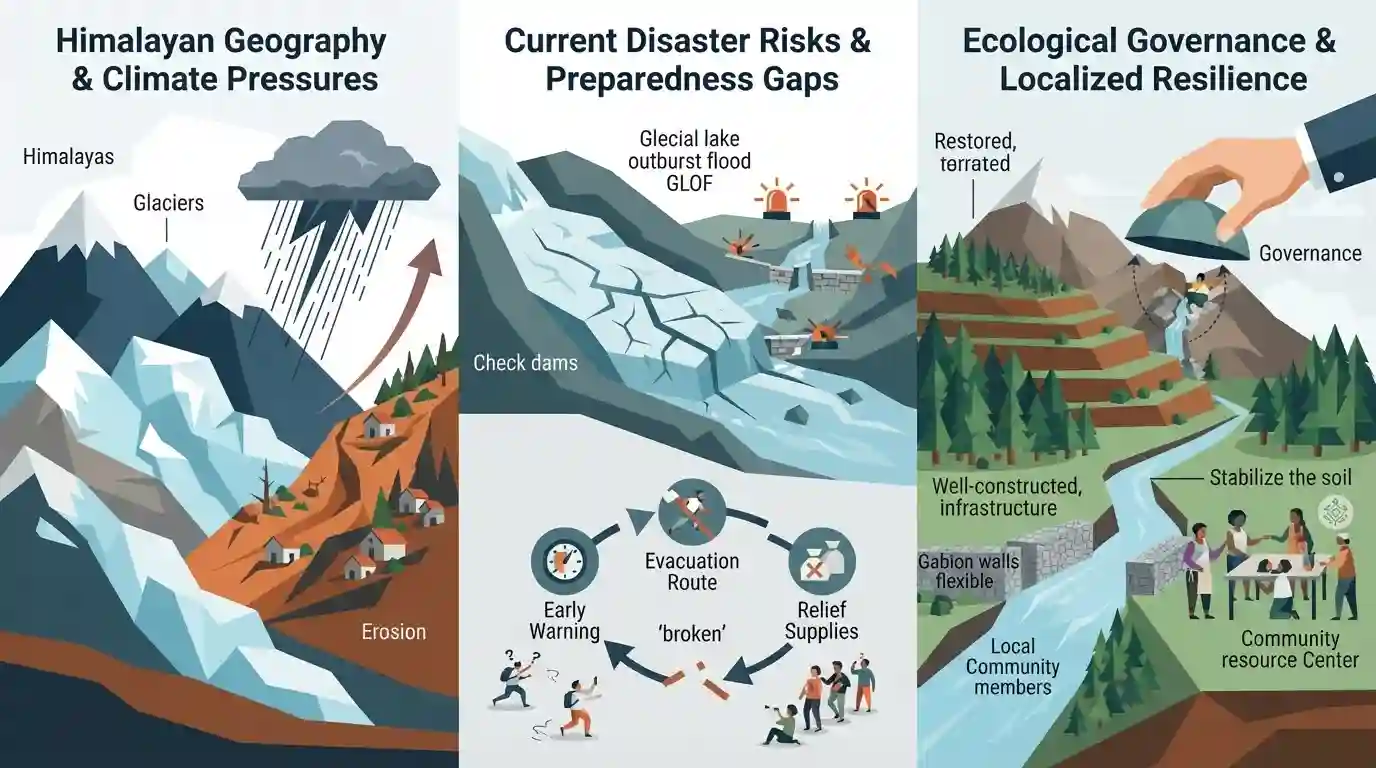
This article from SANDRP critically reviews the disaster preparedness mechanisms in the Himalayan region, highlighting escalating risks from climate change, cloudbursts, and glacial hazards, and calls for robust ecological governance and localized resilience frameworks.
Key Points
- The article examines the increasing vulnerability and disaster preparedness of the Himalayan region against extreme weather events like cloudbursts and flash floods.
- It highlights the gaps in early warning systems, infrastructure resilience, and ecological management in fragile mountainous states like Uttarakhand.
- Emphasizes the need for decentralized disaster management, protection of natural water sources, and integration of scientific assessments into development policies.
Important Terms
SANDRP

South Asia Network on Dams, Rivers and People (SANDRP) is an informal network of organizations and individuals working on issues related to rivers, dams, and environmental governance in South Asia.
UPSC context
Relevant for UKPSC Paper III (Environment, Ecology, and Disaster Management), assessing civil society critiques of Himalayan infrastructure and ecological governance.
Uttarakhand State Disaster Management Authority
The nodal state agency established under the Disaster Management Act, 2005, tasked with disaster mitigation, preparedness, planning, and coordinating emergency response across Uttarakhand.
UPSC context
Crucial for UKPSC Paper III (Disaster Management in Uttarakhand) and state administrative structure questions.
Glacial Lake Outburst Floods (GLOFs)
Sudden and catastrophic floods caused by the breach of natural moraine or ice dams holding glacial meltwater, intensified by Himalayan climate change.
UPSC context
Important for UKPSC Geography and Disaster Management syllabus concerning high-altitude natural hazards and climate vulnerability in the Himalayas.
Prelims Trap
A cloudburst is defined as any heavy downpour exceeding 50 mm of rainfall within a continuous three-hour period.
Aspirants often assume cloudbursts are classified purely by duration or general heavy rain, missing the strict IMD meteorological criterion.
Static Concepts Connected
What is the strict meteorological definition of a cloudburst in India?
- IMD Criterion: Rainfall intensity exceeding 100 mm per hour over a localized geographical area (typically 20-30 sq km).
- Orographic Uplift: Often associated with cumulonimbus clouds trapped in narrow Himalayan valleys, causing sudden, catastrophic flash floods.
What are Glacial Lake Outburst Floods (GLOFs) and why are they critical to Himalayan disaster management?
- Mechanism: Sudden release of vast volumes of water from glacial lakes dammed by weak moraine walls.
- Triggers: Triggered by earthquakes, avalanches, or rapid ice melting due to global warming.
- Vulnerability: Poses severe downstream infrastructure and livelihood risks across fragile Himalayan states like Uttarakhand.
Cross-Topic Patterns
Himalayan Ecology vs. Developmental Infrastructure
Unchecked hydel projects and unscientific road widening in fragile Himalayan states like Uttarakhand connect environmental degradation directly to state-level disaster management failures.
Climate Change & GLOF Vulnerability mapping
The proliferation of vulnerable glacial lakes in Uttarakhand illustrates how climate change adaptation must intersect with local governance and decentralized early warning systems.

Himalayan disaster resilience + GLOF mitigation + state disaster governance is high-yield for UKPSC Mains GS Paper III and Prelims.
Linked PYQs · 1
Linked PYQs · 1
- 2025UKPSC_PRELIMSGS1
Consider the following statements and select the correct answer from the options given below : Statement 1 : Uttarakhand is highly vulnerable to climate change. Statement 2 : Climate change is causing water stress and depleting biodiversity in Uttarakhand.
