Addressing Accidental Drowning as a Neglected Public Health Crisis
Source:The Hindu ↗
ఇది ఎందుకు ముఖ్యం
The topic exposes a critical blind spot in India's public health and disaster management strategies. For UPSC aspirants, it serves as a powerful case study of how preventable mortalities (drowning) require multi-sectoral governance involving health departments, disaster authorities (NDMA), and local civil society.
సారాంశం
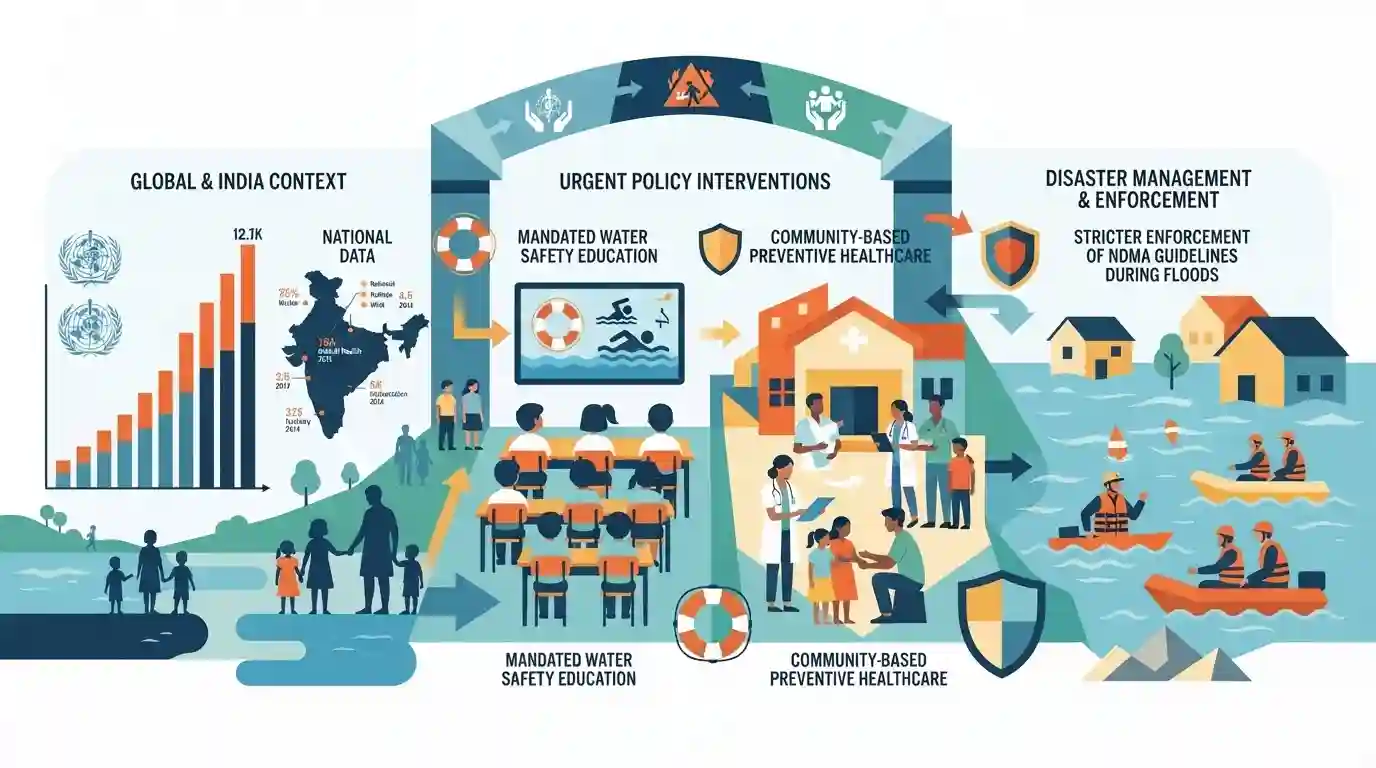
The article underscores drowning as a major but consistently overlooked public health crisis both globally and in India. Despite staggering mortality numbers highlighted by institutions like the WHO and India's NCRB, drowning prevention remains largely absent from mainstream health and disaster management policies. The piece advocates for urgent, coordinated policy interventions—such as mandated water safety education, stricter enforcement of NDMA guidelines during floods, and community-based preventive healthcare measures—to address this preventable loss of life.
ముఖ్య అంశాలు
- Drowning represents a severely neglected but highly preventable global public health crisis, claiming hundreds of thousands of lives annually.
- In India, National Crime Records Bureau (NCRB) data continually highlights a high burden of accidental drowning deaths, particularly affecting children and rural populations.
- There is a critical lack of a coordinated national framework or public health policy specifically targeting water safety and survival swimming education.
- Effective prevention requires multi-sectoral collaboration, bridging public health initiatives, disaster management protocols (via NDMA) during floods, and community-level awareness.
- The WHO and the UN advocate for comprehensive national drowning prevention strategies encompassing infrastructure safety, day-care for children, and robust data surveillance.
ముఖ్యమైన పదాలు
Accidental Deaths and Suicides in India (ADSI) Report

An annual report published by the NCRB detailing official data on deaths caused by natural and unnatural factors, including road accidents, drowning, and suicides across India.
UPSC context
GS Paper 2 (Health, Social Issues). Used to justify policies on preventable deaths, including the high rate of drowning fatalities.
National Disaster Management Authority (NDMA)
An apex body under the Ministry of Home Affairs, headed by the Prime Minister, responsible for laying down policies, plans, and guidelines for disaster management.
UPSC context
GS Paper 3 (Disaster Management). Tests knowledge of India's institutional framework for managing floods and associated drowning risks.
World Health Organization (WHO)
A specialized United Nations agency focused on international public health, monitoring global health trends and issuing guidelines on issues like drowning prevention.
UPSC context
GS Paper 2 (International Institutions, Health). Crucial for citing global data on drowning as a leading cause of preventable death.
UN General Assembly Resolution on Global Drowning Prevention
A landmark 2021 UN declaration that formally recognized drowning as an urgent, preventable public health crisis, establishing World Drowning Prevention Day.
UPSC context
GS Paper 2 (Global Health Initiatives). Demonstrates international momentum and frameworks for tackling preventable mortality.
ప్రిలిమ్స్ ఉచ్చు
The UN General Assembly Resolution on Global Drowning Prevention (2021) is a legally binding treaty on member states.
UNGA resolutions are non-binding. UPSC frequently tests the legal nature of international frameworks to trip up students who assume major global resolutions are binding.
అనుసంధానమైన స్థిర భావనలు
What are the core components of NDMA's guidelines on Urban Flooding?
- Drainage Capacity: Upgrading stormwater drains to handle high-intensity, short-duration rainfall based on a 5-to-10-year return period.
- Encroachment Removal: Clearing natural drainage channels and urban wetlands from illegal encroachments to preserve natural sponge capacities.
- Early Warning Systems: Deploying local, real-time urban flood forecasting systems integrated with automatic weather stations.
How is Public Health constitutionally distributed in India?
- State List: Public health and sanitation are under Entry 6 of the State List, making state governments the primary implementers of health policies.
- Union List: Port quarantine, international health regulations, and central research institutions fall under the Union List.
- Concurrent List: Prevention of the extension of infectious diseases from one state to another falls under Entry 29 of the Concurrent List.
అంతర-అంశ నమూనాలు
Urban Planning + Disaster Risk
Concretization and lost wetlands turn urban rains into drowning hazards, linking municipal governance failure directly to public health risks.
SDGs + Rural Child Safety
Drowning in open water bodies in rural areas directly impedes SDG 3.2 (ending preventable deaths of children under 5 years of age).

Urban flood vulnerability questions will likely test the policy gap between immediate disaster response and preventive public health.
అనుసంధాన PYQలు · 4
అనుసంధాన PYQలు · 4
- 2024MainsGS2
In a crucial domain like the public healthcare system the Indian State should play a vital role to contain the adverse impact of marketisation of the system. Suggest some measures through which the State can enhance the reach of public healthcare at the grassroots level.
- 2020MainsGS2
In order to enhance the prospects of social development, sound and adequate health care policies are needed particularly in the fields of geriatric and maternal health care. Discuss.
- 2024MainsGS3
Flooding in urban areas is an emerging climate-induced disaster. Discuss the causes of this disaster. Mention the features of two such major floods in the last two decades in India. Describe the policies and frameworks in India that aim at tackling such floods.
- 2014MainsGS3
Drought has been recognized as a disaster in view of its spatial expanse, temporal duration, slow onset and lasting effects on vulnerable sections. With a focus on the September 2010 guidelines from the National Disaster Management Authority (NDMA), discuss the mechanisms for preparedness to deal with likely El Niño and La Niña fallouts in India.
