Drought Induced Soil Stress Accelerates Antimicrobial Resistance Risk
Source:The Hindu ↗
Why It Matters
Antimicrobial Resistance (AMR) is a recurring theme in both UPSC Prelims and Mains. This research provides a critical, contemporary link between climate change (droughts) and health (AMR), serving as excellent fodder for essay and GS3 questions that ask candidates to connect environmental degradation with emerging health threats.
Summary
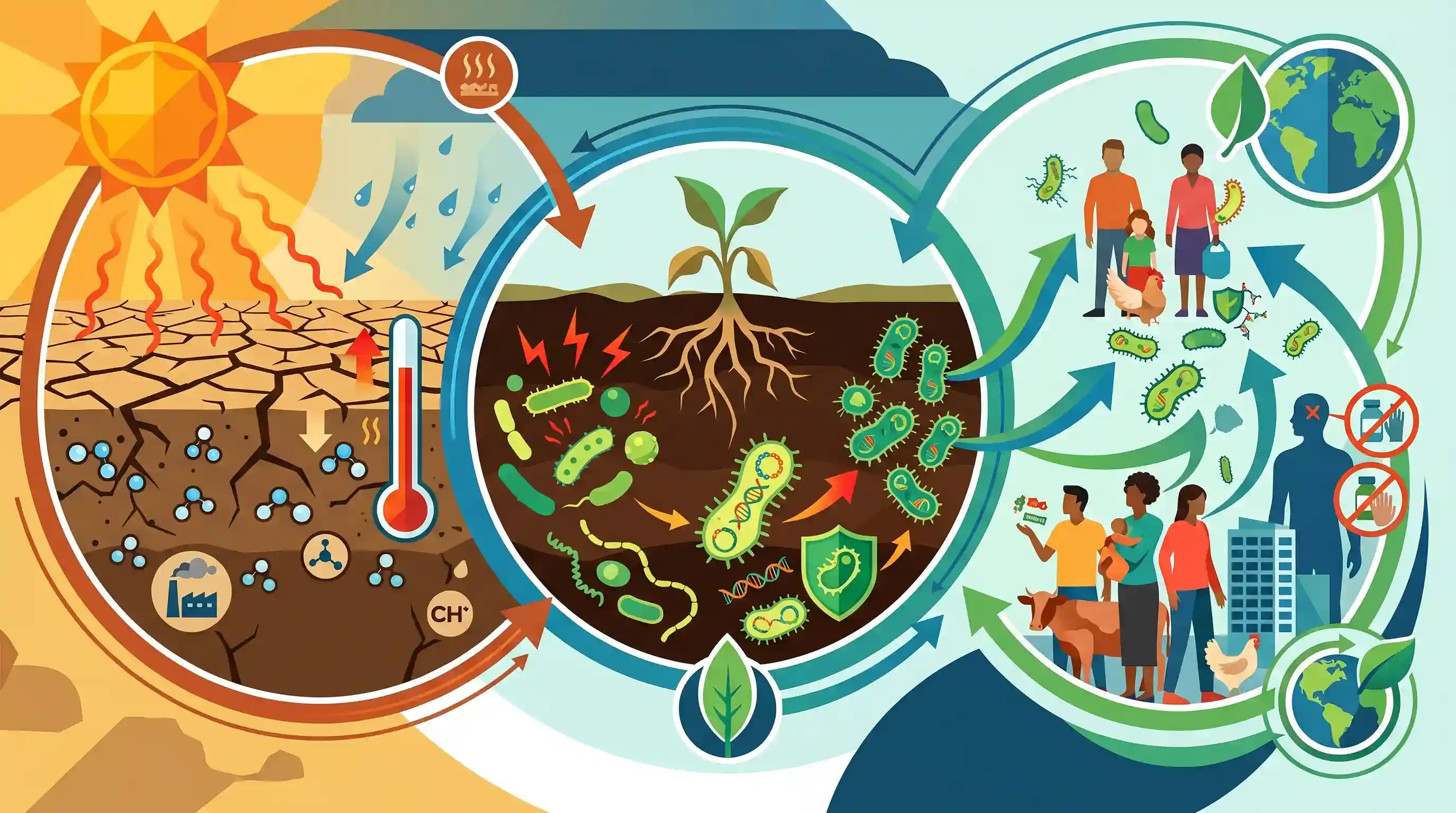
Recent research reveals an alarming intersection between climate change and public health: droughts can drive the emergence and spread of antibiotic resistance in soil bacteria. When soil moisture drops due to drought, the resulting environmental stress and increased concentration of pollutants can trigger genetic adaptations and selection pressures that favor antibiotic-resistant microbes. This environmental pathway to AMR expands our understanding beyond the traditional focus on clinical and veterinary antibiotic misuse, highlighting the urgent need for a 'One Health' approach that integrates climate mitigation, soil conservation, and global health security.
Key Points
- Climate change-induced extreme weather, specifically droughts, can act as a catalyst for the proliferation of antimicrobial resistance (AMR) in soil bacteria.
- Drought conditions create environmental stress and reduce soil moisture, which can concentrate naturally occurring or anthropogenic antibiotics in the soil, intensifying the selection pressure for resistant bacterial strains.
- Stress responses in soil microbiomes may increase mutation rates or facilitate horizontal gene transfer, accelerating the spread of antibiotic resistance genes within the ecosystem.
- The research underscores the importance of the 'One Health' approach, demonstrating that mitigating climate change and preserving soil ecology are directly tied to preventing global public health crises like AMR.
Important Terms
Antimicrobial Resistance (AMR)

The phenomenon where microorganisms (bacteria, fungi, viruses) evolve to withstand medicines designed to kill them, rendering standard treatments ineffective.
UPSC context
GS Paper 2 (Public Health) and GS Paper 3 (Science & Technology); focus on 'superbugs' and global health security.
One Health Approach
An integrated, collaborative framework recognizing that the health of humans, domestic and wild animals, plants, and the wider environment are closely linked and interdependent.
UPSC context
GS Paper 2 (Health Governance) and GS Paper 3 (Environment); critical for questions on pandemic preparedness and zoonotic diseases.
National Action Plan on Antimicrobial Resistance (NAP-AMR) 2.0
India's updated five-year (2025–2029) strategic framework that mandates sector-specific accountability and, for the first time, systematic environmental surveillance of antibiotic residues.
UPSC context
GS Paper 2 (Government Policies and Interventions); essential for discussing India's specific policy response to the AMR crisis.
UN Environment Programme (UNEP)
The principal UN body for environmental activities; its 2023 'Bracing for Superbugs' report formally linked the climate crisis and pollution to the spread of AMR.
UPSC context
GS Paper 3 (Environment and International Institutions); relevant for the 'triple planetary crisis' and environmental dimensions of health.
Selection Pressure
Environmental factors (such as drought-induced stress or high pollutant concentrations) that favor the survival and reproduction of bacteria with specific resistant traits.
UPSC context
GS Paper 3 (Science & Technology - Biology); explains the evolutionary mechanism behind how climate change drives drug-resistant mutations.
Prelims Trap
"Antimicrobial resistance is exclusively driven by the clinical and veterinary misuse of antibiotics."
Drought and natural environmental stress can trigger genetic adaptations and horizontal gene transfer for AMR in soil bacteria, independent of human clinical misuse.
Static Concepts Connected
What is Horizontal Gene Transfer (HGT) in bacteria?
- Definition: The movement of genetic material between unicellular or multicellular organisms other than by the vertical transmission of DNA from parent to offspring.
- AMR Connection: It allows bacteria to rapidly share antibiotic resistance genes (ARGs) across entirely different species, accelerating the creation of environmental 'superbug' reservoirs.
- Key Mechanisms: Occurs via transformation (absorbing free DNA), transduction (via bacteriophages), or conjugation (direct cell-to-cell plasmid transfer).
What forms the institutional basis of the One Health approach?
- Core Principle: An integrated approach recognizing that human, animal, and environmental health are fundamentally interconnected and interdependent.
- Global Quadripartite: It is governed globally by the Quadripartite: the WHO, FAO, UNEP, and the World Organisation for Animal Health (WOAH).
- Focus Areas: Key targets include zoonotic disease spillover, antimicrobial resistance (AMR), vector-borne diseases, food safety, and environmental contamination.
Cross-Topic Patterns
Climate change as a biological multiplier
Just as warming temperatures expand vector-borne disease habitats, climate extremes like droughts act as biological stressors that accelerate horizontal gene transfer and AMR in soil microbiomes.
Pharmaceutical effluents and soil ecology
Droughts concentrate inadequately treated wastewater from the API (Active Pharmaceutical Ingredient) industry, linking river pollution and soil degradation directly to India's National Action Plan on AMR.

Expect a 2026 Prelims multi-statement question combining Horizontal Gene Transfer, environmental AMR reservoirs, and the One Health approach.
Linked PYQs · 4
Linked PYQs · 4
- 2014MainsGS3
Can overuse and free availability of antibiotics without Doctor's prescription, be contributors to the emergence of drug-resistant diseases in India? What are the available mechanisms for monitoring and control? Critically discuss the various issues involved.
- 2019PrelimsGS1
Which of the following are the reasons for the occurrence of multi-drug resistance in microbial pathogens in India? 1. Genetic predisposition of some people 2. Taking incorrect doses of antibiotics to cure diseases 3. Using antibiotics in livestock farming 4. Multiple chronic diseases in some people Select the correct answer using the code given below.
- 2023PrelimsGS1
Consider the following statements: 1. Some microorganisms can grow in environments with temperature above the boiling point of water. 2. Some microorganisms can grow in environments with temperature below the freezing point of water. 3. Some microorganisms can grow in highly acidic environment with a pH below 3. How many of the above statements are correct?
- 2022PrelimsGS1
Consider the following statements: 1. Biofilms can form on medical implants within human tissues. 2. Biofilms can form on food and food processing surfaces. 3. Biofilms can exhibit antibiotic resistance. Which of the statements given above are correct?
