UNCCD Conference and Proactive Drought Resilience Framework
Source:The Hindu ↗
Why It Matters
Desertification and recurrent droughts are central to India's environmental and agricultural security challenges. Understanding UNCCD mandates, Land Degradation Neutrality (LDN), and proactive disaster resilience frameworks is directly testable in GS3 (Environment & Disaster Management) and GS1 (Geography).
Summary
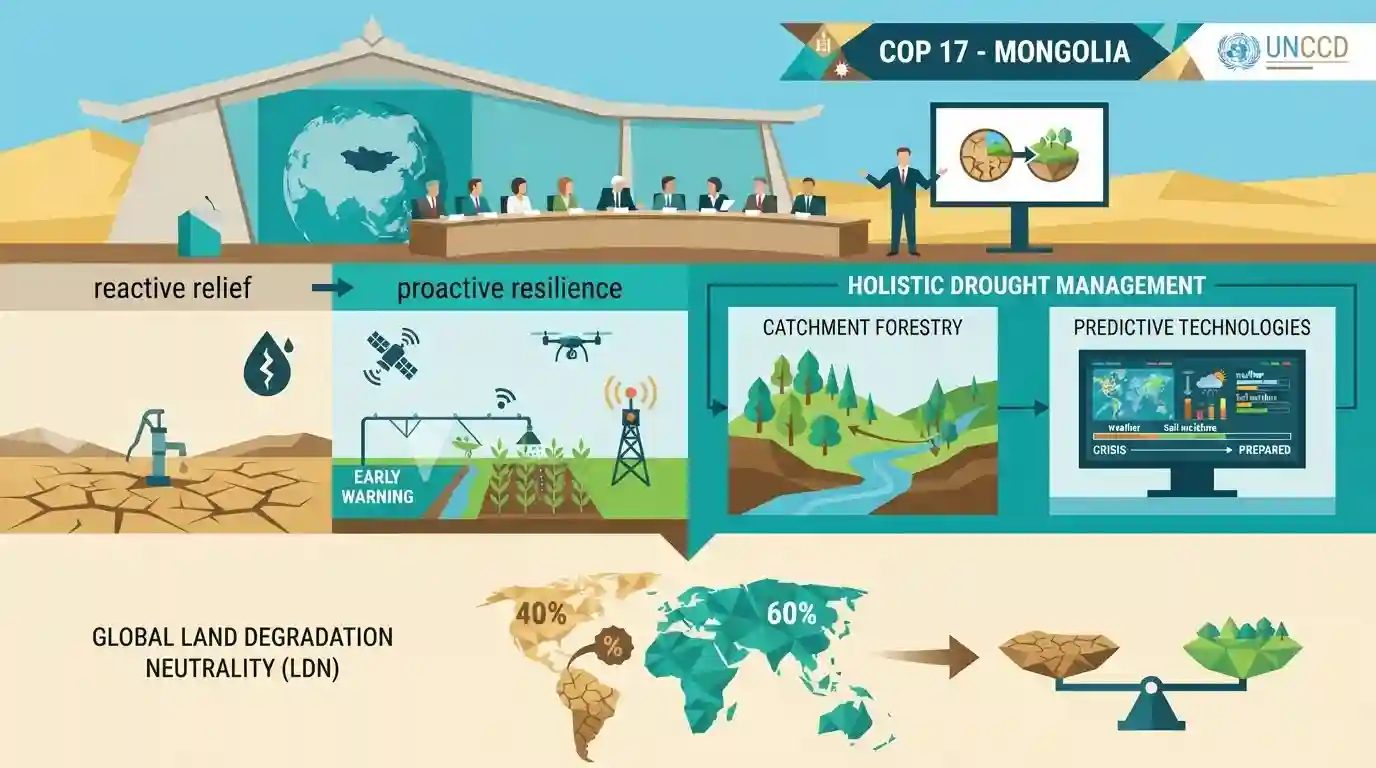
At the 17th Conference of Parties (COP17) to the UNCCD in Mongolia, India’s Environment Minister termed drought a 'defining developmental challenge' with profound impacts on global water and food security. He advocated for a paradigm shift from reactive relief measures to proactive, technology-enabled resilience, emphasizing localized early-warning systems and predictive technologies. India also highlighted its holistic approach to drought management, encapsulated in conservation strategies like catchment forestry. The UNCCD, a legally binding Rio Convention adopted in 1994, focuses on mitigating land degradation which currently affects 40% of the Earth's surface, with the ultimate goal of achieving Land Degradation Neutrality (LDN).
Key Points
- UNCCD COP17 was held in Ulaanbaatar, Mongolia, under the theme 'Restoring Land. Restoring Hope'.
- India described drought as a 'defining developmental challenge' rather than merely an occasional event, citing its impact on water security, agriculture, and economic stability.
- India advocated for shifting from reactive drought relief to proactive, technology-driven resilience, including predictive technologies and localized early-warning systems.
- The 'restore the forest, before the flow' approach was highlighted to promote catchment and riverscape forestry for water conservation.
- The UNCCD, adopted in 1994, is the only legally binding international treaty linking environmental management directly to sustainable land stewardship, and is one of the three Rio Conventions.
- Global priorities discussed included achieving Land Degradation Neutrality (LDN) and restoring degraded rangelands, given that up to 40% of the planet's land surface is currently degraded.
Important Terms
Land Degradation Neutrality (LDN)

A state where the amount and quality of land resources necessary to support ecosystems and food security remain stable or increase. It is tracked under Sustainable Development Goal (SDG) Target 15.3.
UPSC context
GS Paper 3 (Environment & Agriculture). Tests knowledge of sustainable development goals, global land conservation frameworks, and UNCCD targets.
Rio Conventions
The three landmark environmental treaties stemming from the 1992 Rio Earth Summit: the UNFCCC (climate change), CBD (biodiversity), and UNCCD (desertification). They work synergistically toward global sustainable development.
UPSC context
GS Paper 3 (Environment). Vital for understanding the interconnected international frameworks addressing climate change, biodiversity loss, and land degradation.
United Nations Convention to Combat Desertification (UNCCD)
A 1994 legally binding international agreement—born from the 1992 Earth Summit—focused on sustainable land management, combating desertification, and mitigating drought impacts, especially in drylands.
UPSC context
GS Paper 3 (Environment). Essential for questions on global environmental governance, land degradation targets, and legally binding UN treaties.
United Nations Framework Convention on Climate Change (UNFCCC)
An international environmental treaty adopted at the 1992 Earth Summit aiming to stabilize greenhouse gas concentrations in the atmosphere to prevent dangerous human interference with the global climate system.
UPSC context
GS Paper 3 (Environment). Fundamental for any question on global climate change negotiations, greenhouse gas mitigation, and international summits.
Convention on Biological Diversity (CBD)
A multilateral environmental treaty dedicated to conserving biological diversity, ensuring the sustainable use of its components, and promoting the fair and equitable sharing of benefits from genetic resources.
UPSC context
GS Paper 3 (Environment). Crucial for topics on biodiversity conservation, sustainable resource use, and international ecological agreements.
Prelims Trap
The UNCCD is a voluntary framework and not a legally binding treaty.
Aspirants often assume UNCCD is purely voluntary. It is actually the only legally binding international treaty linking environmental management directly to sustainable land stewardship.
Static Concepts Connected
What are the three Rio Conventions originating from the 1992 Earth Summit?
- UNFCCC: United Nations Framework Convention on Climate Change, which serves as the parent treaty for the Paris Agreement.
- UNCBD: Convention on Biological Diversity, focusing on conservation and equitable sharing, parent to Cartagena and Nagoya protocols.
- UNCCD: United Nations Convention to Combat Desertification, the sole legally binding treaty specifically addressing sustainable land management.
What is Land Degradation Neutrality (LDN)?
- Core Concept: A state where healthy and productive land resources necessary to support ecosystem functions remain stable or increase over time.
- SDG Linkage: LDN is explicitly mapped to Sustainable Development Goal (SDG) 15.3, aiming to achieve a land degradation-neutral world by 2030.
- India's Target: India committed at UNCCD COP14 (New Delhi) to restore 26 million hectares of degraded land by 2030, aligning with the Bonn Challenge.
Cross-Topic Patterns
Nature-based solutions for Disaster Management
India's push for 'catchment forestry' links UNCCD mandates to GS3 Disaster Management, emphasizing proactive, nature-based drought and flood mitigation over reactive relief.
LDN and Indian Agriculture Schemes
Global LDN goals overlap directly with domestic agricultural policies like the Soil Health Card scheme and PM Krishi Sinchayee Yojana for improved soil vitality and water-use efficiency.

Expect a multi-statement question comparing the 3 Rio Conventions, testing UNCCD's legally binding status and India's 2030 LDN targets.
Linked PYQs · 4
Linked PYQs · 4
- 2016PrelimsGS1
What is/are the importance/importances of the United Nations Convention to Combat Desertification? 1. It aims to promote effective action through innovative national programmes and supportive international partnerships. 2. It has a special/particular focus on South Asia and North Africa regions, and its Secretariat facilitates the allocation of major portion of financial resources to these regions. 3. It is committed to bottom-up approach, encouraging the participation of local people in combating the desertification. Select the correct answer using the code given below.
- 2010PrelimsGS1
The United Nations Framework Convention on Climate Change (UNFCCC) is an international treaty drawn at
- 2024MainsGS3
What is disaster resilience? How is it determined? Describe various elements of a resilience framework. Also mention the global targets of Sendai Framework for Disaster Risk Reduction (2015–2030).
- 2019MainsGS3
Elaborate the impact of National Watershed Project in increasing agricultural production from water-stressed areas.
