Drone Technology Deployment for Tribal Healthcare Delivery
Source:Indian Express ↗
Why It Matters
This article provides a compelling real-world example of how frontier technologies like drones can be effectively integrated into governance to solve core developmental challenges, such as last-mile healthcare access in difficult terrains. It serves as an excellent case study for Mains answers related to public health delivery and the positive applications of UAVs.
Summary
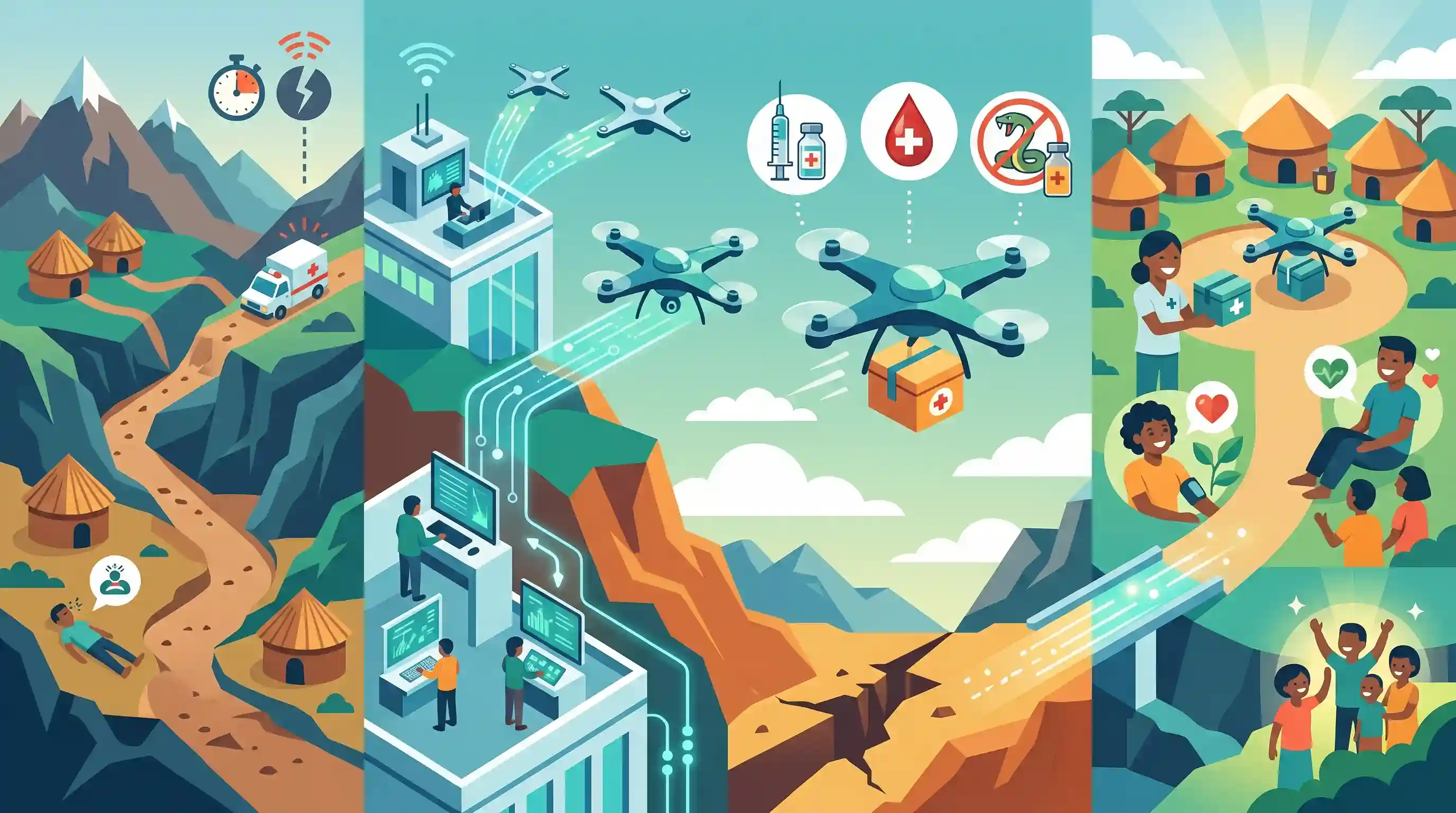
The administration in Maharashtra's Nandurbar district is initiating the use of drones to deliver emergency medical supplies to its remote, tribal-dominated regions. By leveraging Unmanned Aerial Vehicles (UAVs), the project seeks to bypass difficult terrains and poor connectivity, ensuring rapid delivery of critical items like snakebite anti-venom, blood, and vaccines. This technological intervention acts as a powerful model for enhancing grassroots public healthcare and bridging the accessibility gap in marginalized communities.
Key Points
- Nandurbar district in Maharashtra is set to deploy drone technology for the delivery of emergency medicines, including anti-snake venom and vaccines, to remote and tribal areas.
- The initiative aims to overcome geographical barriers and poor road connectivity, significantly reducing the transit time for life-saving medical supplies.
- It serves as an excellent case study of utilizing Unmanned Aerial Vehicles (UAVs) for social good and technology-driven public service delivery.
- The project aligns with the broader goal of ensuring equitable healthcare access at the grassroots level and achieving 'Health for All'.
Important Terms
Maharashtra Drone Mission

A ₹228 crore initiative launched in 2023 with IIT Bombay as the hub to operationalize drone-based services across 12 districts for healthcare, disaster management, and agriculture.
UPSC context
GS Paper 2 & 3: Technology in governance, healthcare infrastructure, and specific state-level interventions for tribal welfare.
Last-mile Delivery
The final stage of the logistics chain where goods or services reach the end-user, often the most challenging part in remote or hilly terrains.
UPSC context
GS Paper 2: Issues relating to development and management of Social Sector/Services relating to Health.
Unmanned Aerial Vehicles (UAVs)
Aircraft operated without an onboard crew, controlled remotely or autonomously; used here for bypassing difficult geography to deliver critical medical supplies.
UPSC context
GS Paper 3: Science and Technology — developments and their applications and effects in everyday life.
Snakebite Anti-venom
A life-saving medication used to neutralize snake toxins; its rapid delivery is vital in India, which accounts for nearly half of global snakebite fatalities.
UPSC context
GS Paper 2: Public Health and GS Paper 3: Disaster Management (Biological hazards).
National Action Plan for Prevention and Control of Snakebite Envenoming (NAP-SE)
Launched in March 2024, this plan aims to halve snakebite deaths by 2030 through enhanced venom collection, regional antivenom centers, and improved rural healthcare access.
UPSC context
GS Paper 2: Government policies and interventions for development in various sectors.
Nandurbar District Administration
The local executive body responsible for implementing the drone project in Nandurbar, focusing on tribal talukas like Dhadgaon and Akkalkuwa.
UPSC context
GS Paper 2: Role of District Administration in development process and welfare of vulnerable sections.
Maharashtra Public Health Department
The state nodal agency overseeing the health-related objectives of the drone mission, including vaccine distribution and emergency medical response.
UPSC context
GS Paper 2: Statutory, regulatory and various quasi-judicial bodies in the state health sector.
Prelims Trap
BVLOS drone operations for medical deliveries are completely exempt from DGCA prior clearance.
While Drone Rules 2021 liberalised Green Zones, Beyond Visual Line of Sight (BVLOS) flights and payload dropping still require specific DGCA clearances or framework exemptions to ensure aviation safety.
Static Concepts Connected
What is the Airspace Zoning under Drone Rules 2021?
- Green Zone: Airspace up to 400 ft (and 200 ft near airports) where no prior permission is required for operating drones.
- Yellow Zone: Controlled airspace requiring prior permission from ATC, recently reduced from 45km to 12km from the airport perimeter.
- Red Zone: Strictly prohibited areas (military, strategic installations) where drone operations are completely banned without exceptional government clearance.
How do geographical barriers impact public health in Scheduled Areas?
- Golden Hour loss: Poor terrain connectivity delays emergency access to anti-venom and blood, drastically increasing mortality rates due to the loss of the critical 'Golden Hour'.
- Cold chain gaps: Lack of reliable power and transport in hilly tribal districts degrades temperature-sensitive vaccines and biologicals before they reach end-users.
Cross-Topic Patterns
Universal Health Coverage via Deep-Tech
Merges GS3 S&T (BVLOS drones) with GS2 Health. Bypassing physical infrastructure deficits in Scheduled Areas acts as a force multiplier for Primary Health Centres and the 'Health for All' mandate.
Snakebites & Neglected Tropical Diseases (NTDs)
Snakebite envenoming is a WHO Neglected Tropical Disease. Rapid drone delivery of temperature-sensitive anti-venom directly addresses the disproportionate mortality rates faced by remote agrarian and tribal populations.

BVLOS drone applications bridging GS2 public health gaps (like i-DRONE) are prime targets for a 2026 GS3 e-governance or S&T question.
Linked PYQs · 4
Linked PYQs · 4
- 2025PrelimsGS1
With reference to Unmanned Aerial Vehicles (UAVs), consider the following statements : I. All types of UAVs can do vertical landing. II. All types of UAVs can do automated hovering. III. All types of UAVs can use battery only as a source of power supply. How many of the statements given above are correct?
- 2024MainsGS2
In a crucial domain like the public healthcare system the Indian State should play a vital role to contain the adverse impact of marketisation of the system. Suggest some measures through which the State can enhance the reach of public healthcare at the grassroots level.
- 2018MainsGS2
Appropriate local community-level healthcare intervention is a prerequisite to achieve 'Health for All' in India. Explain.
- 2023MainsGS3
The use of unmanned aerial vehicles (UAVs) by our adversaries across the borders to ferry arms/ammunitions, drugs, etc., is a serious threat to the internal security. Comment on the measures being taken to tackle this threat.
