Operation Sindoor and India Anti-Drone Preparedness
Source:Indian Express ↗
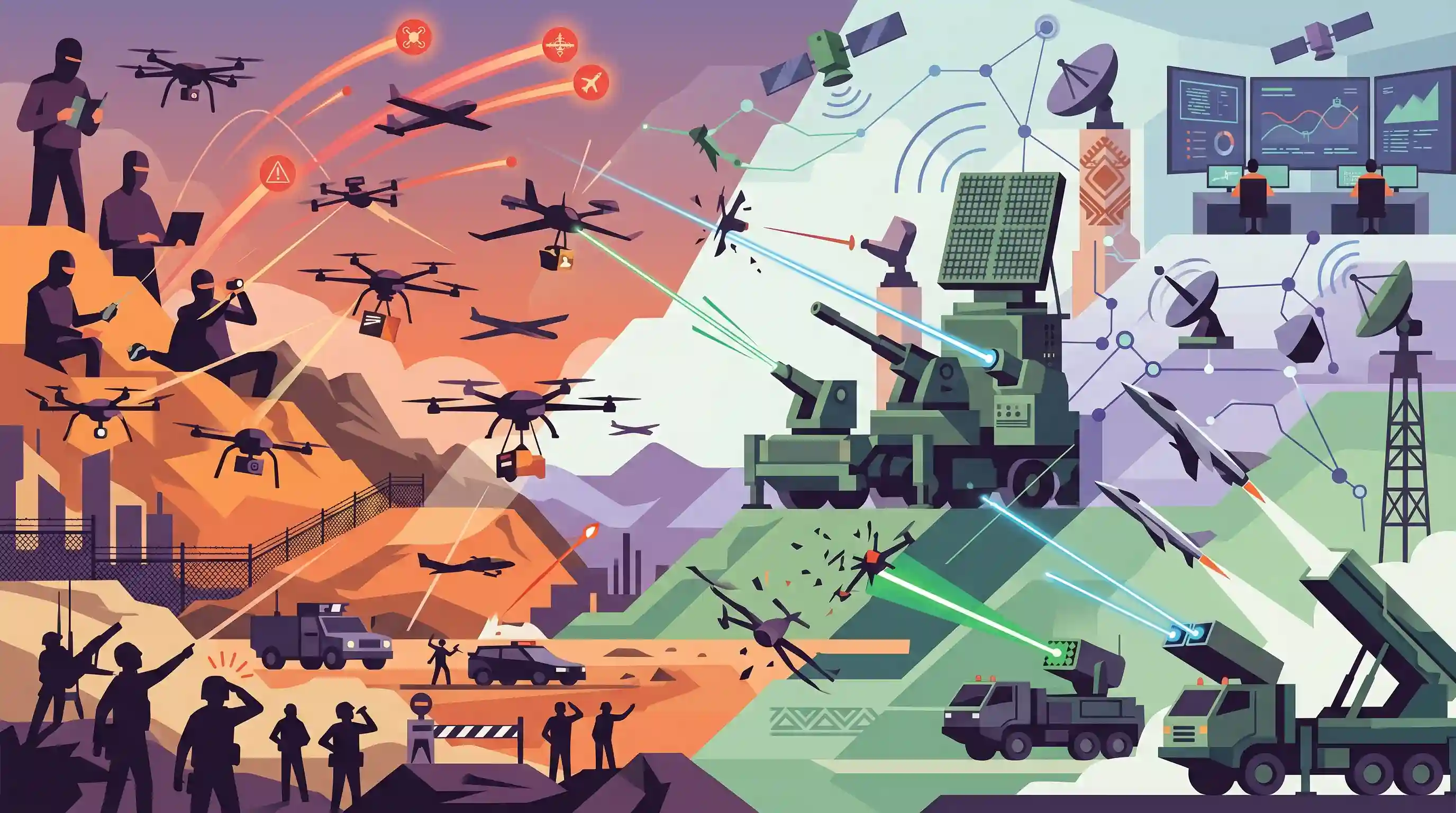
Why It Matters
Demonstrates the evolving nature of internal security threats where inexpensive, commercially available technology is weaponized, demanding immediate policy and technological countermeasures from India's defense establishment.
Summary
The article analyzes the implications of drone warfare entering India's internal security matrix, citing Operation Sindoor as a critical case study. It explores how the deployment of commercial and tactical drones by hostile actors transforms traditional conflict zones into complex, multi-domain environments. The analysis assesses India's current standing in unmanned aerial vehicle (UAV) technology, emphasizing the urgent need to accelerate the development of indigenous anti-drone systems and adapt operational tactics to counter asymmetric aerial threats effectively.
Key Points
- Evaluates the impact of commercial and tactical drone utilization by non-state actors during internal security operations, notably Operation Sindoor.
- Highlights the shift towards asymmetric warfare where inexpensive UAVs provide hostile elements with aerial surveillance and strike capabilities.
- Discusses India's defense preparedness, examining the gap in advanced anti-drone technologies (kinetic and non-kinetic).
- Underscores the critical necessity for indigenous research and development to secure critical infrastructure and frontline forces against evolving drone threats.
Important Terms
Operation Sindoor

A 2025 tri-service military mission responding to terror attacks, notable for its heavy reliance on indigenous drones and non-contact precision strikes against infrastructure.
UPSC context
GS Paper 3: Internal Security. Tests understanding of contemporary military doctrines and tech-driven counter-terrorism responses.
Asymmetric Warfare
Warfare where belligerents have significantly unequal resources, leading the weaker side to use unconventional tactics like drone strikes or guerrilla maneuvers.
UPSC context
GS Paper 3: Internal Security challenges. Essential for analyzing non-state actor threats and hybrid warfare.
Unmanned Aerial Vehicles (UAVs)
Remotely or autonomously piloted aircraft used for intelligence, surveillance, reconnaissance (ISR), and tactical strikes without an on-board human pilot.
UPSC context
GS Paper 3: Science & Tech / Internal Security. Focuses on border management and technological self-reliance.
Anti-Drone Systems
Systems designed to detect and neutralize rogue drones via "soft kill" (electronic jamming) or "hard kill" (lasers or kinetic projectiles) measures.
UPSC context
GS Paper 3: Defense Technology. Tests knowledge of indigenous defense systems like DRDO’s D4S.
Loitering Munition
A weapon system (often called a 'kamikaze drone') that hovers over a target area before identifying and striking a target by crashing into it.
UPSC context
GS Paper 3: Defense Technology. Relevant for modern battlefield innovations and precision-strike capabilities.
DRDO
India's premier R&D organization under the Ministry of Defence, focused on achieving self-reliance in critical military technologies.
UPSC context
GS Paper 3: Science & Tech. Primary agency for indigenization of defense under "Atmanirbhar Bharat."
Prelims Trap
India's D4 anti-drone system relies exclusively on kinetic measures to neutralize threats.
The DRDO-developed D4 (Drone Detect, Deter and Destroy) system employs both non-kinetic 'soft kills' (RF jamming/spoofing) and kinetic 'hard kills' (lasers).
Static Concepts Connected
What are the primary mechanisms of Counter-Unmanned Aircraft Systems (C-UAS)?
- Soft Kill (Non-Kinetic): Disabling drones without physical destruction by using Radio Frequency (RF) jamming, GPS spoofing, or electronic warfare to sever command links.
- Hard Kill (Kinetic): Physically neutralizing the drone using Laser Directed Energy Weapons (DEW), localized EMPs, net guns, or traditional anti-aircraft artillery (like L-70 guns).
What defines Asymmetric Warfare in the context of internal security?
- Core Premise: A conflict where adversaries possess vastly unequal military resources, prompting the weaker side to exploit the stronger side's vulnerabilities using unconventional tactics.
- Drone Application: Hostile non-state actors deploying swarms of inexpensive, commercially available drones to saturate and overwhelm multi-million-dollar conventional air defense architectures.
Cross-Topic Patterns
Drone Rules vs Border Security
India's dual imperative to become a global commercial drone hub via the Liberalized Drone Rules 2021 inherently clashes with the rising threat of cheap, weaponized FPV drones used by non-state actors.
CIBMS + Aerial Threats
The 'Integrated Counter UAS Grid' represents the next evolutionary step for the Comprehensive Integrated Border Management System (CIBMS), moving focus from ground infiltration to aerial drug/arms drops.

Expect a 2026 Prelims 'match the pairs' on indigenous defense tech (Nagastra-1, D4) alongside a GS-3 Mains on asymmetric warfare.
Linked PYQs · 3
Linked PYQs · 3
- 2023MainsGS3
The use of unmanned aerial vehicles (UAVs) by our adversaries across the borders to ferry arms/ammunitions, drugs, etc., is a serious threat to the internal security. Comment on the measures being taken to tackle this threat.
- 2022MainsGS3
Naxalism is a social, economic and developmental issue manifesting as a violent internal security threat. In this context, discuss the emerging issues and suggest a multilayered strategy to tackle the menace of Naxalism.
- 2021MainsGS3
How is S-400 air defence system technically superior to any other system presently available in the world?
