UAV Proliferation and Transformation of Modern Warfare Tactics
Source:The Hindu ↗
हे का महत्त्वाचे आहे
Understanding the drone revolution is vital for GS3 (Internal Security and Defence Technology) as UAVs increasingly define modern military conflicts, border management, and counter-terrorism strategies.
सारांश
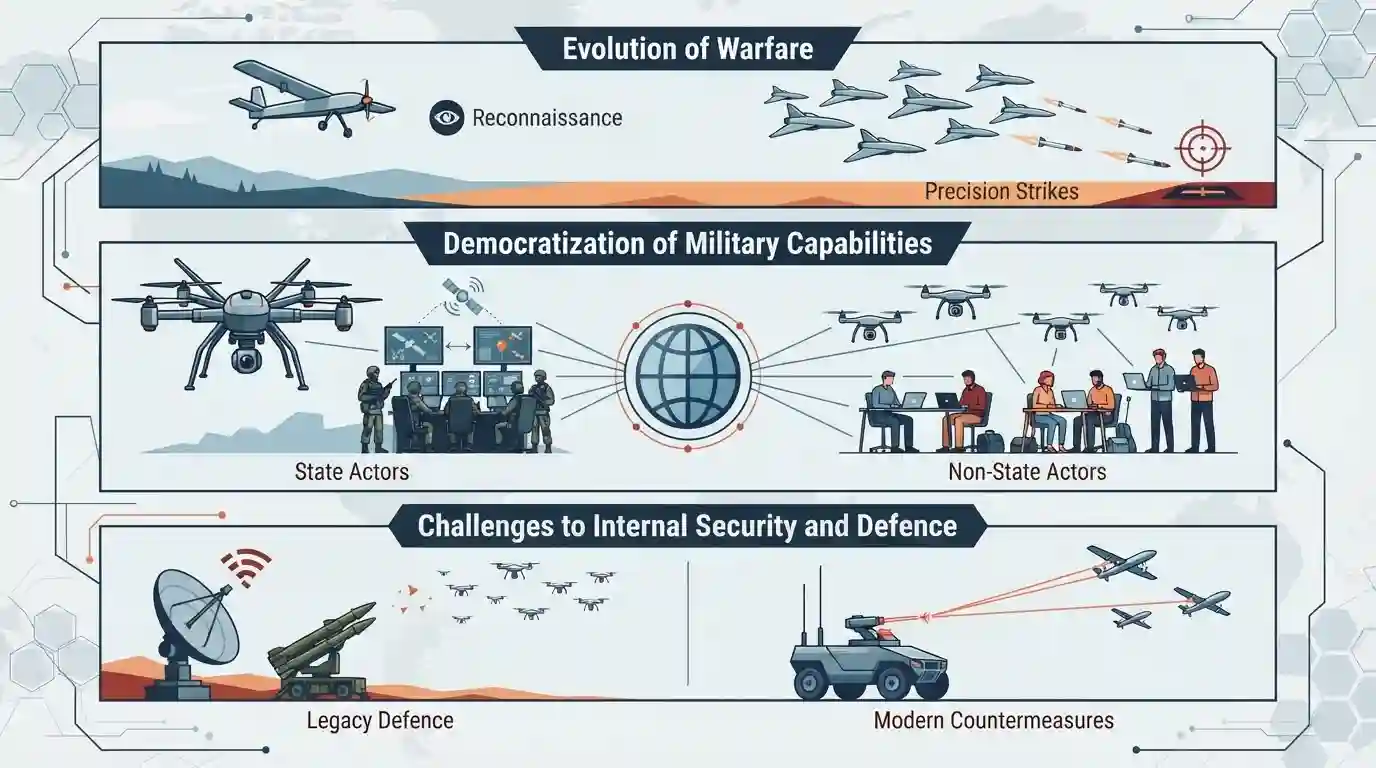
The article provides an in-depth explanation of how the drone revolution is transforming modern warfare. It discusses how Unmanned Aerial Vehicles (UAVs) have evolved from simple reconnaissance tools into core tactical assets capable of precision strikes, changing strategic doctrines, democratizing military capabilities, and creating new challenges for traditional defence infrastructure and internal security.
मुख्य मुद्दे
- The proliferation of drones (Unmanned Aerial Vehicles or UAVs) has fundamentally altered modern warfare, shifting the balance from heavy conventional platforms (like tanks and warplanes) to low-cost, highly effective autonomous systems.
- Drones democratize air power, allowing state and non-state actors alike to conduct precision strikes, reconnaissance, and asymmetric warfare at a fraction of traditional costs.
- Integration of artificial intelligence, swarm technology, and first-person view (FPV) pilot controls have enhanced the lethality and tactical utility of drones on contemporary battlefields.
- Poses profound challenges to traditional air defence systems, forcing militaries worldwide—including India—to rethink defence doctrines, counter-drone (C-UAS) technologies, and force protection.
पूर्वपरीक्षा सापळा
Traditional air defence systems deployed for conventional fighter jets are fully equipped to neutralize low-altitude micro-drone swarm threats without modification.
Aspirants often assume traditional air defence radar systems designed for high-altitude fighter jets can effortlessly detect and intercept low-altitude, low-radar-cross-section commercial drones. In reality, their low altitude and speed pose severe clutter challenges.
संबंधित स्थिर संकल्पना
What are the primary mechanisms used in Counter-Unmanned Aircraft Systems (C-UAS)?
- Soft-Kill Measures: Soft-kill methods involve disrupting command, control, and navigation links through radio frequency jamming, GPS spoofing, or cyber takeovers without physical destruction.
- Hard-Kill Measures: Hard-kill methods involve physical destruction or neutralization of the UAV using directed-energy weapons (lasers, high-powered microwaves), net-capturing projectiles, or kinetic interceptors.
- Detection Grids: Multi-layered detection networks integrate active/passive radar, electro-optical/infrared (EO/IR) cameras, and acoustic sensors to detect low-RCS micro-drones.
आंतर-विषय नमुने
Asymmetric Warfare & Internal Security Challenges
The proliferation of low-cost commercial drones and FPV technologies by non-state actors directly intersects with internal security management along international borders, testing traditional counter-infiltration grids.
Defence Indigenization & Critical Technology Ecosystems
India's push for indigenous C-UAS (Counter-Unmanned Aircraft Systems) highlights the integration of critical electronics, sensors, and artificial intelligence into the Atmanirbhar Bharat defence manufacturing ecosystem.

C-UAS tech (soft-kill vs hard-kill) combined with cost asymmetry in modern warfare will likely feature in a 2-statement Prelims/Mains Q.
संबंधित PYQ · 1
संबंधित PYQ · 1
- 2023MainsGS3
The use of unmanned aerial vehicles (UAVs) by our adversaries across the borders to ferry arms/ammunitions, drugs, etc., is a serious threat to the internal security. Comment on the measures being taken to tackle this threat.
