Drone Sector Localization Challenges and Import Risks
Source:The Hindu ↗
Why It Matters
This topic directly relates to India's push for defense self-reliance, internal security resilience against cross-border drone threats, and technological indigenization under Make in India.
Summary
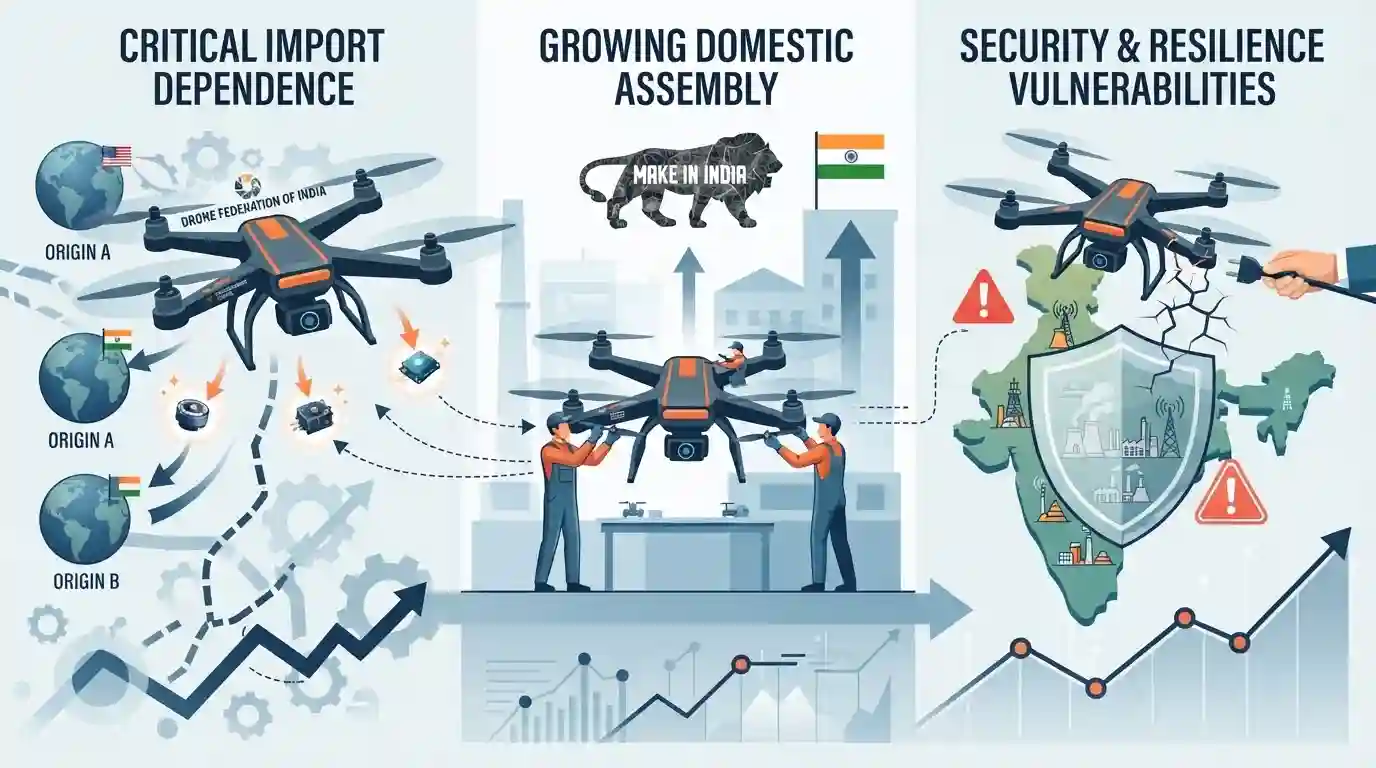
According to the Drone Federation of India, the domestic drone industry faces critical vulnerabilities due to high import dependence for key sub-components and technology. Emphasizing deeper localization, experts note that while final manufacturing is growing under Make in India initiatives, supply chain dependencies on foreign nations for high-end components threaten national security and sustainable industrial growth.
Key Points
- The Drone Federation of India has highlighted that heavy import dependence for critical components poses strategic and operational risks to India's drone sector.
- Depper localization is urgently required across the drone manufacturing supply chain to ensure national security and self-reliance.
- While final assembly is increasing domestically, sourcing of high-end sensors, propulsion systems, and microchips continues to rely heavily on foreign suppliers.
- Addressing these vulnerabilities requires targeted research and development, component manufacturing incentives, and stronger industry-academia collaboration.
Important Terms
Drone Federation of India

An apex industry body representing India's drone ecosystem, working towards policy advocacy, standard-setting, and accelerating supply chain localization to reduce import dependence.
UPSC context
UPSC GS Paper III (Internal Security / Technology): Tests understanding of indigenous defense manufacturing, emerging tech ecosystems, and regulatory frameworks.
Make in India
A flagship government initiative launched in 2014 to transform India into a global manufacturing hub by boosting domestic production, attracting foreign investment, and enhancing industrial competitiveness across sectors.
UPSC context
UPSC GS Paper III (Economy / Industrial Policy): Evaluates strategies for industrial growth, self-reliance (Aatmanirbhar Bharat), job creation, and export-led development.
Prelims Trap
while final manufacturing is growing under Make in India initiatives, supply chain dependencies on foreign nations... threaten security
Aspirants often assume that if a drone is assembled in India under Make in India, all its critical sub-components are also indigenously manufactured.
Static Concepts Connected
What are the key policy initiatives and regulatory bodies governing India's drone (UAV) sector?
- Drone Rules 2021:: Drone Rules 2021 liberalized the regulatory regime, significantly reducing paperwork and approvals for commercial drone operations in India.
- PLI Scheme:: Production Linked Incentive (PLI) scheme for drones provides financial incentives to manufacturers of drones and drone components.
- Digital Sky:: Digital Sky platform is the Government of India's single-window online system for airspace permissions and drone registration.
- Airspace Zoning:: Airspace restriction zones (Red, Yellow, Green zones) are demarcated nationwide to protect sensitive defense and civil installations.
Cross-Topic Patterns
UAV Component Localization + Defense Procurement Policy
Just as defense indigenization faces bottlenecks in aero-engines, civilian and tactical drones struggle with high-end propulsion, flight controllers, and rare earth sensors.
Geopolitical Sourcing Bans + Global Trade Rules
Government restrictions barring components from nations sharing land borders with India intersect directly with trade and technology policy vis-à-vis global electronics supply chains.

Expect a multi-statement prelims question on critical UAV sub-component dependencies (motors, sensors) and domestic sourcing bans.
Linked PYQs · 2
Linked PYQs · 2
- 2023MainsGS3
The use of unmanned aerial vehicles (UAVs) by our adversaries across the borders to ferry arms/ammunitions, drugs, etc., is a serious threat to the internal security. Comment on the measures being taken to tackle this threat.
- 2025MainsGS3
India aims to become a semiconductor manufacturing hub. What are the challenges faced by the semiconductor industry in India? Mention the salient features of the India Semiconductor Mission.
