Bhopal Gas Tragedy Survivors Warn of Groundwater Contamination
Source:theobserverpost ↗
Why It Matters
It underscores the persistent environmental degradation and public health vulnerabilities in post-disaster Bhopal, highlighting critical issues of groundwater contamination and municipal accountability relevant to MPPSC's focus on state-specific environmental and social challenges.
Summary
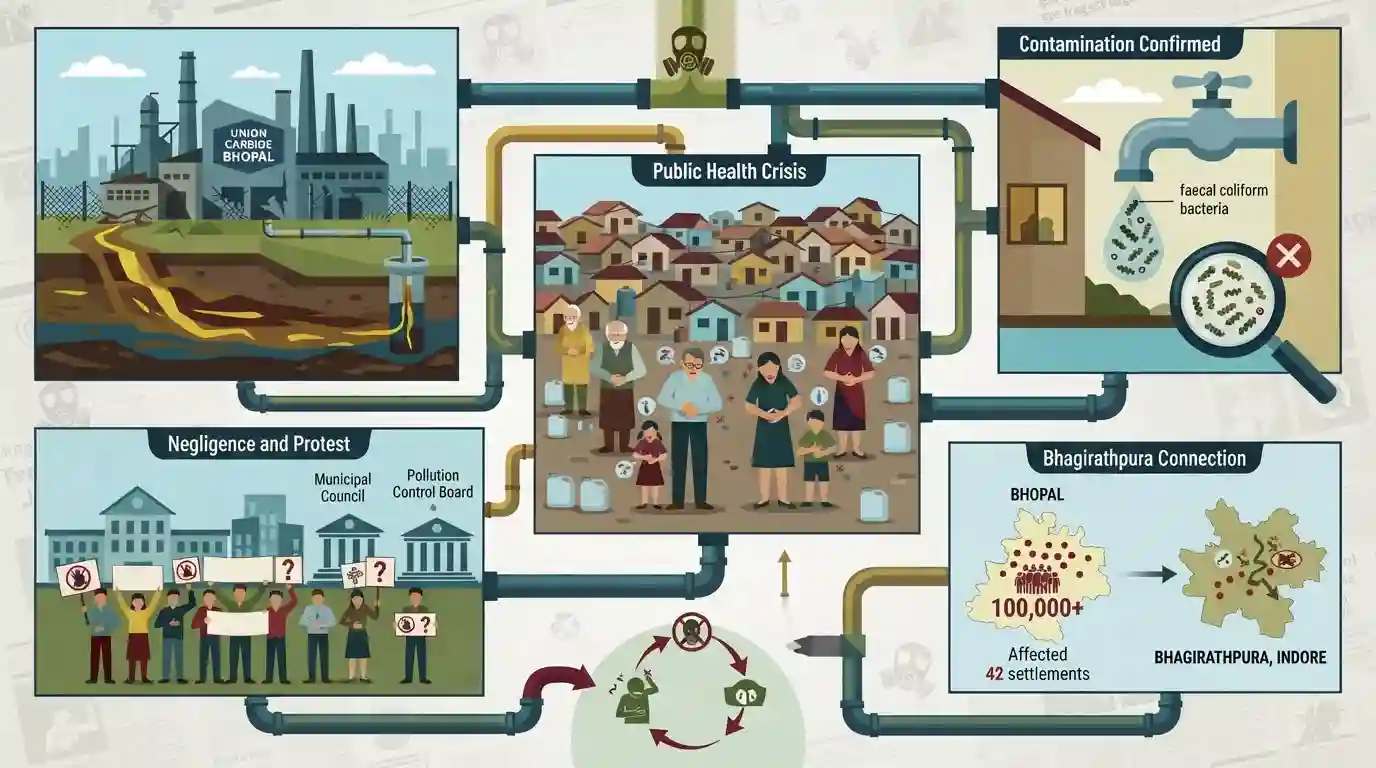
Survivors of the 1984 Bhopal Gas Tragedy have warned of a looming public health crisis after tests revealed widespread contamination of drinking water with faecal coliform bacteria in localities near the abandoned Union Carbide factory. Tests by the State Public Health Engineering (PHE) department confirmed the water is unsafe for human consumption. Four organizations representing the survivors criticized the Bhopal Municipal Corporation and the MP Pollution Control Board for their negligence, comparing the situation to the recent Bhagirathpura tragedy in Indore. The contamination affects over 100,000 residents in 42 settlements, exacerbating the chronic health issues already suffered by the gas tragedy victims.
Key Points
- Survivors of the 1984 Bhopal gas tragedy raised alarms over severe drinking water contamination in communities near the abandoned Union Carbide factory.
- Water quality tests conducted by the State Public Health Engineering (PHE) department confirmed the presence of faecal coliform bacteria in the water supply of 29 localities.
- Representatives from four survivor organizations warned of an impending public health crisis, citing the recent Bhagirathpura water contamination tragedy in Indore as a cautionary example.
- Over 100,000 residents across 42 settlements are forced to consume contaminated groundwater, compounding the long-term health complications they already face from the 1984 disaster.
- Local authorities, including the MP Pollution Control Board and the Bhopal Municipal Corporation, are accused of negligence and failing to provide safe drinking water to vulnerable populations.
Important Terms
Union Carbide

An American chemical corporation whose Indian subsidiary operated the pesticide plant in Bhopal responsible for the devastating 1984 toxic gas leak, one of the world's worst industrial disasters.
UPSC context
Central to GS-III (Disaster Management) and GS-IV (Corporate Ethics); illustrative of industrial hazards and corporate liability.
MP Pollution Control Board
The statutory authority in Madhya Pradesh established to implement environmental laws, regulate pollution, and monitor air, water, and soil quality across the state.
UPSC context
Key for GS-III (Environment); highlights the role of state statutory bodies in regulating hazardous waste and ensuring environmental compliance.
State Public Health Engineering (PHE) Department
A state-level government department responsible for planning, executing, and maintaining rural and urban water supply and sanitation infrastructure, including monitoring drinking water quality.
UPSC context
Relevant for GS-II (Public Health & Governance) regarding state delivery mechanisms for basic amenities and addressing waterborne health crises.
Bhopal Municipal Corporation
The local urban governing body responsible for the civic administration of Bhopal, including the provision and maintenance of citywide safe drinking water, sewerage, and drainage systems.
UPSC context
Fits into GS-II (Urban Local Bodies); tests the accountability of municipal administration in delivering basic civic services and public health mandates.
Bhopal Group for Information & Action
An advocacy organization representing survivors of the 1984 Bhopal gas tragedy, campaigning for medical relief, environmental remediation, and corporate accountability.
UPSC context
Relevant to GS-II (Role of NGOs) and GS-III (Disaster Management) as an example of civil society fighting for environmental justice.
Prelims Trap
"The Central Pollution Control Board (CPCB) is a statutory organization constituted under the Environment (Protection) Act, 1986."
CPCB and SPCBs were actually established under the Water (Prevention and Control of Pollution) Act, 1974, though they execute powers under the EPA 1986.
Static Concepts Connected
What are Coliform bacteria and why are they used in water testing?
- Indicator organisms: They serve as primary biological indicators to detect sewage or faecal contamination in drinking water sources.
- Biological traits: They are typically gram-negative, rod-shaped bacteria originating from the digestive tracts of warm-blooded animals.
- Pathogenic implication: While most coliforms are harmless themselves, their presence strongly implies the co-existence of dangerous pathogens causing cholera or typhoid.
What is the statutory framework governing State Pollution Control Boards (SPCBs)?
- Origin: They are statutory bodies created under the Water (Prevention and Control of Pollution) Act, 1974.
- Mandate: They are tasked with advising state governments and planning comprehensive programs to prevent, control, or abate water pollution.
- Enforcement powers: SPCBs hold the authority to issue directions for the closure, prohibition, or regulation of polluting industries and operations.
Cross-Topic Patterns
Disaster legacy + Urban sanitation failures
The compounding vulnerabilities of disaster survivors exposed to secondary civic failures (sewage mixing with groundwater) highlight major gaps in long-term post-disaster rehabilitation and municipal sanitation planning.
Groundwater governance + Public health
Over-reliance on untreated groundwater in urban slums frequently intersects with recurrent outbreaks of waterborne diseases, underscoring the critical need for effective implementation of the Jal Jeevan Mission (Urban).

Expect a multi-statement Prelims question linking biological indicators of water pollution (Coliform) with the statutory powers of SPCBs.
Linked PYQs · 5
Linked PYQs · 5
- 2008MPPSC_PRELIMSGS1
Gas released during Bhopal gas tragedy was:
- 2021MPPSC_PRELIMSGS1
In which year Bhopal Gas disaster occurred?
- 2023MPPSC_PRELIMSGS1
Which among the following is not a biodegradable pollutant?
- 2022MPPSC_PRELIMSGS1
Which pollution causes Itai-Itai disease in human beings?
- 2024MPPSC_PRELIMSGS1
In the aquatic ecosystem of a pond, which of the following components is represented by fungi, bacteria and flagellates?
