SAFTA Rules of Origin Violations in Arecanut Smuggling Cases
Source:The Hindu ↗
Why It Matters
This case illustrates the structural vulnerabilities in regional trade agreements (like SAFTA) arising from weak enforcement of 'Rules of Origin'. It highlights how organized trade-fraud, customs evasion, and illicit financial channels (hawala) can jeopardize national economic sovereignty and devastate the livelihoods of domestic farmers by creating artificial price depression.
Summary
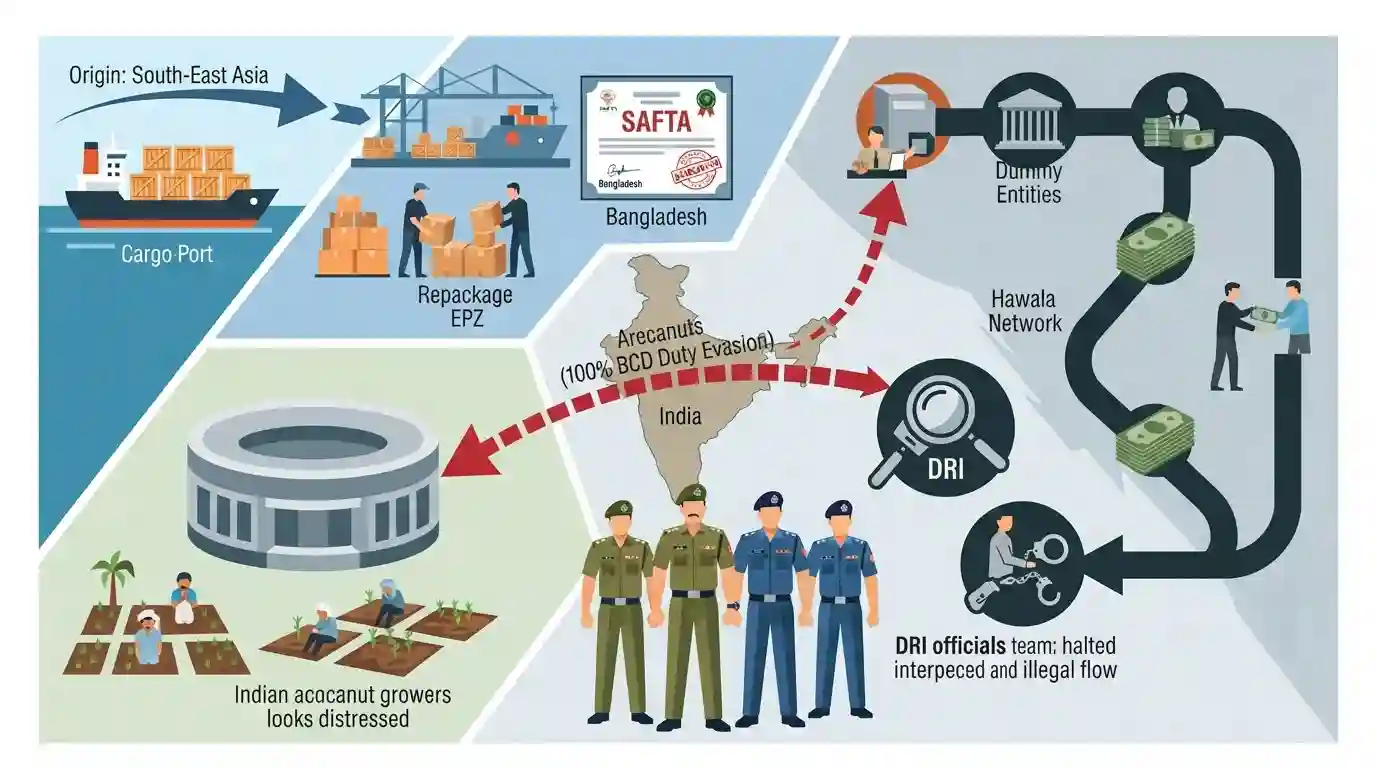
The Directorate of Revenue Intelligence (DRI) dismantled a massive smuggling syndicate that illegally imported South-East Asian arecanuts into India by falsely declaring their origin as Bangladesh to exploit tariff exemptions. While arecanut imports typically attract a 100% Basic Customs Duty (BCD), imports originating from Bangladesh are fully exempt under the South Asian Free Trade Area (SAFTA) agreement. The syndicate routed goods through Bangladesh's Export Processing Zones (EPZs), repackaged them, and obtained fraudulent SAFTA Certificates of Origin, causing an estimated exchequer loss of over ₹2,500 crore. The network utilized hawala channels and dummy entities for layering illicit funds, severely distorting domestic market prices and harming local areca growers.
Key Points
- Modus Operandi of Evasion: Syndicates routed South-East Asian arecanuts (from Indonesia, Thailand, Malaysia) through Export Processing Zones (EPZs) in Bangladesh, swapped containers, and obtained fraudulent Bangladeshi Certificates of Origin to illegally claim 100% customs duty exemption under SAFTA.
- The Duty Incentive: Importing arecanut into India normally incurs a Basic Customs Duty (BCD) of 100%. However, under SAFTA, imports from Least Developed Countries (LDCs) like Bangladesh are fully exempt, providing a massive tax-evasion arbitrage.
- Exchequer Loss & DRI Actions: The DRI estimated the cumulative revenue loss at over ₹2,500 crore. Operations led to the arrest of nine individuals, suspension of a prominent Customs broker's license, and seizure of 160 MT of arecanut and ₹75 lakh in cash.
- Financial Layering: The operation revealed extensive use of dummy entities and hawala channels to move and disguise the illicit financial proceeds generated from the smuggled goods.
- Domestic Agricultural Impact: The influx of cheap, zero-duty smuggled arecanut causes severe price distortions in Indian markets, directly hurting domestic areca growers (primarily in Karnataka) and disrupting fair trade.
Important Terms
South Asian Free Trade Area

A free trade agreement signed in 2004 among SAARC nations (including India and Bangladesh) aiming to reduce tariffs, eliminate trade barriers, and foster regional economic integration and trade cooperation.
UPSC context
GS Paper II & III (International Relations/Trade). Tests knowledge of regional integration, bilateral trade agreements, and SAARC economic cooperation.
Rules of Origin
The criteria used to establish the economic nationality of imported products, ensuring trade benefits like tariff exemptions are only granted to eligible products originating from FTA partner countries.
UPSC context
GS Paper III (Indian Economy/Trade Policy). Tests concepts of tariff evasion prevention, trade diversion, and CAROTAR rules.
Basic Customs Duty
A tax levied on goods imported into India under the Customs Act, 1962, designed to generate revenue and protect domestic industries from competitive foreign imports.
UPSC context
GS Paper III (Economy/Taxation). Tests understanding of indirect taxes, trade protectionism, fiscal policy, and import regulation mechanisms.
Importer Exporter Code
A mandatory 10-digit unique identification number issued by India's Directorate General of Foreign Trade (DGFT) to any business or individual engaged in the import or export of goods and services.
UPSC context
GS Paper III (Economy/Foreign Trade). Tests understanding of trade facilitation, administrative regulations, and ease of doing business in India.
Directorate of Revenue Intelligence
The premier anti-smuggling intelligence and enforcement agency under India's Central Board of Indirect Taxes and Customs, Ministry of Finance, combating trade-related commercial fraud and illicit contraband.
UPSC context
GS Paper III (Internal Security/Economy). Tests capabilities in combating economic offenses, trade-based money laundering, and border resource protection.
Union Ministry of Finance
The pivotal ministry of the Government of India managing fiscal policy, national budgeting, tax administration, and the financial sector, overseeing departments like Revenue and Economic Affairs.
UPSC context
GS Paper II & III (Polity/Economy). Tests knowledge of fiscal governance, national budgeting, and the institutional structure of economic regulation.
Prelims Trap
An importer is automatically entitled to FTA preferential tariffs upon producing a valid Certificate of Origin.
CAROTAR 2020 strictly shifts the burden of proof to the importer, who must perform independent due diligence and cannot claim duty exemption merely by presenting a certificate.
Static Concepts Connected
What are the CAROTAR Rules, 2020, and their key functions?
- Burden of Proof: Shifts the primary duty of proving origin onto the importer, requiring them to conduct independent due diligence rather than relying only on a Certificate of Origin.
- Verification Power: Authorises Customs officers to demand specific origin information and temporarily suspend preferential tariff treatment if the importer fails to provide sufficient proof.
- Trade Diversion Control: Prevents third-country goods from routing through FTA partner nations to illegally exploit concessional tariff rates.
What are the geographical and production parameters of Arecanut in India?
- Climatic Requirements: Requires a moist tropical climate, temperatures between 14°C and 36°C, and heavy, well-distributed annual rainfall of 150 cm to 350 cm.
- Soil Profile: Thrives best in well-drained gravelly laterite soils, red loams, and alluvial soils, showing high sensitivity to waterlogging.
- Production Distribution: India is the world's largest producer; Karnataka alone accounts for nearly 80% of domestic production, followed by Kerala and Assam.
Cross-Topic Patterns
SAFTA concessions vs. Border Security
Economic concessions under SAFTA create border-security vulnerabilities where porous boundaries and tariff differentials are exploited by transnational trade-based money laundering syndicates.
Tariff evasion & Agrarian distress
Illegal evasion of protective tariffs (like 100% BCD on arecanut) bypasses domestic protectionist policy, directly depressing local mandi prices and triggering agrarian distress.

A single multi-statement question linking CAROTAR Rules 2020, LDC trade concessions under SAFTA, and Arecanut geographical conditions.
Linked PYQs · 3
Linked PYQs · 3
- 2011MainsGS2
Compared to the South Asian Free Trade Area (SAFTA), the Bay of Bengal Initiative for Multisectoral Technical and Economic Cooperation Free Trade Area (BIMSTEC FTA) seems to be more promising." Critically evaluate.
- 2021MainsGS3
Discuss how emerging technologies and globalisation contribute to money laundering. Elaborate measures to tackle the problem of money laundering both at national and international levels.
- 2013MainsGS3
Money laundering poses a serious security threat to a country's economic sovereignty. What is its significance for India and what steps are required to be taken to control this menace?
