DRDO directed energy weapon trials for border security
Source:The Hindu ↗
Why It Matters
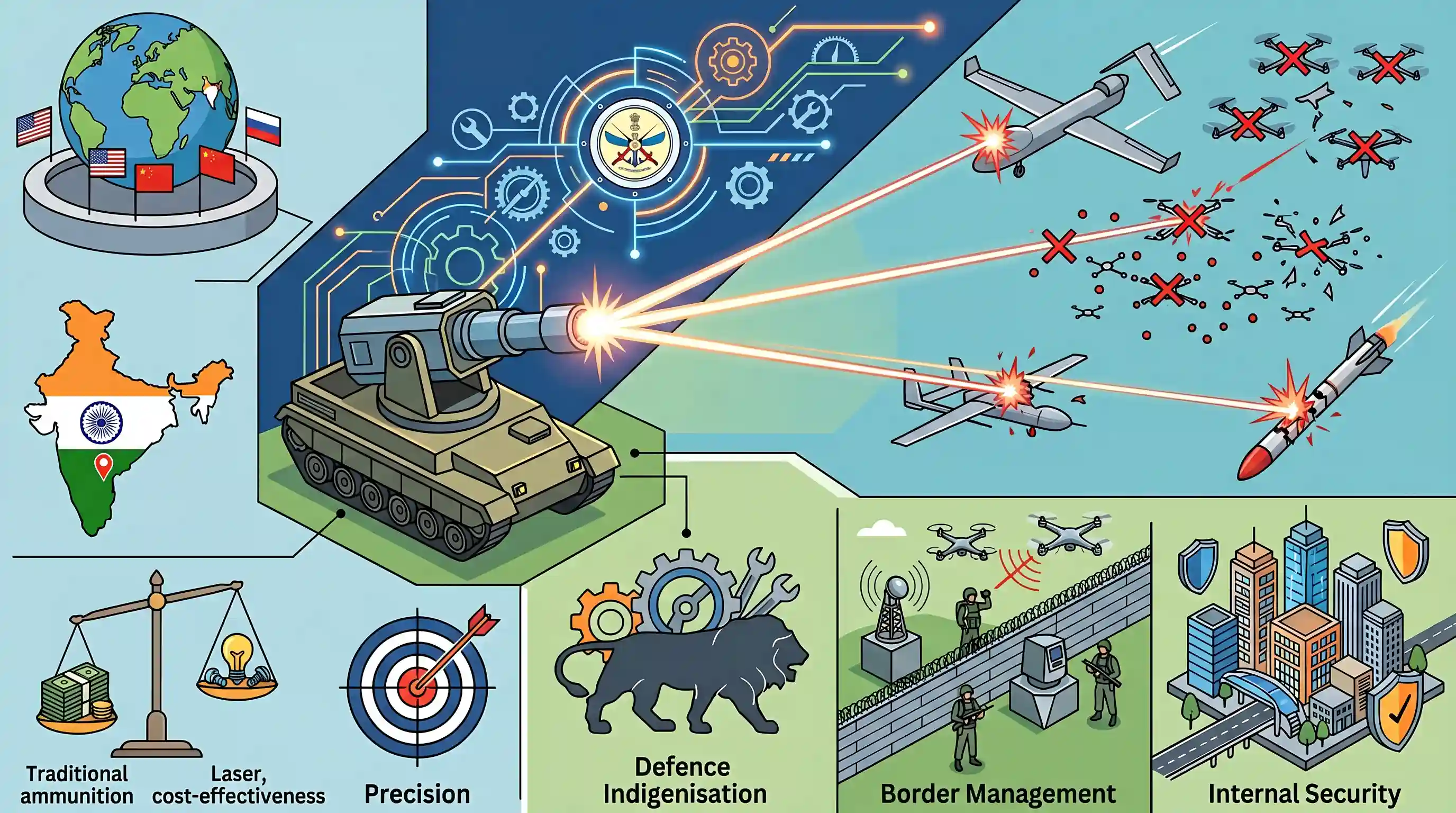
The development of Directed Energy Weapons is crucial for countering modern asymmetric security threats, such as drone swarms used by hostile state and non-state actors, providing a sustainable and cost-effective mechanism for border defence and internal security.
Summary
The Defence Research and Development Organisation (DRDO) has successfully tested the Mk-II(A) Laser-Directed Energy Weapon (DEW) system, marking a major milestone in India's defence indigenisation. Developed by DRDO's Centre for High Energy Systems and Sciences (CHESS), the system can engage targets at the speed of light, effectively disabling fixed-wing drones, drone swarms, and missiles. The weapon provides a cost-effective and highly precise alternative to traditional kinetic ammunition, addressing the growing asymmetric security threats posed by low-cost unmanned aerial systems (UAS). The successful trial at the National Open Air Range in Kurnool elevates India into a limited club of nations possessing advanced high-power DEW technology.
Key Points
- DRDO successfully tested the indigenously developed Mk-II(A) Laser-Directed Energy Weapon (DEW) system at Kurnool, Andhra Pradesh.
- The system can disable drones, missiles, and surveillance sensors at the speed of light by inducing structural failure.
- DEWs present a highly cost-effective and precise alternative to traditional kinetic weapons and missile defence systems.
- The technology provides a critical counter-measure against the growing asymmetric threats posed by unmanned aerial systems and drone swarms.
- The development places India in an exclusive group of nations possessing high-power Laser-DEW technology.
Important Terms
Directed Energy Weapon (DEW)

Systems using focused electromagnetic energy—lasers, microwaves, or particle beams—to damage or destroy targets at the speed of light, offering high precision and low operational costs.
UPSC context
GS Paper 3 (Science & Tech); tests knowledge of emerging defense technologies, counter-drone systems, and strategic military modernization.
Indigenisation of Technology
The capability to design, develop, and manufacture tools or equipment within the nation using local skills and resources to reduce reliance on imports and ensure strategic autonomy.
UPSC context
GS Paper 3 (Science & Tech / Defence); relevant to 'Atmanirbhar Bharat' and self-reliance in critical sectors.
Centre for High Energy Systems and Sciences (CHESS)
A premier Hyderabad-based laboratory under DRDO specializing in the research and development of high-energy laser systems and directed energy technologies for military applications.
UPSC context
GS Paper 3 (Science & Tech); tests awareness of institutional frameworks driving India's indigenous defense R&D.
Asymmetric Security Threats
Security challenges where a weaker adversary uses low-cost, unconventional methods (like drone swarms or cyberattacks) to exploit vulnerabilities and create a disproportionate cost burden for the defender.
UPSC context
GS Paper 3 (Security / Border Management); tests ability to analyze modern warfare paradigms and cost-effective defense solutions.
Drone Swarms
Interconnected groups of unmanned aerial vehicles (UAVs) that coordinate using AI to saturate and overwhelm enemy air defenses, making them difficult to neutralize with traditional missiles.
UPSC context
GS Paper 3 (Internal Security); focuses on emerging threats in aerial warfare and counter-UAS (Unmanned Aerial Systems) technologies.
Defence Research and Development Organisation (DRDO)
India's apex military R&D agency under the Ministry of Defence, established in 1958 to develop advanced weapon systems, sensors, and technological solutions for the Indian Armed Forces.
UPSC context
GS Paper 3 (Science & Tech); essential for understanding India's defense ecosystem and indigenization milestones.
Prelims Trap
Directed Energy Weapons (DEWs) rely exclusively on high-power laser technology to intercept threats.
DEWs are a broad category encompassing High-Power Microwaves (HPM) and particle beams alongside lasers. While lasers cause structural failure via heat, HPMs fry electronic circuits.
Static Concepts Connected
What are Directed Energy Weapons (DEWs) and their primary types?
- Laser Weapons: Uses concentrated light energy to heat, melt, or cause structural failure in physical targets (e.g., DRDO's Mk-II(A)).
- Microwave Weapons: Uses High-Power Microwaves (HPM) to disrupt or permanently destroy the electronic circuitry and sensors of targets like drone swarms.
- Particle Beams: Accelerates subatomic particles to near-light speed to disrupt target molecular structures (currently largely theoretical/experimental).
How do DEWs differ from conventional kinetic weapons?
- Engagement Speed: DEWs engage targets almost instantly at the speed of light, leaving no reaction time for the target, unlike physical missiles.
- Unlimited Magazine: DEWs do not run out of physical ammunition; they can fire continuously as long as a power source is available.
- Cost Efficiency: The electrical cost per shot is negligible compared to multi-million dollar traditional interceptor missiles, making them ideal against cheap drones.
Cross-Topic Patterns
Border Management + Asymmetric Drone Threats
DEWs offer a cost-effective, high-tech counter to the growing asymmetric threat of low-cost drones smuggling narcotics and small arms across the Punjab and J&K borders.
Space Weaponisation + Soft vs Hard Kill
Beyond terrestrial drones, DEWs can perform 'soft kills' by dazzling or blinding enemy surveillance satellites, offering a non-debris-creating alternative to kinetic ASAT missiles (like Mission Shakti).

Expect a 2026 Prelims multi-statement question contrasting the mechanisms of Laser DEWs (structural damage) and Microwave DEWs (electronic disruption).
Linked PYQs · 3
Linked PYQs · 3
- 2023MainsGS3
The use of unmanned aerial vehicles (UAVs) by our adversaries across the borders to ferry arms/ammunitions, drugs, etc., is a serious threat to the internal security. Comment on the measures being taken to tackle this threat.
- 2021MainsGS3
Analyse the multidimensional challenges posed by external state and non-state actors, to the internal security of India. Also discuss measures required to be taken to combat these threats.
- 2020MainsGS3
Analyze internal security threats and transborder crimes along Myanmar, Bangladesh and Pakistan borders including Line of Control (LoC). Also discuss the role played by various security forces in this regard.
