DRDO Indigenous MPATGM Test and Defence Indigenisation
Source:The Hindu ↗
Why It Matters
Demonstrates India's advancement in indigenous defence technology (missile systems), which is crucial for self-reliance (Aatmanirbhar Bharat) and reducing dependency on foreign arms imports, a key theme in UPSC Mains GS3.
Summary
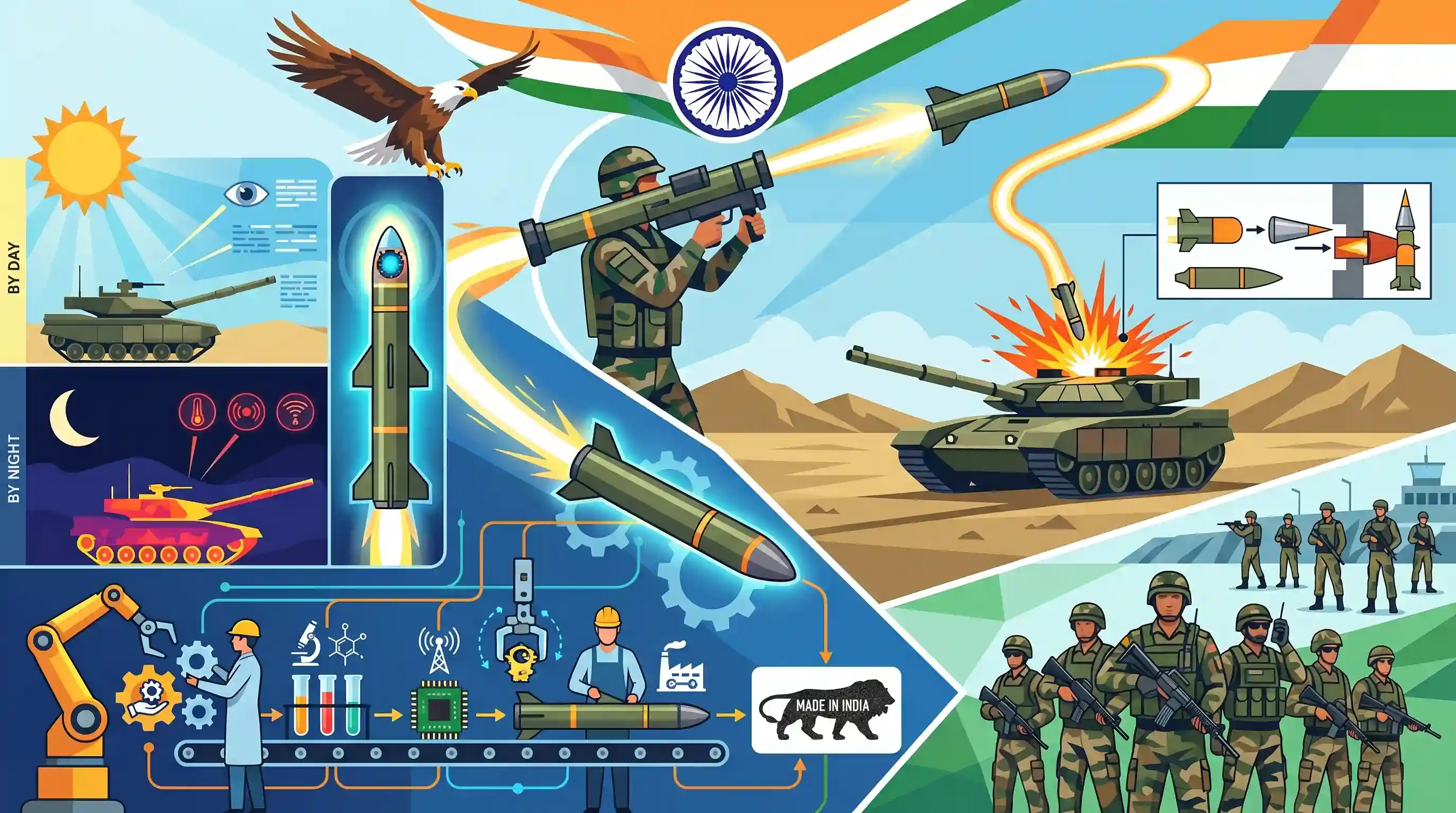
The Defence Research and Development Organisation (DRDO) has successfully flight-tested the indigenous third-generation Man Portable Anti-Tank Guided Missile (MPATGM) at KK Ranges in Maharashtra. Equipped with advanced features such as 'top attack' capability, a dual-mode seeker, and a tandem warhead, the system can effectively neutralize modern heavily armored battle tanks in both day and night conditions. Developed through the collaboration of various DRDO laboratories and industry partners like BDL and BEL, the successful test highlights India's progress toward self-reliance in advanced defence technologies under the 'Aatmanirbhar Bharat' initiative, significantly enhancing the Indian Army's operational readiness.
Key Points
- DRDO successfully conducted the flight-test of the indigenous third-generation Man Portable Anti-Tank Guided Missile (MPATGM) with 'top attack' capability at KK Ranges, Maharashtra.
- The MPATGM is equipped with a tandem warhead capable of defeating modern Explosive Reactive Armour (ERA) protected main battle tanks.
- The system features 'fire and forget' capability and employs a highly capable dual-mode seeker (Imaging Infra-Red and Electro-Optical), allowing for day and night operations.
- The development involved collaborative efforts from multiple DRDO laboratories (including DRDL, RCI, TBRL, HEMRL, and IRDE) along with industry partners BDL and BEL.
- This achievement marks a significant step towards self-reliance in defense manufacturing ('Aatmanirbhar Bharat') and paves the way for meeting the Indian Army's operational requirements.
Important Terms
Aatmanirbhar Bharat

A policy framework launched in 2020 to make India self-reliant by fostering domestic manufacturing, reducing import dependency, and strengthening local supply chains, especially in defense.
UPSC context
GS Paper 3 (Economy/S&T); central to questions on indigenization, self-reliance, and defense manufacturing.
DRDO (Defence Research and Development Organisation)
The premier R&D wing of the Ministry of Defence, responsible for developing indigenous defense technologies, systems, and weapon platforms for the Indian Armed Forces.
UPSC context
GS Paper 3 (S&T/Security); essential for topics on indigenous defense technology and modernization.
Defence Research & Development Laboratory (DRDL)
A Hyderabad-based DRDO laboratory that serves as the nodal agency for designing and developing advanced missile systems, including the MPATGM and various tactical missiles.
UPSC context
GS Paper 3 (S&T); tests knowledge of specific institutions driving India's missile programs.
Research Centre Imarat (RCI)
A key DRDO laboratory specializing in avionics, navigation, and seeker technologies (like IIR seekers) for precision-guided missiles, founded by Dr. APJ Abdul Kalam.
UPSC context
GS Paper 3 (S&T); relevant for advanced guidance systems and high-tech defense indigenization.
Bharat Dynamics Limited (BDL)
A premier Public Sector Undertaking (PSU) under the Ministry of Defence that serves as the primary manufacturer of guided missiles and torpedoes for India.
UPSC context
GS Paper 3 (Indigenization); focuses on the industrial production of strategic and tactical weapon systems.
Bharat Electronics Limited (BEL)
A leading Navratna PSU that manufactures advanced defense electronics, including radars, communication systems, and fire control units for the Indian Armed Forces.
UPSC context
GS Paper 3 (S&T/Security); critical for understanding electronic warfare and defense equipment supply chains.
Indian Army
The land-based branch of the Indian Armed Forces, which defines operational requirements and serves as the primary end-user for systems like the MPATGM.
UPSC context
GS Paper 3 (Security); emphasizes operational readiness and the modernization of infantry and armored units.
Prelims Trap
MPATGM is an air-to-surface missile because it utilizes a 'top attack' mode.
'Top attack' describes the missile's trajectory—climbing and plunging onto the tank's vulnerable roof armor—not the launch platform. MPATGM is infantry-launched (Man-Portable).
Static Concepts Connected
What distinguishes a Third-Generation Anti-Tank Guided Missile (ATGM)?
- First Generation: Requires continuous manual guidance via wire or radio (MCLOS) until it hits the target.
- Second Generation: Semi-automatic (SACLOS); the operator must keep the targeting crosshairs on the enemy until impact.
- Third Generation: Features 'fire-and-forget' capabilities using integrated seekers, allowing the operator to relocate immediately after launch.
How do Tandem Warheads defeat Explosive Reactive Armour (ERA)?
- ERA Mechanism: Sandwiches explosives between metal plates; detonates outward upon impact to disrupt an incoming warhead's penetrator jet.
- Precursor Charge: The tandem weapon's first, smaller explosive charge triggers and clears the ERA block prematurely.
- Main Charge: The second, larger explosive follows immediately to penetrate the tank's newly exposed primary hull armor.
Cross-Topic Patterns
Aatmanirbhar Bharat & Import Substitution
Transitioning from imported Israeli Spike or US Javelin ATGMs to domestic DRDO-BDL systems directly serves the GS3 Indigenization of Technology mandate, reducing reliance on foreign OEMs.
The Nag Missile Family Evolution
MPATGM is part of India’s broader anti-tank ecosystem, which UPSC may test collectively alongside the helicopter-launched HELINA (Dhruvastra) and the vehicle-mounted NAMICA.

Expect a multi-statement question distinguishing 3rd-Gen 'fire-and-forget' ATGMs from earlier variants, focusing on top-attack trajectories.
Linked PYQs · 3
Linked PYQs · 3
- 2023PrelimsGS1
Consider the following statements: 1. Ballistic missiles are jet-propelled at subsonic speeds throughout their flights, while cruise missiles are rocket-powered only in the initial phase of flight. 2. Agni-V is a medium-range supersonic cruise missile, while BrahMos is a solid-fuelled intercontinental ballistic missile. Which of the statements given above is/are correct?
- 2007PrelimsGS1
Consider the following statements: 1. In November, 2006, DRDO successfully conducted the interception test using Prithvi-II missile. 2. Prithvi-II is a surface-to-surface missile and can be deployed to guard the metros against air attacks. Which of the statements given above is/are correct?
- 2014MainsGS3
Foreign Direct Investment (FDI) in the defence sector is now set to be liberalized. What influence this is expected to have on Indian defence and economy in the short and long run?
