DRDO tests solid fuel ramjet technology for supersonic missiles
Source:Indian Express ↗
Why It Matters
The SFDR technology directly impacts India's strategic autonomy by empowering the indigenous development of long-range air-to-air and supersonic cruise missiles. For UPSC candidates, understanding the difference between conventional rocket motors and air-breathing propulsion (like ramjet and scramjet) is essential for science and defense topics in GS3 and Prelims.
Summary
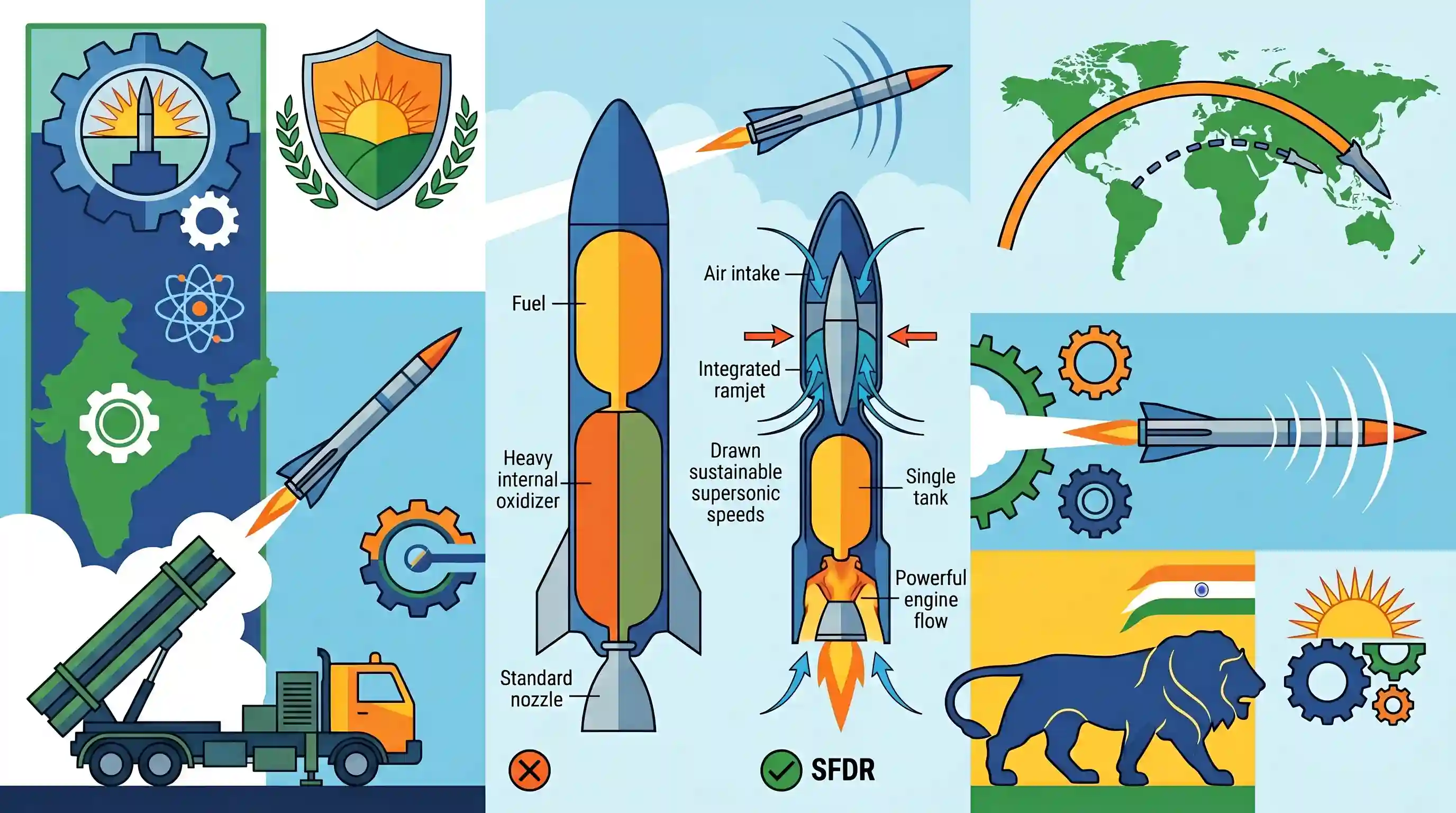
The Defence Research and Development Organisation (DRDO) successfully flight-tested the Solid Fuel Ducted Ramjet (SFDR) technology, a pivotal advancement for next-generation missile systems. The SFDR utilizes an air-breathing ramjet engine that draws oxygen from the atmosphere rather than carrying a heavy onboard oxidizer. This innovation significantly extends the operational range and enables sustained supersonic speeds, providing a critical boost to India's capacity to develop indigenous long-range air-to-air missiles. This achievement bolsters India's defense self-reliance under the Aatmanirbhar Bharat initiative.
Key Points
- The Defence Research and Development Organisation (DRDO) has successfully flight-tested the Solid Fuel Ducted Ramjet (SFDR) technology.
- Unlike traditional solid-propellant rockets that must carry an oxidizer, SFDR systems breathe oxygen from the atmosphere to burn the solid fuel, significantly reducing missile weight and freeing up space for larger payloads.
- Ramjet propulsion enables the missile to maintain high supersonic speeds over exceptionally long ranges, allowing it to effectively intercept fast-moving aerial threats.
- Mastering this technology is a major milestone for defense indigenisation, elevating India into a select group of nations possessing advanced ducted ramjet capabilities and paving the way for superior air-to-air missiles.
Important Terms
Solid Fuel Ducted Ramjet (SFDR)

An air-breathing propulsion system that utilizes atmospheric oxygen to burn solid fuel, enabling missiles to maintain sustained supersonic speeds and significantly extended operational ranges.
UPSC context
GS Paper 3: Science and Technology. Tests knowledge of indigenous defense advancements and air-breathing propulsion milestones.
Ramjet
An air-breathing jet engine that uses the vehicle's forward motion to compress incoming air for combustion, lacking rotating compressors and requiring a booster for initial acceleration.
UPSC context
GS Paper 3: Science and Technology. Essential for distinguishing between propulsion types like ramjet, scramjet, and traditional rockets.
Beyond-Visual-Range (BVR) Missiles
Air-to-air missiles capable of engaging enemy aircraft at distances exceeding 37 km (20 nautical miles), providing a tactical edge in modern aerial combat.
UPSC context
GS Paper 3: Internal Security/Defense. Tests understanding of modern warfare capabilities and strategic air superiority.
Defence Research and Development Organisation (DRDO)
India's premier R&D agency under the Ministry of Defence, focused on developing indigenous military technologies and achieving self-reliance in defense systems.
UPSC context
GS Paper 3: Science and Technology. Key institution for indigenization of technology and defense R&D.
Aatmanirbhar Bharat
A policy initiative to make India self-reliant, specifically targeting defense indigenization through import bans, indigenous design, and domestic manufacturing of military equipment.
UPSC context
GS Paper 3: Indian Economy and Security. Relates to strategic autonomy and reducing defense import dependency.
High Energy Materials Research Laboratory (HEMRL)
A specialized DRDO laboratory in Pune dedicated to the research and development of propellants, high explosives, and pyrotechnics for defense applications.
UPSC context
GS Paper 3: Science and Technology. Represents the specific R&D infrastructure supporting indigenous missile components.
Prelims Trap
Ramjet and Scramjet engines can be used as primary propulsion from liftoff without requiring an external booster stage.
Ramjets lack rotating compressors and cannot produce thrust at zero velocity. They require an initial solid booster rocket to accelerate to supersonic speeds before activating.
Static Concepts Connected
What is the primary operational difference between Ramjet and Scramjet engines?
- Ramjet combustion: Decelerates supersonic incoming air to subsonic speeds for combustion. It is generally efficient up to Mach 6.
- Scramjet combustion: Maintains supersonic airflow during combustion, allowing the missile or vehicle to sustain true hypersonic speeds.
- Zero-velocity limitation: Neither can start from rest; they both require a primary booster to reach supersonic speeds first.
What are the structural advantages of air-breathing propulsion systems like SFDR?
- No onboard oxidizer: They absorb atmospheric oxygen for combustion, eliminating the need to carry heavy internal oxidizers.
- Payload efficiency: The saved weight allows for heavier warheads or extra solid fuel, drastically improving operational range.
- No moving parts: Unlike traditional turbojets, they lack rotating compressors or turbines, relying purely on high-speed forward motion (the ram effect).
Cross-Topic Patterns
Air-Breathing Tech in Space Launch
ISRO utilizes similar air-breathing scramjet principles for its Advanced Technology Vehicle (ATV) to dramatically lower the mass and cost of launching payloads into low earth orbit.
BVR Missiles & Air Superiority
Mastery of SFDR enhances India's indigenous Beyond Visual Range (BVR) missile capabilities (like the Astra series), a crucial factor for air superiority and reducing import dependence.

UPSC 2026 will likely test the exact combustion speed differences (subsonic vs supersonic) between Ramjet and Scramjet in a Prelims MCQ.
Linked PYQs · 1
Linked PYQs · 1
- 2023PrelimsGS1
Consider the following statements: 1. Ballistic missiles are jet-propelled at subsonic speeds throughout their flights, while cruise missiles are rocket-powered only in the initial phase of flight. 2. Agni-V is a medium-range supersonic cruise missile, while BrahMos is a solid-fuelled intercontinental ballistic missile. Which of the statements given above is/are correct?
