DRDO and Navy Helicopter Launched Anti Ship Missile Test
Source:Indian Express ↗
Why It Matters
Highlights the achievements of DRDO and the Indian Navy in reducing foreign dependency for critical military hardware. It is highly relevant for GS Paper 3 questions concerning the indigenisation of technology, 'Make in India' in defence, and advancements in missile/navigation technologies.
Summary
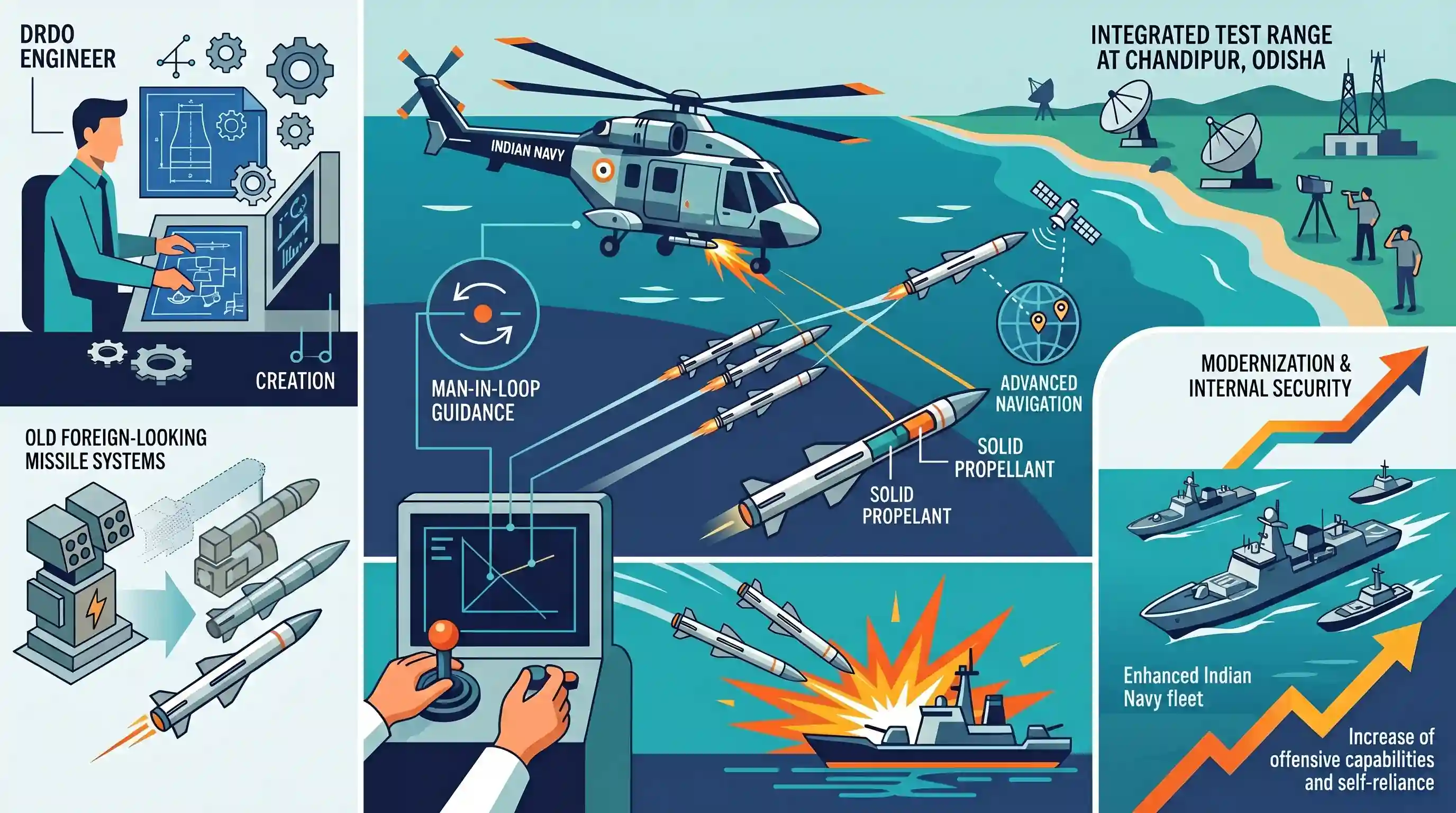
The DRDO and the Indian Navy successfully conducted the first salvo launch of the indigenously developed Naval Anti-Ship Missile – Short Range (NASM-SR) from a helicopter at the Integrated Test Range in Chandipur, Odisha. Equipped with advanced navigation systems and a 'Man-in-Loop' guidance feature, this lightweight solid-propulsion missile replaces older foreign systems, marking a significant advancement in India's defence indigenisation and enhancing the Navy's offensive capabilities.
Key Points
- The DRDO and Indian Navy successfully executed the first salvo launch of the Naval Anti-Ship Missile – Short Range (NASM-SR) from a Sea King 42B helicopter.
- Two missiles were fired in quick succession to demonstrate their salvo launch capacity and precise waterline hit capability.
- The indigenously developed missile features solid propulsion, a fibre-optic gyroscope-based inertial navigation system (INS), and a radio-altimeter for highly precise guidance.
- A unique 'Man-in-Loop' feature allows human operators to manually intervene or steer the missile during its flight.
- The NASM-SR aims to replace older foreign-origin anti-ship missiles, marking a significant milestone in defence indigenisation and self-reliance (Aatmanirbhar Bharat).
Important Terms
DRDO (Defence Research and Development Organisation)

India's premier military R&D agency under the Ministry of Defence, focused on achieving self-reliance through the indigenous design and development of critical defense technologies.
UPSC context
GS Paper III: Indigenisation of technology and development of new technology; critical for 'Atmanirbhar Bharat' in defense.
Indian Navy
The maritime branch of India's Armed Forces tasked with safeguarding territorial waters, protecting maritime trade, and maintaining regional maritime security.
UPSC context
GS Paper III: Security challenges and their management in border areas; role in maritime strike capabilities.
Research Centre Imarat (RCI)
A lead DRDO laboratory specializing in the R&D of avionics, control systems, and seeker technologies essential for missile navigation and guidance.
UPSC context
GS Paper III: Science and Technology; specifically the technological heart of India's missile systems like NASM-SR.
High Energy Materials Research Laboratory (HEMRL)
A DRDO lab dedicated to basic and applied research in propellants, high explosives, and pyrotechnics for missile and ammunition systems.
UPSC context
GS Paper III: Science and Technology; relevant for material sciences and chemical propulsion in defense.
Terminal Ballistics Research Laboratory (TBRL)
A specialized DRDO facility focused on detonation physics, warhead design, and testing the terminal effectiveness and precision of weapon systems.
UPSC context
GS Paper III: Science and Technology; tests the lethality and structural impact of indigenous missiles.
Defence Research and Development Laboratory (DRDL)
A major DRDO laboratory responsible for the design, development, and system integration of indigenous missile systems and aerospace technologies.
UPSC context
GS Paper III: Science and Technology; key to India's legacy in missile development (e.g., IGMDP).
Ministry of Defence (MoD)
The central government authority responsible for national security policy, defense procurement, and the administrative oversight of the Indian Armed Forces.
UPSC context
GS Paper II/III: Governance and Security; sets policies for indigenisation and defense modernization.
Prelims Trap
NASM-SR operates purely as an autonomous fire-and-forget missile.
NASM-SR is not fully autonomous. It features 'Man-in-Loop' guidance via a datalink, enabling human operators to manually retarget or abort the missile mid-flight.
Static Concepts Connected
How do sea-skimming cruise missiles evade enemy detection?
- Low Altitude: Cruises extremely close to the water surface (often as low as 5 meters) during its terminal approach to the target.
- Radar Horizon: Exploits the Earth's curvature to remain hidden below the enemy's radar line-of-sight until the final moments of the attack.
- Clutter Masking: The missile's radar signature blends with the natural wave clutter of the ocean surface, confusing enemy detection sensors.
What is a Fibre-Optic Gyroscope (FOG)?
- Sagnac Effect: Uses interfering light beams within coiled optical fibres (Sagnac effect) to measure rotation and orientation with extremely high accuracy.
- Jamming Immunity: Functions as an Inertial Navigation System (INS) that is totally independent of external signals, making it immune to GPS/GNSS jamming.
- Durability: Contains no mechanical moving parts, offering superior reliability and accuracy under intense launch vibrations.
Cross-Topic Patterns
Positive Indigenisation Lists
Replacing the UK-origin 'Sea Eagle' with NASM-SR directly reflects the Ministry of Defence's phased import bans (Positive Indigenisation Lists) aimed at building a domestic defence manufacturing ecosystem.
Man-in-Loop vs. AI Autonomy
While global militaries push for AI-driven autonomous drones, systems like NASM-SR retain 'Man-in-Loop' control, balancing precision strike capabilities with human accountability for target verification.

Expect a 2026 Prelims statement comparing 'Man-in-Loop' manual override capabilities with 'Fire-and-Forget' autonomous missile systems.
Linked PYQs · 3
Linked PYQs · 3
- 2021MainsGS3
How is S-400 air defence system technically superior to any other system presently available in the world?
- 2022PrelimsGS1
Which one of the following statements best reflects the idea behind the "Fractional Orbital Bombardment System" often talked about in media?
- 2025PrelimsGS1
What is the common characteristic of the chemical substances generally known as CL-20, HMX and LLM-105, which are sometimes talked about in media?
