Indigenous Astra Missile Flight Test with RF Seeker
Source:The Hindu ↗
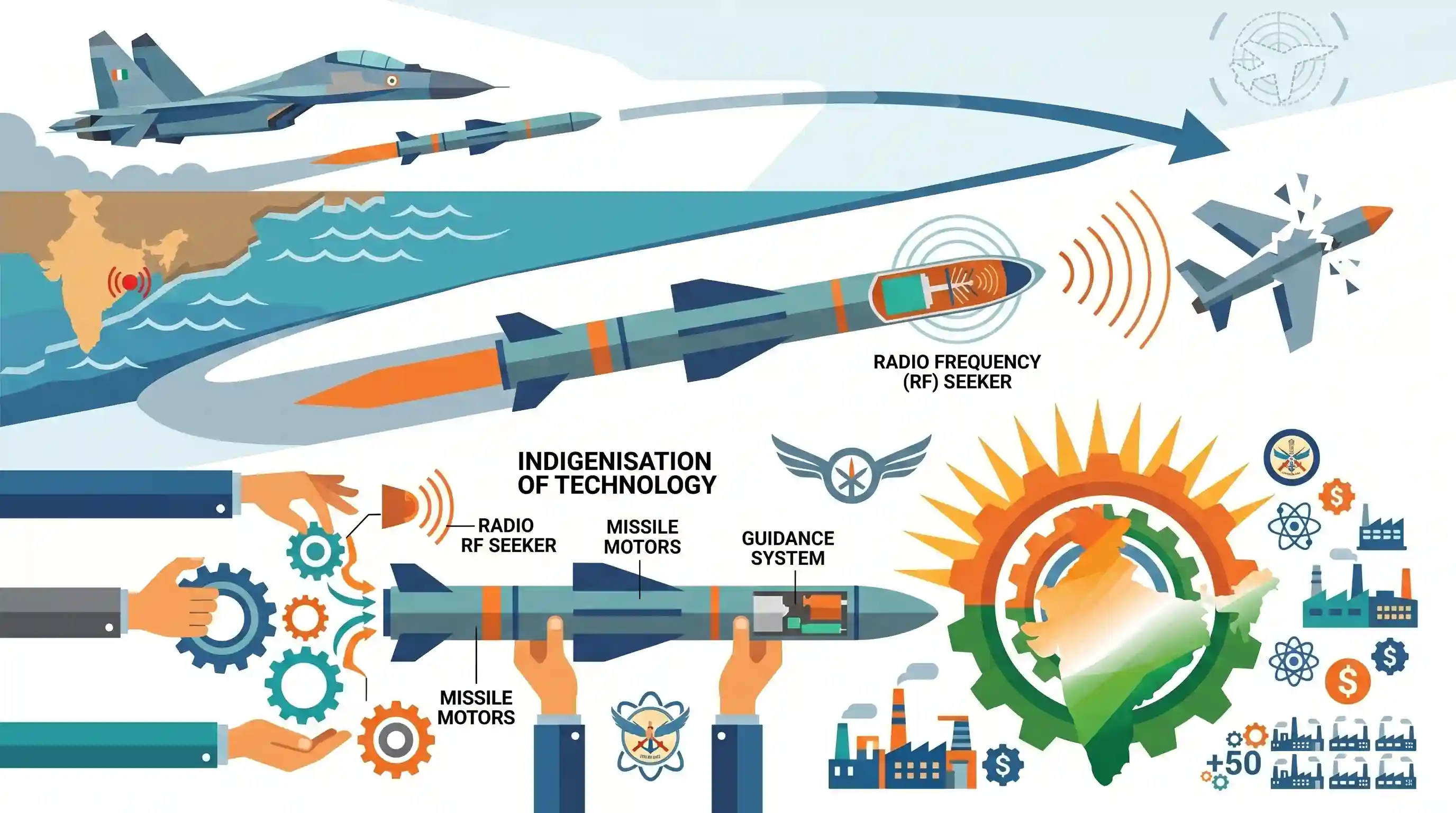
Why It Matters
Missile technology and indigenisation of defense equipment are highly recurrent themes in GS-3. The development of indigenous subsystems like the RF Seeker highlights India's strategic push to reduce import dependency and build a domestic military-industrial complex.
Summary
The Defence Research and Development Organisation (DRDO) and the Indian Air Force (IAF) successfully flight-tested the indigenously developed 'Astra' Beyond Visual Range Air-to-Air Missile (BVRAAM). Fired from a Su-30 MKI fighter jet off the coast of Odisha, the missile successfully intercepted high-speed unmanned aerial targets. A critical achievement of this test was the validation of the missile's indigenous Radio Frequency (RF) Seeker, which provides state-of-the-art guidance and navigation. The project, supported by over 50 public and private industries, highlights India's growing self-reliance in complex defence technologies and strengthens the aerospace ecosystem.
Key Points
- The DRDO and IAF successfully flight-tested the indigenous Astra Beyond Visual Range Air-to-Air Missile (BVRAAM) from a Su-30 MKI fighter jet.
- The missile successfully intercepted high-speed unmanned aerial targets off the coast of Odisha with pinpoint accuracy.
- The Astra missile features an indigenously designed and developed Radio Frequency (RF) Seeker, marking a significant milestone in self-reliance for advanced guidance systems.
- The development of Astra involved contributions from over 50 public and private sector industries, including HAL, advancing India's 'Atmanirbhar Bharat' goals in defense.
Important Terms
Astra Missile

India's first indigenously developed Beyond Visual Range Air-to-Air Missile (BVRAAM), designed to intercept highly maneuverable supersonic aerial targets at ranges exceeding 100 km.
UPSC context
GS-3: Science & Technology. Key example of 'Indigenisation of Technology' and indigenous missile programs.
Beyond Visual Range Air-to-Air Missile (BVRAAM)
A missile category capable of engaging enemy aircraft at ranges beyond the pilot's visual limit (typically >37 km), utilizing radar-based terminal homing for high-accuracy interceptions.
UPSC context
GS-3: Science & Technology. Important technical classification for modern aerial warfare and strategic defence.
Radio Frequency (RF) Seeker
A critical onboard radar guidance system that tracks and locks onto targets autonomously during the terminal phase, providing missiles with "fire-and-forget" capability.
UPSC context
GS-3: Science & Technology. Represents a breakthrough in 'Critical Technologies' reducing dependency on imported electronics.
Atmanirbhar Bharat
A national policy initiative aiming to make India self-reliant by promoting indigenous design and manufacturing, particularly in strategic sectors like defence to enhance strategic autonomy.
UPSC context
GS-3: Economy/S&T. Central theme for reducing import dependency and fostering domestic industrial growth.
DRDO
India's premier military R&D agency under the Ministry of Defence, responsible for the indigenous design and development of advanced weapon systems and technologies.
UPSC context
GS-3: Science & Technology. Primary institutional body for indigenous military research and technology clusters.
Integrated Test Range (ITR)
A specialized DRDO facility at Chandipur, Odisha, providing launch and tracking infrastructure for the performance evaluation of rockets, missiles, and airborne weapon systems.
UPSC context
GS-3: Security/S&T. Significant strategic infrastructure location for India's missile testing programs.
Prelims Trap
"Astra is a surface-to-air missile developed under the Integrated Guided Missile Development Programme (IGMDP)."
Astra is an Air-to-Air missile (BVRAAM), not a SAM. Furthermore, it was developed independently and is NOT part of the legacy 5-missile IGMDP.
Static Concepts Connected
What distinguishes a Beyond Visual Range (BVR) missile?
- Extended Range: Engagement ranges typically exceed 37 km (20 nautical miles), allowing engagement beyond the pilot's line of sight.
- Active Guidance: Utilizes active radar homing or RF seekers in the terminal phase, granting 'fire-and-forget' capabilities without constant tracking by the launch aircraft.
- ECCM capability: Often equipped with Electronic Counter-Countermeasures (ECCM) to resist enemy jamming attempts during flight.
How does Astra fit into India's missile classification?
- Missile Type: It is an Air-to-Air Missile (AAM), distinct from Surface-to-Surface (Agni, Prithvi) or Surface-to-Air (Akash) missiles.
- Propulsion: Astra Mk-1 uses a smokeless solid-fuel rocket motor achieving speeds of Mach 4.5.
- Platform Agnostic: Designed for multi-platform integration, operable from Su-30 MKI, LCA Tejas, and MiG-29 fighters.
Cross-Topic Patterns
Positive Indigenisation Lists
Astra's success ties into the MoD's Positive Indigenisation Lists, which progressively ban imports of equivalent foreign systems (like AMRAAM) to force domestic R&D and procurement.
MSME integration in Defence R&D
With over 50 private industries contributing, Astra highlights the policy shift from DRDO-monopolized production to a collaborative R&D model integrating private MSMEs into the defence supply chain.

Expect a match-the-following question in 2026 pairing indigenous missiles (Astra, Rudram, Pralay) with their exact combat classifications.
Linked PYQs · 3
Linked PYQs · 3
- 2023PrelimsGS1
Consider the following statements: 1. Ballistic missiles are jet-propelled at subsonic speeds throughout their flights, while cruise missiles are rocket-powered only in the initial phase of flight. 2. Agni-V is a medium-range supersonic cruise missile, while BrahMos is a solid-fuelled intercontinental ballistic missile. Which of the statements given above is/are correct?
- 2014PrelimsGS1
With reference to Agni-IV Missile, which of the following statements is/are correct? 1. It is a surface-to-surface missile. 2. It is fuelled by liquid propellant only. 3. It can deliver one-tonne nuclear warheads about 7500 km away. Select the correct answer using the code given below.
- 2025PrelimsGS1
With reference to India's defence, consider the following pairs : Aircraft type Description I. Dornier-228 : Maritime patrol aircraft II. IL-76 : Supersonic combat aircraft III. C-17 Globemaster III : Military transport aircraft How many of the pairs given above are correctly matched?
