Solid fuel ducted ramjet missile technology successful flight test
Source:The Hindu ↗
Why It Matters
Mastering SFDR technology is critical for developing next-generation, long-range air-to-air missiles like the Astra series. It reduces dependence on foreign technology, bolsters aerial combat superiority, and aligns with the strategic goal of Atmanirbhar Bharat in defence manufacturing.
Summary
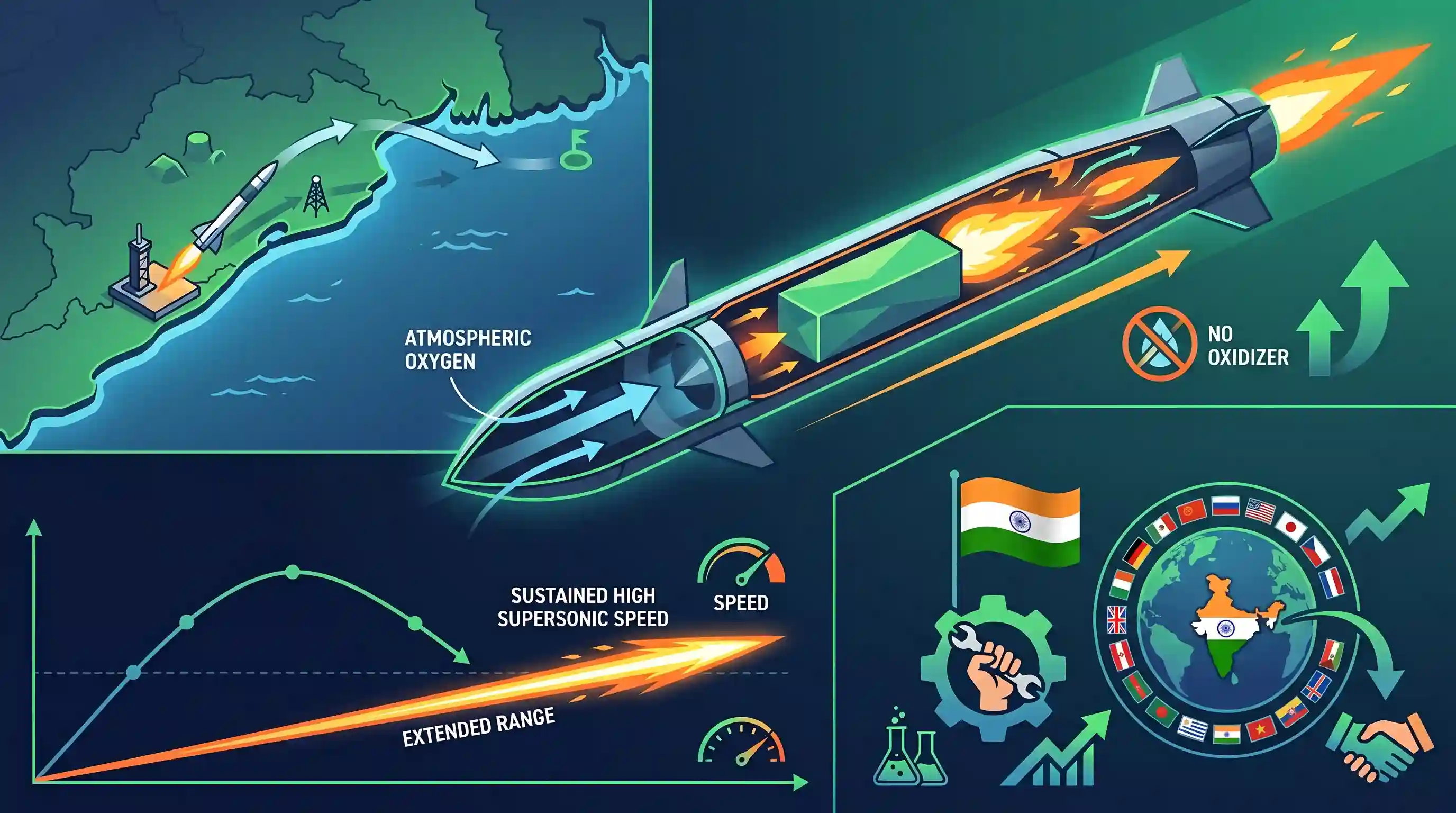
The Defence Research and Development Organisation (DRDO) has successfully flight-tested the Solid Fuel Ducted Ramjet (SFDR) technology off the coast of Odisha. This cutting-edge propulsion system uses a ramjet engine that draws atmospheric oxygen during flight, eliminating the need to carry an onboard oxidizer. This weight reduction allows the missile to achieve extended ranges and sustained high supersonic speeds. The successful demonstration of SFDR technology is a major milestone for India's indigenous defence capabilities, placing the country among a select group of nations capable of developing advanced long-range air-to-air missiles.
Key Points
- DRDO successfully flight-tested Solid Fuel Ducted Ramjet (SFDR) technology from the Integrated Test Range in Chandipur, Odisha.
- SFDR is a missile propulsion technology that uses a ramjet engine system. Unlike traditional solid-propellant rockets that carry both fuel and oxidizer, a ramjet takes in oxygen from the atmosphere during flight.
- By drawing oxygen from the air, the missile carries less weight (no heavy oxidizer needed), allowing it to carry a heavier payload or achieve a significantly longer range.
- The technology enables sustained high supersonic speeds, significantly enhancing the effectiveness of long-range air-to-air missiles.
- This successful test places India in an elite club of nations possessing SFDR technology, boosting self-reliance in advanced defence manufacturing.
Important Terms
Solid Fuel Ducted Ramjet (SFDR)

An advanced air-breathing missile propulsion system using atmospheric oxygen instead of an onboard oxidizer, enabling sustained supersonic speeds and significantly extended ranges for long-range air-to-air missiles.
UPSC context
GS Paper III: Science & Technology and Security. Tests understanding of indigenous defense innovations and propulsion technology.
Defence Research and Development Organisation (DRDO)
India’s premier agency under the Ministry of Defence, responsible for the design and development of indigenous world-class weapon systems, platforms, and military equipment to enhance national security.
UPSC context
GS Paper III: Achievements of Indians in S&T. Central to questions on institutional roles in defense indigenisation.
Atmanirbhar Bharat
A strategic vision and policy framework aimed at making India self-reliant by reducing import dependence, particularly in critical sectors like defense through indigenous R&D and manufacturing.
UPSC context
GS Paper II & III: Government policies and defense indigenisation. Key for essays and policy-related questions.
Beyond Visual Range Air-to-Air Missile (BVRAAM)
An air-to-air missile capable of engaging targets at distances greater than 20 nautical miles (37 km), typically requiring sophisticated radar and propulsion like SFDR for high terminal energy.
UPSC context
GS Paper III: Defense Technology. Relevant for technical questions on aerial combat capabilities and modern warfare.
Indigenisation of Technology
The process of developing and producing defense equipment within India using domestic resources and expertise to ensure strategic autonomy and technological sovereignty.
UPSC context
GS Paper III: S&T development and Security. Core theme for mains questions on defense self-sufficiency.
No-Escape Zone (NEZ)
An area in aerial combat where a target aircraft cannot evade an incoming missile solely through its own maneuverability due to the missile's sustained high speed and energy.
UPSC context
GS Paper III: Internal Security/Defense. Tests knowledge of tactical advantages provided by advanced missile systems.
Make in India
A major national initiative designed to facilitate investment, foster innovation, and build best-in-class manufacturing infrastructure, specifically encouraging domestic production of defense hardware.
UPSC context
GS Paper III: Indian Economy and Industrial Policy. Relevant for investment and manufacturing-led growth discussions.
Prelims Trap
Ramjet engines like SFDR can independently launch missiles from zero airspeed without needing a primary booster.
Ramjets rely entirely on the vehicle's forward motion to compress incoming air. They cannot produce thrust at zero airspeed and strictly require a primary rocket booster for initial launch.
Static Concepts Connected
What distinguishes Ramjet from Scramjet engines in missile propulsion?
- Airflow speed: Ramjets slow incoming supersonic air to subsonic speeds for combustion. Scramjets (Supersonic Combustion Ramjet) maintain supersonic airflow through the combustion chamber.
- Mach range: Ramjets operate most efficiently up to Mach 3-6. Scramjets are designed exclusively for hypersonic flights operating at Mach 5 and above.
- Zero-speed thrust: Neither engine can compress air or generate thrust from a standstill; both rely on initial acceleration from a conventional booster.
What are the tactical advantages of air-breathing missile propulsion like SFDR?
- Weight reduction: By drawing atmospheric oxygen for combustion, the missile eliminates the need to carry a heavy onboard oxidiser (like liquid oxygen).
- Payload and range: The weight saved by removing the oxidiser allows the missile to carry a heavier warhead or significantly extend its flight range.
- Terminal energy: Unlike traditional solid rockets that coast after early fuel burnout, SFDR provides continuous thrust, enabling high kinetic energy and maneuverability during terminal interception.
Cross-Topic Patterns
SFDR integration with Astra Mk-3 BVRAAM
SFDR technology is the foundation for the upcoming Astra Mk-3 missile, shifting India's aerial combat strategy by heavily extending beyond-visual-range (BVR) strike capabilities against adversary fighter jets.
ISRO's Scramjet vs DRDO's Ramjet applications
While DRDO weaponizes Ramjet/SFDR for terminal-phase missile maneuverability, ISRO is concurrently applying advanced Scramjet technology to develop low-cost, reusable space launch vehicles (RLV) and the HSTDV.

Expect a 2026 Prelims multi-statement question testing combustion airflows, oxidizer needs, and zero-speed thrust of Ramjet vs Scramjet.
Linked PYQs · 3
Linked PYQs · 3
- 2023PrelimsGS1
Consider the following statements: 1. Ballistic missiles are jet-propelled at subsonic speeds throughout their flights, while cruise missiles are rocket-powered only in the initial phase of flight. 2. Agni-V is a medium-range supersonic cruise missile, while BrahMos is a solid-fuelled intercontinental ballistic missile. Which of the statements given above is/are correct?
- 2021MainsGS3
How is S-400 air defence system technically superior to any other system presently available in the world?
- 2024PrelimsGS1
What is the common characteristic of the chemical substances generally known as CL-20, HMX and LLM-105, which are sometimes talked about in media?
