DRDO Raises Concerns Over Low Bids in Defence Manufacturing
Source:Indian Express ↗
Why It Matters
Demonstrates the practical challenges—such as aggressive underbidding—faced during the implementation of public-private partnership models (like DcPP) in India's push for indigenous defence manufacturing and Atmanirbharta.
Summary
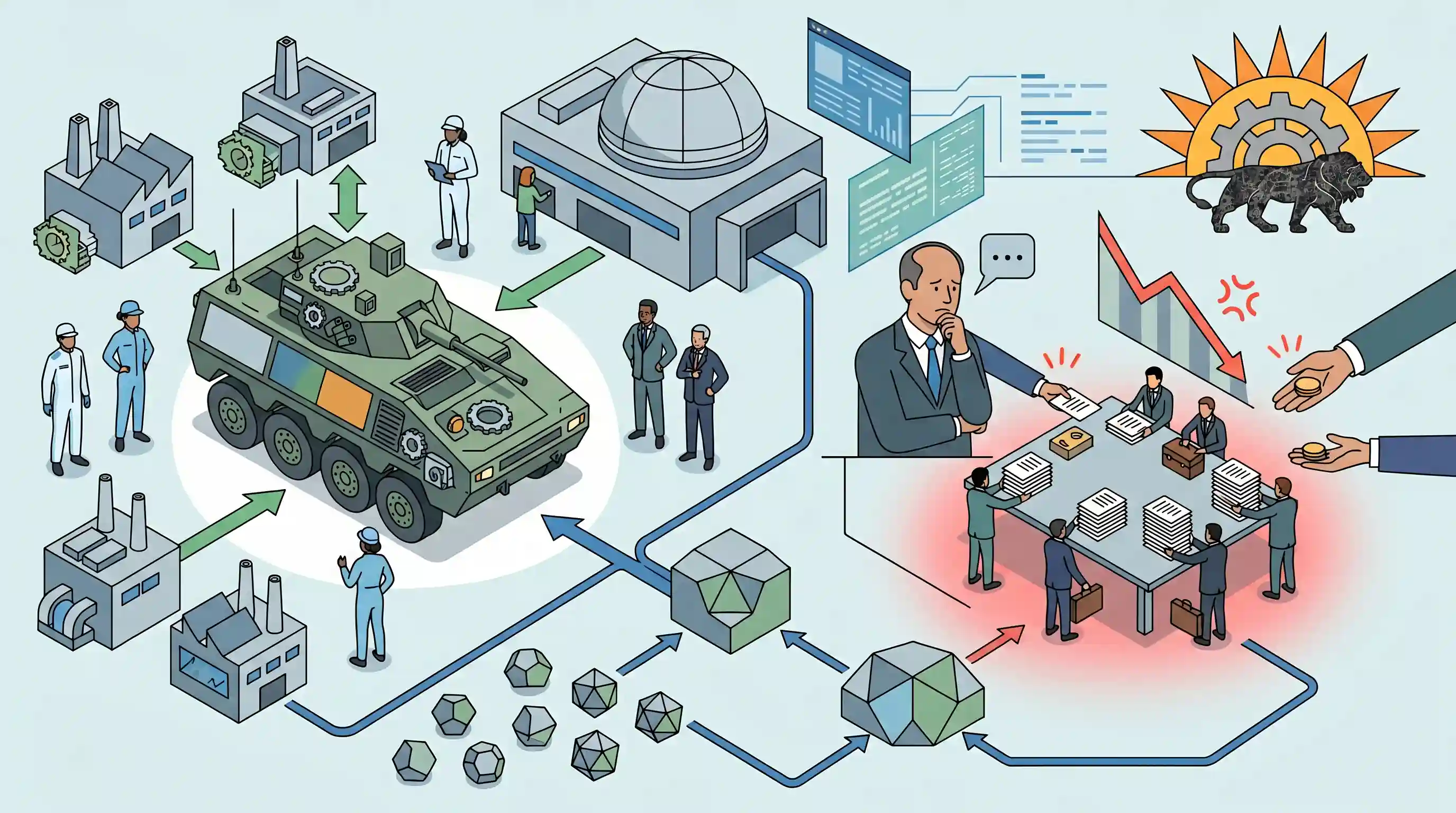
DRDO Chairman Samir V Kamat has highlighted concerns over private companies submitting aggressively low bids to secure contracts under the Development cum Production Partner (DcPP) model. The DcPP model aims to foster self-reliance (Atmanirbharta) by partnering DRDO with private players for developing complex defence systems. The remarks were made during the unveiling of 'Vikram VT21', an advanced armoured platform developed with over 60% indigenous content by VRDE in collaboration with Tata Advanced Systems and Bharat Forge. The issue underscores the teething troubles in public-private partnerships within India's growing domestic defence manufacturing ecosystem.
Key Points
- DRDO unveiled 'Vikram VT21', an Advanced Armoured Platform with over 60% indigenous content, designed by VRDE.
- The platform was manufactured in partnership with Tata Advanced Systems and Bharat Forge, supported by local MSMEs.
- Under the Development cum Production Partner (DcPP) model, DRDO collaborates with private industries for complex systems, while leaving simpler systems entirely to the private sector.
- DRDO Chief Samir V Kamat raised concerns over private firms submitting excessively low bids to become DcPP partners, which threatens to vitiate the procurement and development process.
Important Terms
Development cum Production Partner (DcPP) model

A collaborative model where DRDO selects private industry partners early in the design phase to participate in both research and subsequent mass production of defence systems.
UPSC context
GS Paper III (Indigenization of Technology). Tests understanding of Public-Private Partnerships (PPP) and strategies to reduce military procurement timelines.
Atmanirbharta in Defence
India's strategic initiative to achieve self-reliance by domesticating the design, development, and manufacture of critical defence equipment, thereby reducing high import dependency and ensuring strategic autonomy.
UPSC context
GS Paper III (Economy/Internal Security). Relevant for discussions on strategic autonomy, domestic manufacturing, and the 'Make in India' mission.
DRDO (Defence Research and Development Organisation)
India's premier military research agency under the Ministry of Defence, tasked with developing state-of-the-art weapon systems, platforms, and technologies for the Indian Armed Forces.
UPSC context
GS Paper III (Science & Technology). Essential for understanding the institutional framework of India's national security and R&D ecosystem.
Vehicles Research and Development Establishment (VRDE)
An Ahmednagar-based DRDO laboratory specializing in the research, design, and testing of wheeled and light tracked vehicles for the Indian military.
UPSC context
GS Paper III (Defence). A specific example of a specialized R&D lab contributing to the indigenization of land-based military platforms.
Vikram VT21
An advanced indigenously developed armoured platform (available in wheeled and tracked versions) featuring over 60% local content, designed for high mobility and crew protection.
UPSC context
GS Paper III (Internal Security/Indigenization). Serves as a case study for the success of indigenous platform development under the DcPP model.
Indigenization of Technology
The process of developing and manufacturing sophisticated equipment within the country to replace foreign imports, enhancing sovereign control over critical military technologies.
UPSC context
GS Paper III (S&T/Economy). A central theme in UPSC Mains regarding India's industrial policy and defense self-sufficiency.
Prelims Trap
"DRDO charges a mandatory technology transfer fee from private players under the DcPP model."
Under the DcPP framework, DRDO collaborates extensively with private sector players, not just DPSUs, and transfers technology at zero ToT fee to boost domestic manufacturing.
Static Concepts Connected
What is the L1 criterion in government public procurement and its major flaw?
- L1 System: The contract is awarded to the technically qualified bidder submitting the lowest financial bid.
- Predatory Pricing Flaw: Bidders often quote unviably low prices just to win the tender, leading to subsequent cost overruns, project delays, or compromised quality.
- QCBS Alternative: For complex technological or consultancy projects, the government is shifting toward Quality-and-Cost-Based Selection (QCBS) instead of strict L1.
What were the key recommendations of the K. VijayRaghavan Committee on DRDO?
- Core R&D Focus: DRDO should restrict itself to high-end, futuristic research, leaving the manufacturing of conventional systems entirely to the private sector and PSUs.
- Defence Technology Council: Recommended establishing a top-level body chaired by the Prime Minister to determine the country's strategic defence technology roadmap.
- Private Sector Integration: Advocated for deeper, institutionalized collaboration with academia and private industry right from the conceptualization stage of defence platforms.
Cross-Topic Patterns
Defence PPPs + Public Procurement Reforms
The shift away from L1 (lowest bidder) bottlenecks connects defence indigenization efforts directly with broader Ministry of Finance reforms to the General Financial Rules (GFR) regarding Quality-and-Cost-Based Selection (QCBS).
MSME integration + Import Substitution
Relying on local MSMEs for sub-assemblies in platforms like Vikram VT21 aligns with the Ministry of Defence's Positive Indigenization Lists, simultaneously supporting import substitution and MSME formalization.

Expect a GS3 question linking DRDO restructuring (VijayRaghavan committee) with systemic flaws of L1 procurement in defence PPPs.
Linked PYQs · 3
Linked PYQs · 3
- 2014MainsGS3
Foreign Direct Investment (FDI) in the defence sector is now set to be liberalized. What influence this is expected to have on Indian defence and economy in the short and long run?
- 2023MainsGS3
Faster economic growth requires increased share of the manufacturing sector in GDP, particularly of MSMEs. Comment on the present policies of the Government in this regard.
- 2022MainsGS3
Why is Public Private Partnership (PPP) required in infrastructural projects ? Examine the role of PPP model in the redevelopment of Railway Stations in India.
