Draft guidelines on artificial intelligence use in Indian courts
Source:The Hindu ↗
Why It Matters
This development marks a crucial intersection of GS2 (Judiciary/Governance), GS3 (Science & Tech), and GS4 (Ethics). It establishes India's foundational legal and ethical framework for integrating AI into the justice delivery system, ensuring that human judgment, transparency, and fundamental rights are preserved against the risks of algorithmic bias and opaque automated decision-making.
Summary
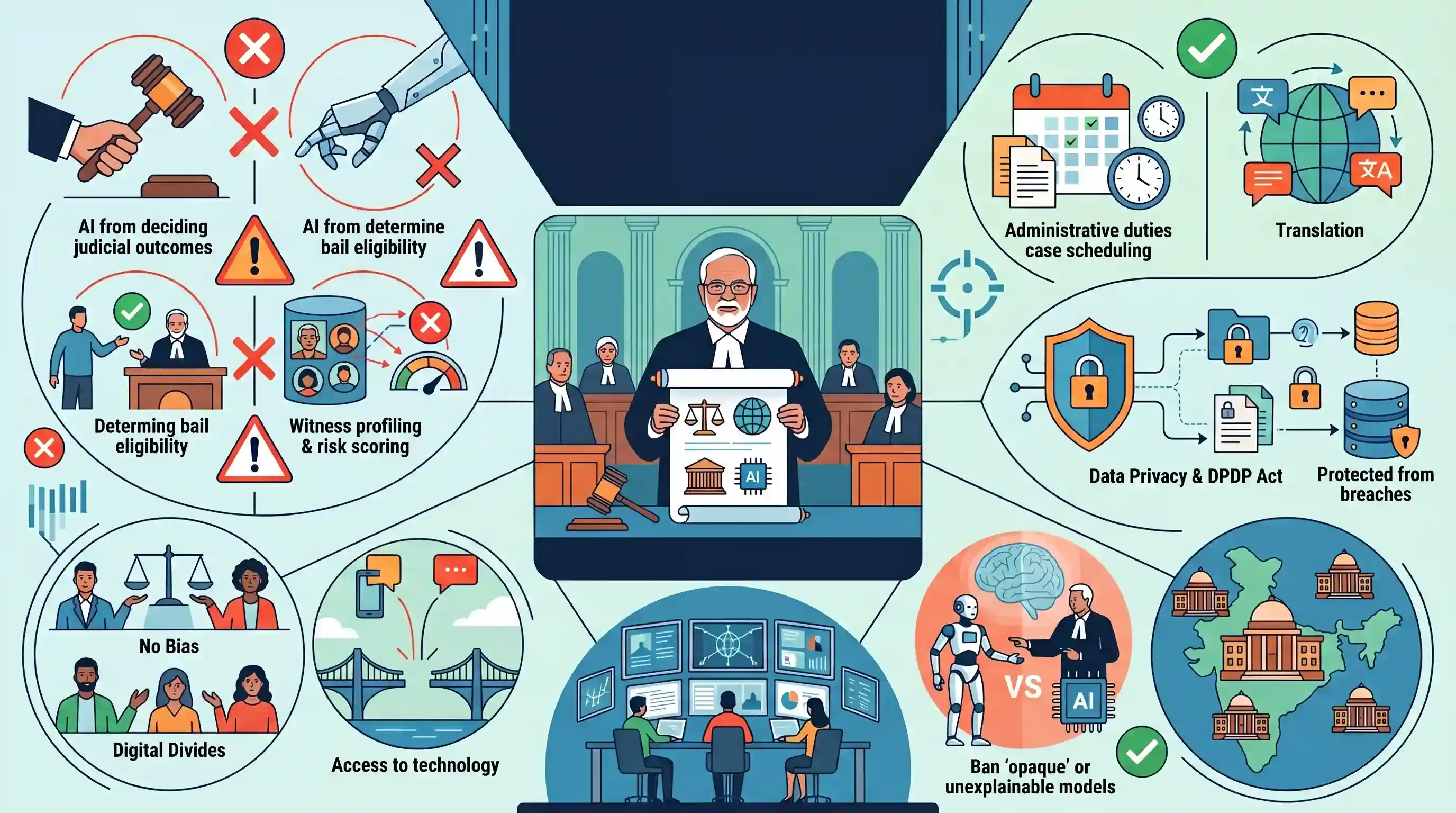
The Supreme Court AI committee, led by Justice P.S. Narasimha, has proposed the 'Regulations for Use of Artificial Intelligence (AI) in Courts, 2026' to set strict ethical and functional boundaries for AI in the judiciary. The draft rules firmly prohibit AI from deciding judicial outcomes, determining bail eligibility, or performing witness profiling and risk scoring. Emphasizing human oversight, the regulations state that AI must function solely in an assistive capacity and ban "opaque" or unexplainable models. While AI is permitted for administrative tasks like case scheduling and translation, its deployment must not introduce biases, widen digital divides, or violate the Digital Personal Data Protection Act, 2023. An apex body will be created to supervise AI integration across Indian courts.
Key Points
- The draft 'Regulations for Use of Artificial Intelligence (AI) in Courts, 2026' explicitly prohibit using AI for judicial outcomes, sentencing, predicting recidivism, or determining bail eligibility.
- AI systems are strictly banned from witness profiling, assessing credibility, and analyzing psychological traits or flight risk.
- The rules mandate that AI must serve strictly in an "assistive capacity" and remain entirely subservient to human judgment and oversight.
- "Opaque" or unexplainable AI models are forbidden; all algorithms must be transparent and non-discriminatory to prevent biases based on race, religion, or gender.
- AI can only be deployed for administrative and procedural tasks, including case management, scheduling, transcription, and translation of judgments.
- Data processing via AI must strictly comply with the Digital Personal Data Protection Act, 2023.
- An apex supervisory body at the Supreme Court level will be formed to oversee the adoption and integration of AI across the judiciary.
Important Terms
Regulations for Use of Artificial Intelligence (AI) in Courts, 2026

A proposed framework establishing ethical and functional boundaries for AI in the Indian judiciary, mandating AI remain subservient to human judgment and prohibiting its use for final judicial outcomes.
UPSC context
GS Paper II & III: Judicial reforms, E-governance, and ethics in technology. Tests understanding of technology’s role in justice delivery.
Digital Personal Data Protection (DPDP) Act, 2023
India’s primary legislation for digital data privacy, regulating how personal data is processed by entities (Data Fiduciaries) while granting rights like consent and erasure to individuals (Data Principals).
UPSC context
GS Paper II: Fundamental Rights (Article 21), Governance, and Privacy. Critical for topics on data sovereignty and legislative safeguards.
Supreme Court AI Committee
A specialized panel, led by Justice P.S. Narasimha, tasked with drafting rules and overseeing the adoption, development, and integration of artificial intelligence tools across Indian courts.
UPSC context
GS Paper II: Judiciary-led administrative reforms and the evolution of the E-Courts project.
Risk Scoring
The prohibited practice of using AI algorithms to predict an individual’s flight risk, recidivism (re-offending), or bail eligibility, often criticized for encoding systemic biases.
UPSC context
GS Paper II & IV: Ethical concerns in AI, criminal justice reform, and the Right to Equality (Article 14).
Human-in-the-Loop (HITL)
A mandatory requirement in the draft AI rules ensuring that no judicial decision or sentencing is finalized by an algorithm without independent evaluation and approval by a human judge.
UPSC context
GS Paper III: Technology ethics and accountability. Tests the concept of human agency in automated systems.
Apex Body (Judiciary AI)
The proposed national supervisory body at the Supreme Court responsible for setting standards, approving AI systems, and ensuring ethical compliance in technology adoption across the judiciary.
UPSC context
GS Paper II: Institutional frameworks for governance and judicial administration.
Prelims Trap
Under the new rules, AI algorithms can be used to predict recidivism and determine bail eligibility to reduce judicial pendency.
The rules strictly prohibit AI from determining bail, sentencing, or predicting recidivism; its use is completely restricted to administrative and procedural tasks.
Static Concepts Connected
What are the existing AI-driven initiatives under the Indian Judiciary?
- SUVAS: Supreme Court Vidhik Anuvaad Software (SUVAS) uses machine learning to translate judgments into vernacular languages.
- SUPACE: Supreme Court Portal for Assistance in Courts Efficiency assists judges with legal research, tracking case facts, and managing administrative loads.
- Assistive Mandate: Technology acts strictly as a facilitator to improve efficiency, preserving absolute judicial discretion and human oversight.
How does algorithmic bias challenge constitutional protections in India?
- Article 14 Violation: Opaque AI models (black boxes) produce decisions lacking transparent reasoning, which violates the test of non-arbitrariness under Article 14.
- Systemic Discrimination: Algorithms trained on historical data can replicate societal prejudices, leading to automated profiling based on caste, religion, or gender.
- Threat to Article 21: Automated risk-scoring for bail or sentencing without human override threatens the fundamental right to life and personal liberty.
Cross-Topic Patterns
AI Ethics + Article 14 Equality
The prohibition of "opaque" AI models directly connects tech ethics (GS4) to the Right to Equality (Article 14), preventing systemic algorithmic bias against marginalized communities.
Judicial Pendency + Tech Integration Limits
Highlights the tension in judicial reforms: while AI is aggressively pushed to reduce pendency via scheduling and translation, core adjudication and civil liberties (bail) remain strictly protected domains.

Expect a GS-2/GS-3 crossover question analyzing the ethical and constitutional limits of AI integration within India's judicial system.
Linked PYQs · 4
Linked PYQs · 4
- 2024MainsGS4
The application of Artificial Intelligence as a dependable source of input for administrative rational decision-making is a debatable issue. Critically examine the statement from the ethical point of view.
- 2020PrelimsGS1
With the present state of development, Artificial Intelligence can effectively do which of the following? 1. Bring down electricity consumption in industrial units 2. Create meaningful short stories and songs 3. Disease diagnosis 4. Text-to-Speech Conversion 5. Wireless transmission of electrical energy Select the correct answer using the code given below:
- 2023MainsGS3
Introduce the concept of Artificial Intelligence (AI). How does Al help clinical diagnosis? Do you perceive any threat to privacy of the individual in the use of Al in healthcare?
- 2023MainsGS2
e-governance, as a critical tool of governance, has ushered in effectiveness, transparency and accountability in governments. What inadequacies hamper the enhancement of these features ?
