Draft regulations on artificial intelligence use in courts
Source:The Hindu ↗
Why It Matters
The intersection of artificial intelligence and the judicial system is a critical emerging topic for UPSC. These draft rules highlight the ethical and legal challenges of AI, such as algorithmic bias, lack of transparency, and data privacy, while showcasing how technology can safely aid administrative efficiency (e-governance) without compromising judicial integrity and fundamental rights.
Summary
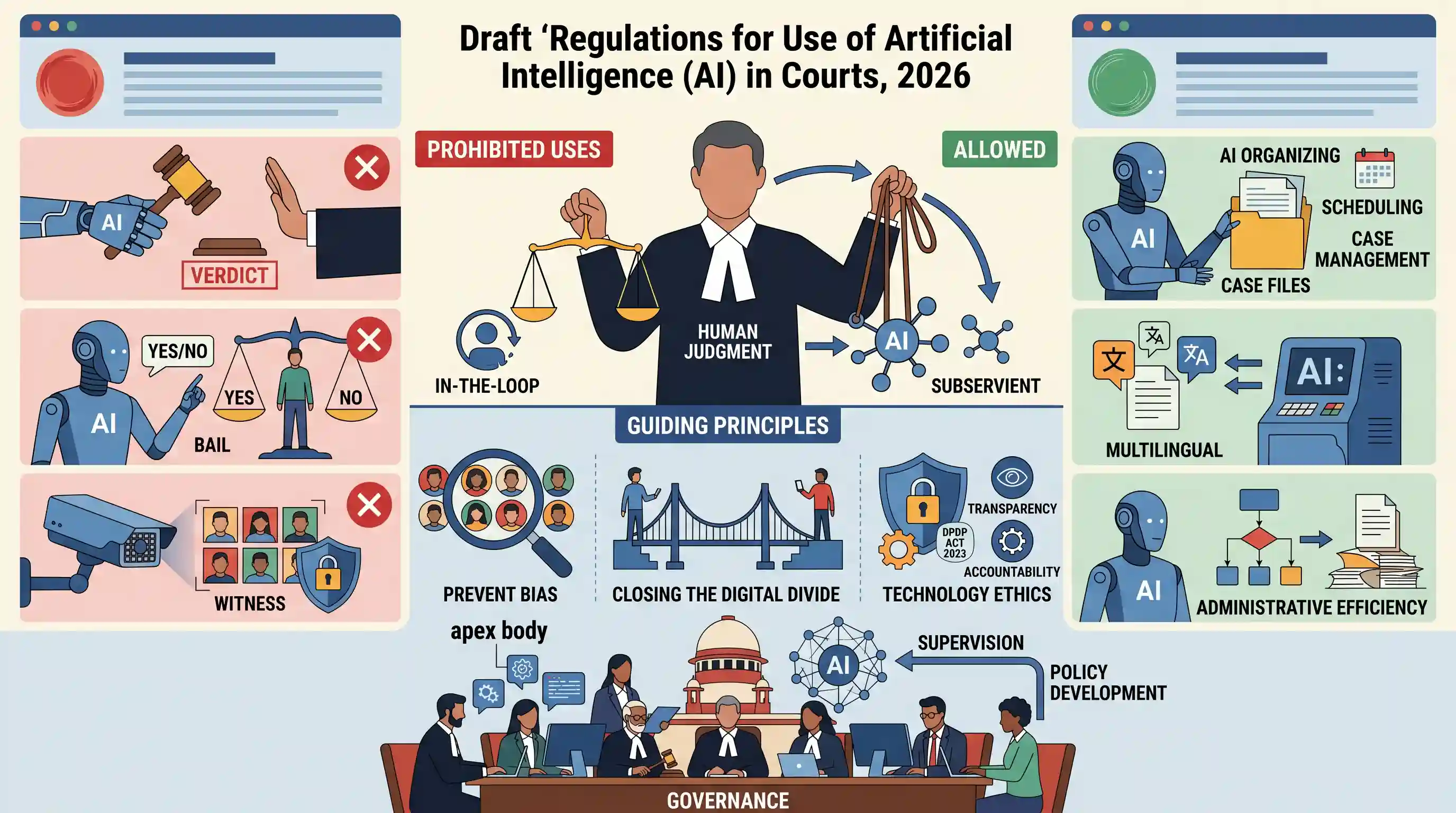
A Supreme Court committee has proposed draft 'Regulations for Use of Artificial Intelligence (AI) in Courts, 2026' that explicitly prohibit the use of AI for determining judicial outcomes, evaluating bail eligibility, or profiling witnesses. While allowing AI for administrative functions like case management and translation, the rules mandate that AI systems remain strictly subservient to human judgment. The draft emphasizes the prevention of algorithmic bias, safeguards against widening the digital divide, and compliance with the Digital Personal Data Protection Act, 2023. Additionally, it recommends creating an "apex body" at the Supreme Court, comprising judges and technology experts, to oversee AI adoption and policy in the judiciary.
Key Points
- The Supreme Court has released draft regulations prohibiting the use of AI for determining judicial outcomes, risk scoring, and witness profiling.
- AI systems in courts must function in an assistive capacity for administrative tasks like case management and translation, remaining subservient to human judgment.
- The regulations bar the use of opaque or unexplainable AI and prohibit algorithmic bias based on race, religion, gender, or economic status.
- Processing of personal data by AI in courts will be governed by the Digital Personal Data Protection Act, 2023.
- The draft proposes establishing a full-time "apex body" at the Supreme Court to supervise AI adoption, standard-setting, and policy development in the judiciary.
Important Terms
Regulations for Use of Artificial Intelligence (AI) in Courts, 2026

Proposed 2026 draft rules governing AI integration in the Indian judiciary, ensuring technology remains assistive, subservient to human judgment, and prohibited from making core judicial determinations like bail or sentencing.
UPSC context
GS Paper II (Judiciary/e-Governance) and GS III (AI Ethics); tests knowledge of technology's role in judicial reform.
Digital Personal Data Protection Act, 2023
India's landmark legislation establishing a framework for processing personal data, mandating consent, and protecting privacy; the draft court rules require all judicial AI systems to comply with its provisions.
UPSC context
GS Paper II (Government policies) and GS III (Data Privacy); critical for understanding India's digital legal architecture.
Supreme Court AI committee
A specialized panel, currently chaired by Justice P.S. Narasimha, responsible for drafting guidelines and overseeing the ethical adoption and technical auditing of AI tools within the Indian judicial system.
UPSC context
GS Paper II (Judiciary structure); relates to internal mechanisms for modernizing court administration and ensuring judicial independence.
Ministry of Electronics and Information Technology (MeitY)
The central government department responsible for IT policy; the draft regulations propose its representation in a new 'apex body' to coordinate technical standards for judicial AI.
UPSC context
GS Paper II (Executive/Ministries); relevant for inter-departmental cooperation in implementing digital India initiatives and emerging tech governance.
National Judicial Academy (NJA)
A premier institute in Bhopal for the continuing education of judges; its AI department head is designated as a key expert member in the proposed national judicial AI oversight body.
UPSC context
GS Paper II (Judiciary); significant for questions on judicial capacity building and training officers for 21st-century legal challenges.
Supreme Court of India
The highest judicial authority in India; through its AI committee, it issues regulations to safeguard constitutional values and prevent algorithmic bias in the justice delivery system.
UPSC context
GS Paper II (Judiciary); fundamental for understanding the apex court's role in law-making and administrative oversight.
Prelims Trap
"The Supreme Court allows AI to assist judges in evaluating bail eligibility to reduce judicial pendency."
The draft explicitly bars AI from evaluating bail, assessing risk, or profiling witnesses. AI in courts is strictly limited to administrative and translation tasks to ensure human oversight over liberty.
Static Concepts Connected
What are the existing AI and tech initiatives used by the Indian Judiciary?
- SUVAS: Machine learning tool that translates Supreme Court judgments into vernacular languages to improve access to justice.
- SUPACE: An AI-driven research assistant for judges designed to extract facts and manage case files without making judicial decisions.
- FASTER: A system for secure, electronic transmission of Supreme Court interim orders and bail judgments to prisons, avoiding release delays.
How does 'Algorithmic Bias' in AI conflict with Fundamental Rights?
- Article 14: Black-box AI models trained on historical data can perpetuate systemic discrimination based on caste or religion, violating the Right to Equality.
- Article 21: Automated risk-scoring for bail or sentencing risks arbitrary deprivation of personal liberty without explainable human reasoning or due process.
Cross-Topic Patterns
DPDP Act exemptions vs. Judicial AI rules
The DPDP Act 2023 exempts courts from certain obligations when processing data for judicial functions. However, these draft rules proactively align court AI systems with DPDP privacy standards.
Aligning with the EU AI Act
India's prohibition of AI for bail and risk-scoring mirrors the EU AI Act, which strictly categorizes judicial AI, biometric profiling, and automated predictive policing as 'high-risk' applications.

Expect a multi-statement question on e-courts combining SUVAS/SUPACE, the 2026 AI draft prohibitions, and the DPDP Act's exemptions.
Linked PYQs · 4
Linked PYQs · 4
- 2023MainsGS2
e-governance, as a critical tool of governance, has ushered in effectiveness, transparency and accountability in governments. What inadequacies hamper the enhancement of these features ?
- 2024MainsGS2
e-governance is not just about the routine application of digital technology in service delivery process. It is as much about multifarious interactions for ensuring transparency and accountability. In this context evaluate the role of the 'Interactive Service Model' of e-governance.
- 2023MainsGS3
Introduce the concept of Artificial Intelligence (AI). How does Al help clinical diagnosis? Do you perceive any threat to privacy of the individual in the use of Al in healthcare?
- 2024MainsGS2
Right to privacy is intrinsic to life and personal liberty and is inherently protected under Article 21 of the constitution. Explain. In this reference discuss the law relating to D.N.A. testing of child in the womb to establish its paternity.
