Education Policy: Draft Act To Regulate Private Coaching Classes
Source:scc-online ↗
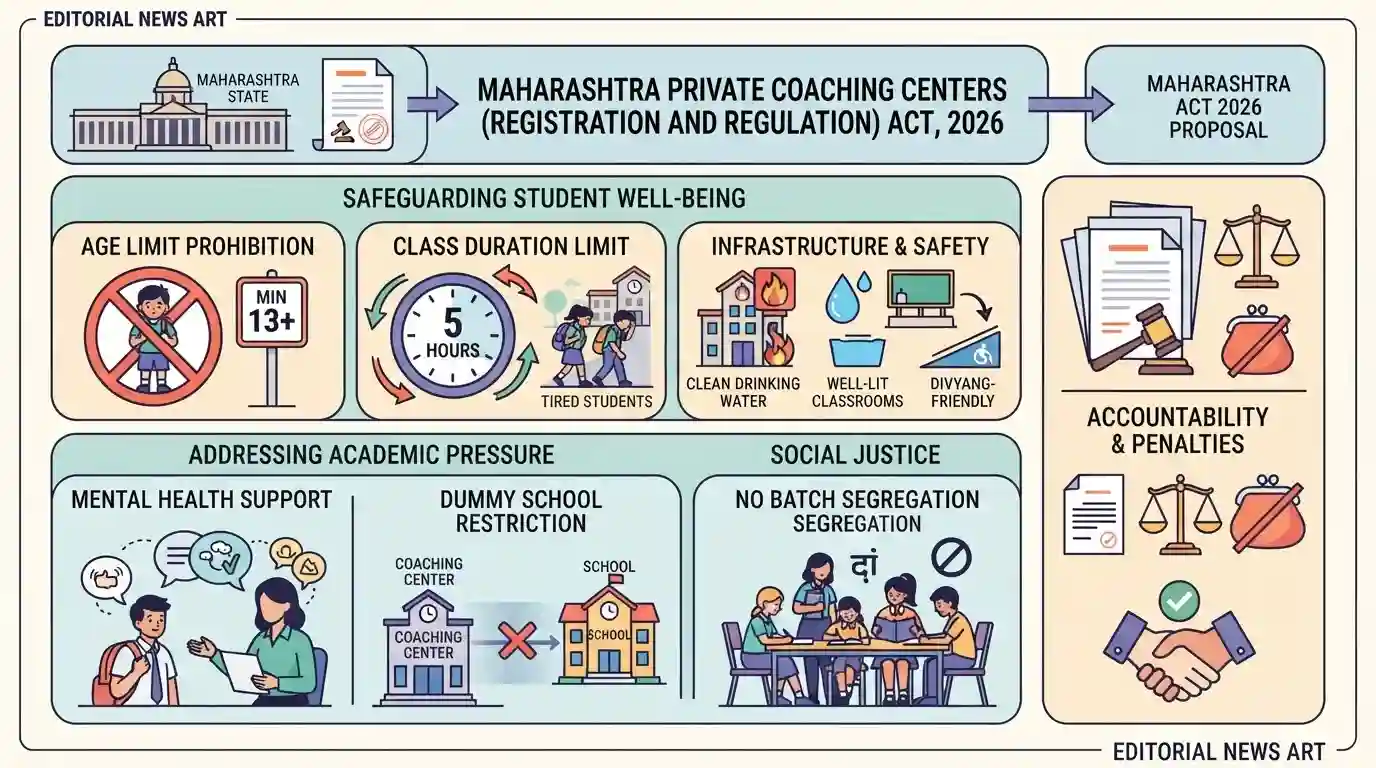
Why It Matters
The regulation of the private coaching industry is a major governance issue across India, dealing directly with educational quality, child rights, and mental health. This draft Act serves as a model for state intervention in unregulated sectors and highlights key themes for MPSC/UPSC questions regarding educational reforms, dummy schools, and student welfare policies.
Summary
The Maharashtra Government has proposed the Draft Maharashtra Private Coaching Centers (Registration and Regulation) Act, 2026, to bring accountability to the unregulated private coaching sector. The Act aims to safeguard students' physical and mental well-being by prohibiting the enrollment of children under 13, limiting daily classes to 5 hours, and enforcing strict infrastructure and safety standards, including Divyang-friendly facilities. It also addresses academic pressure by mandating mental health counselling, restricting 'dummy school' tie-ups, and prohibiting batch segregation based on academic performance. The draft prescribes substantial penalties for violations to ensure strict compliance.
Key Points
- The proposed Act bans the admission of students under the age of 13 in private coaching centers to reduce early academic pressure.
- Class duration is restricted to a maximum of 5 hours a day, and centers are required to ensure a mandatory weekly off for both students and tutors.
- The Act cracks down on 'dummy schools' by strictly prohibiting any integration or tie-ups between coaching centers and recognized schools/colleges.
- Coaching centers must establish robust mental health and counselling mechanisms, including aptitude assessments, to prioritize student wellbeing.
- Stringent infrastructure norms mandate a minimum space of 1 sq. meter per student, fire safety, CCTV surveillance, and Divyang-friendly premises.
- Violations can attract severe financial penalties ranging from Rs. 1 lakh for minor infractions up to Rs. 50 lakh for major non-compliance.
Important Terms
Draft Maharashtra Private Coaching Centers (Registration and Regulation) Act, 2026

Proposed 2026 legislation to regulate Maharashtra's private coaching industry by mandating registration, banning under-13 enrollments and dummy schools, capping classes to 5 hours, and enforcing safety norms.
UPSC context
GS Paper 2 (Education). Vital for understanding state-level educational reforms, student welfare initiatives, and the regulation of commercialized education.
Dummy School Model
An unethical educational practice where students formally enroll in recognized schools to meet board criteria but spend their academic time entirely at private coaching centers.
UPSC context
GS Paper 2 (Governance). Highlights loopholes in the formal education system and the need for stricter compliance with state board attendance norms.
Government of Maharashtra
The state executive authority in Maharashtra, currently proposing regulatory reforms like the Private Coaching Centers Act 2026 following controversies such as the NEET-UG paper leak.
UPSC context
GS Paper 2 (State Governance). Relevant for MPSC aspirants studying state-specific policy initiatives, regulatory frameworks, and government interventions in education.
Prelims Trap
Maharashtra's proposed Act prohibits coaching enrollment for students below 16 years of age.
Union Ministry of Education guidelines suggest 16 years, but the Maharashtra draft specifically bans enrollment for children under 13. Ensure you note which government's rule is asked.
Static Concepts Connected
How is legislative power over Education distributed in India?
- Concurrent List: Education was moved from the State List to the Concurrent List (Entry 25) by the 42nd Constitutional Amendment Act, 1976.
- RTE Act 2009: Operationalizes Article 21A, placing a duty on the State to provide free and compulsory education (ages 6-14) in a child-friendly environment, countering early coaching pressure.
What are the accessibility mandates under the RPwD Act, 2016?
- Barrier-Free Access: Public and private educational establishments must provide inclusive education and accessible, barrier-free physical infrastructure for Divyang students.
- Non-Discrimination: Prohibits discrimination in educational opportunities and mandates necessary learning accommodations, legally underpinning the draft's strict Divyang-friendly infrastructure rules.
Cross-Topic Patterns
Shadow Education & NEP 2020
Regulating private coaching aligns directly with NEP 2020's goal of shifting away from rote learning, high-stakes exam pressure, and the reliance on parallel "shadow education."
Center-State Concurrent Regulation
Contrasts with the Centre's 2024 guidelines (which ban under-16 enrollment), demonstrating state-level legislative adaptation on Concurrent List subjects like education.

Expect a comparative question distinguishing Maharashtra's draft rules (age 13 limit) from the Centre's 2024 coaching guidelines.
Linked PYQs · 2
Linked PYQs · 2
- 2024MPSC_PRELIMSGS1
Match the following pairs : | List-I | List-II | |---|---| | (a) Dr. Nitin Karmalkar Committee | (i) For implementation of National Education Policy - 2020 in Maharashtra | | (b) Nitin Karir Committee | (ii) To enquire the incident which happened during the distribution of Maharashtra Bhushan Award | | (c) Sunil Pawar Committee | (iii) To study why the rates of onion collapse. | | (d) Dr. K. Kasturirangan Committee | (iv) To make the syllabus for pre-primary to degree according to National Education Policy - 2020 | Code: (a) (b) (c) (d)
- 2025MPSC_PRELIMSGS1
Program/s implemented under the Integrated Child Development Services Scheme ________. A. Nutrition supplemental program B. Health check-up C. Worker's training D. Gender inequality
