Dr Surbhi Kumari empowers rural women through mushroom cultivation
Source:yourstory ↗
Why It Matters
Provides crucial case studies for BPSC Mains (GS Paper 2: Economy & Geography of Bihar, Social Justice) and Prelims on how civil society interventions can address systemic challenges like female workforce participation and agricultural diversification.
Summary
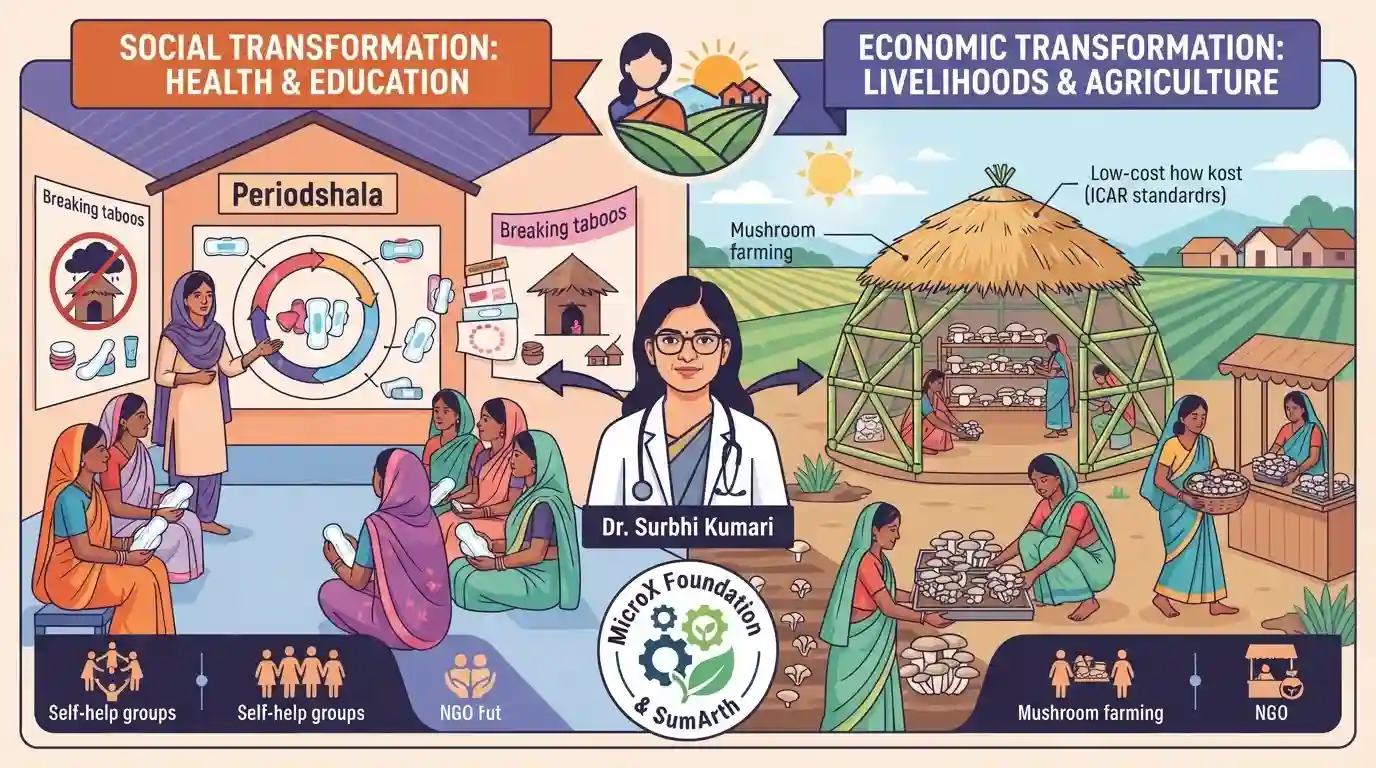
Dr. Surbhi Kumari is driving social and economic transformation for rural women in Bihar through dual initiatives focusing on menstrual health awareness and sustainable agriculture. Under her NGO, the MicroX Foundation, programs like Periodshala and SABLA combat entrenched period taboos. Simultaneously, her enterprise SumArth provides alternative livelihoods by teaching women to build low-cost, climate-friendly mushroom farming huts using local materials (bamboo and kusha grass) based on ICAR guidelines, helping to improve Bihar's rural female labor participation and economic independence.
Key Points
- Dr. Surbhi Kumari is leading initiatives in Bihar to break deep-rooted menstrual taboos through awareness campaigns like Periodshala, SABLA, and Pad Yatra under the MicroX Foundation.
- Through her social enterprise SumArth, she empowers rural women economically by introducing low-cost, climate-resilient mushroom farming.
- The mushroom cultivation uses locally available materials like bamboo and kusha grass, adhering to ICAR principles while significantly reducing water usage.
- The dual focus on health awareness and sustainable agriculture directly targets both the low female workforce participation rate and rural poverty in Bihar.
Important Terms
SumArth

A social enterprise co-founded by Dr. Surbhi Kumari promoting economic independence for marginalized rural women in Bihar. It provides training in low-cost, climate-friendly mushroom farming using local materials like bamboo and kusha grass.
UPSC context
GS Paper 3 (Agriculture) & GS Paper 1 (Women Empowerment). Highlights sustainable alternative livelihoods for rural female farmers.
Indian Council of Agricultural Research (ICAR)
An autonomous apex body under the Ministry of Agriculture established in 1929. It coordinates, guides, and manages agricultural research and education, promoting innovations like low-cost mushroom farming to boost rural incomes.
UPSC context
GS Paper 3 (Agricultural Technology/Institutions). Vital for understanding India's R&D framework driving sustainable agriculture and crop diversification.
Periodshala
A grassroots awareness campaign in Bihar aimed at breaking entrenched taboos surrounding menstruation. It fosters open community dialogues involving both men and women to educate rural populations about menstrual health and dignity.
UPSC context
GS Paper 2 (Health & Sanitation) & GS Paper 1 (Social Empowerment). Demonstrates community-led behavioral change in rural healthcare.
MicroX Foundation
An NGO operating in rural Bihar that drives social and economic transformation by integrating women's health initiatives with sustainable livelihood programs, bridging the gap between menstrual hygiene awareness and financial independence.
UPSC context
GS Paper 2 (Role of NGOs). Illustrates how civil society organizations effectively address intersecting socio-economic vulnerabilities in rural communities.
Pad Yatra
A community march initiative in rural Bihar designed to challenge menstrual stigma. By actively involving men, boys, and families, it normalizes conversations around menstruation and transforms public attitudes toward women's biological health.
UPSC context
GS Paper 1 (Society) & GS Paper 2 (Health Policy). Relevant as a successful grassroots methodology for destigmatizing public health issues.
SABLA
A menstrual health and social awareness program run by the MicroX Foundation in Bihar. Alongside Periodshala, it educates adolescent girls and communities, fostering female self-reliance and challenging traditional orthodoxies regarding women's bodies.
UPSC context
GS Paper 1 (Women Empowerment) & GS Paper 2 (Social Justice). Tests knowledge of targeted civil interventions for adolescent female health.
Prelims Trap
The recent surge in rural FLFPR indicates a successful shift of rural women into remunerative, formal enterprises.
While rural FLFPR has surged in recent PLFS data, it is predominantly driven by unpaid helper roles in household agriculture, not formal or remunerative jobs.
Static Concepts Connected
What drives the recent surge in India's rural Female Labour Force Participation Rate (FLFPR)?
- Sustained increase: PLFS data shows a consistent rise in rural female participation over the last five years, reversing earlier decades of declining trends.
- Unpaid family labor: The surge is heavily concentrated in self-employment, specifically as unpaid helpers in household agricultural enterprises, rather than formal, wage-paying jobs.
- Distress-driven work: Economists often attribute this rise to agrarian distress or the need to supplement household income, pushing women into auxiliary farming roles.
Why is mushroom cultivation considered a prime example of climate-resilient agriculture?
- High water efficiency: Cultivation requires minimal water compared to traditional crops, reducing vulnerability to erratic monsoons and severe groundwater depletion.
- Waste valorization: It thrives on agricultural residues (like straw, bamboo, and kusha grass), offering a productive, income-generating alternative to crop stubble burning.
- Land neutrality: Being an indoor, vertical-farming compatible crop, it provides high economic yields without placing additional stress on scarce, degradable arable land.
Cross-Topic Patterns
Micro-enterprises and Rural FLFPR
NGOs creating low-cost agriculture models (like mushroom huts) provide the missing link to transition rural women from unpaid family labor into genuinely remunerative self-employment (GS3).
Right to Dignity & Menstrual Health
Supreme Court rulings increasingly interpret Menstrual Hygiene Management (MHM) as intrinsic to Article 21, tying grassroots NGO awareness drives directly to core constitutional rights (GS2).

Expect a GS3 Mains question linking climate-resilient agriculture (like mushrooms) to shifting rural FLFPR and women's empowerment.
Linked PYQs · 5
Linked PYQs · 5
- 2025BPSC_PRELIMSGS1
According to PLFS 2023-24, which of the following statements best describe the nature of employment among women in Bihar?
- 2023BPSC_PRELIMSGS1
At what percentage has Bihar registered the lowest Female Workforce Participation Rate for the year 2020–2022?
- 2024-EBPSC_PRELIMSGS1
What is the contribution of agriculture in the Gross Domestic Product (GDP) of Bihar?
- 2022BPSC_PRELIMSGS1
Which type of banks is proposed to be established for agriculture and rural development in Bihar?
- 2022BPSC_PRELIMSGS1
The new ministry proposed in the Bihar Budget for the year 2021-22 focuses on
