Dr K Kasturirangan Legacy in Space Science and Education Policy
Source:Indian Express ↗
Why It Matters
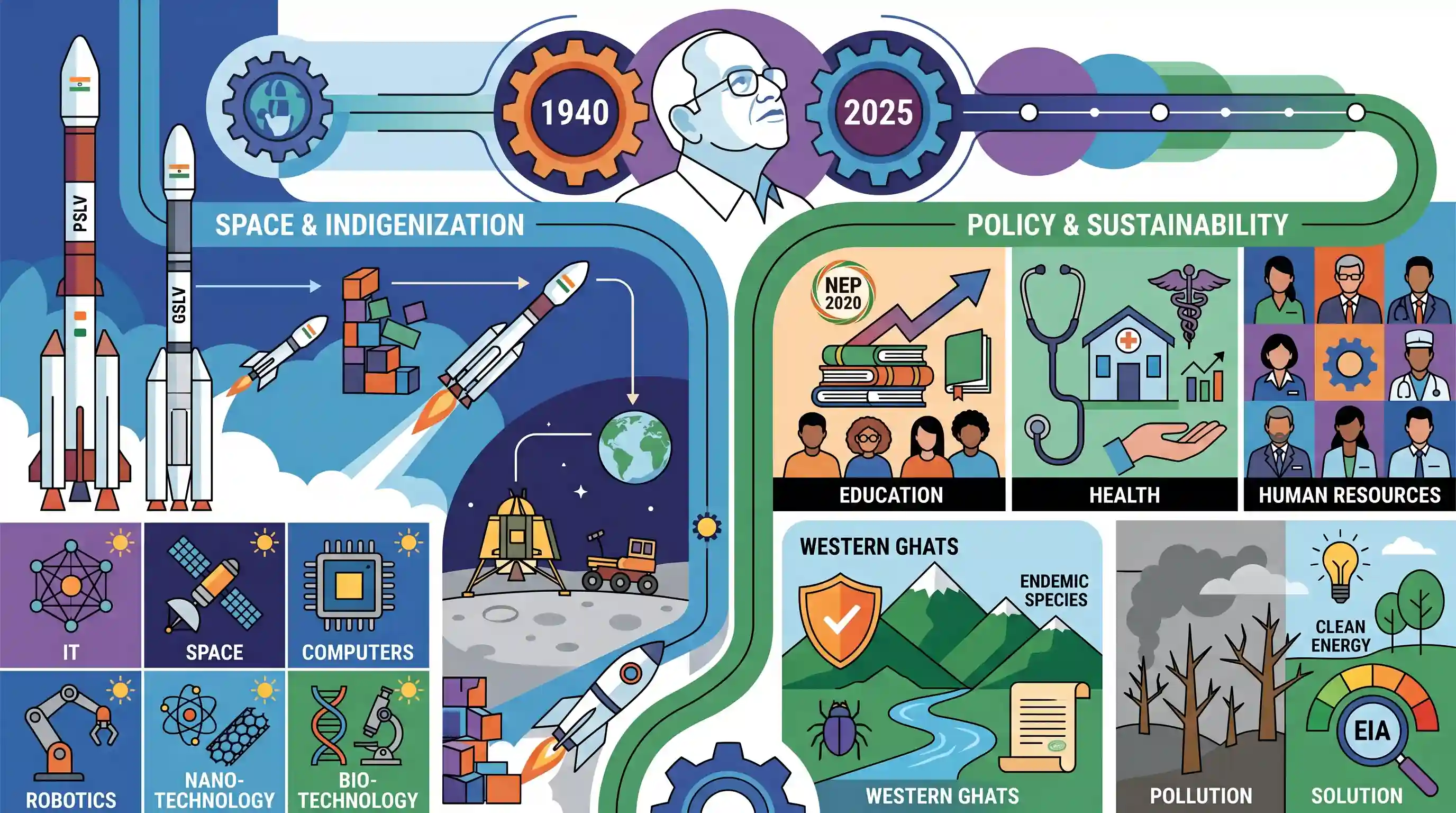
Dr. K. Kasturirangan is a towering figure in India's post-independence scientific and policy landscape. His life's work covers highly important UPSC syllabus areas: India's space achievements (GS3), the National Education Policy 2020 (GS2), and environmental conservation via the Western Ghats expert panel report (GS3). Understanding his contributions provides valuable context for essays, GS2, and GS3 answers.
Summary
An obituary and tribute to Dr. K. Kasturirangan (1940-2025), a visionary Indian space scientist who chaired ISRO from 1994 to 2003. The article highlights his leadership in operationalizing the PSLV and GSLV during a period of international technology denial. Beyond his monumental contributions to India's space capabilities and planetary exploration, his enduring legacy includes shaping the National Education Policy (NEP) 2020 and heading the High-Level Working Group on Western Ghats ecology.
Key Points
- Dr. K. Kasturirangan served as ISRO Chairman from 1994 to 2003, overseeing the operationalization of the PSLV and GSLV launch vehicles.
- He steered India's space program through a challenging period of international technology denial regimes and sanctions following the 1998 nuclear tests.
- Under his leadership, foundational work for India's planetary exploration missions, such as Chandrayaan-1, was laid out.
- Beyond space, he was instrumental in public policy, chairing the drafting committee for the National Education Policy (NEP) 2020.
- He also headed the High-Level Working Group on Western Ghats (Kasturirangan Committee) in 2012, which recommended measures to protect the ecologically sensitive region.
Important Terms
National Education Policy (NEP) 2020

A 2020 framework replacing the 1986 policy, introducing a 5+3+3+4 structure and emphasizing multidisciplinary learning, vocational integration, and 100% school enrollment by 2030.
UPSC context
GS Paper II (Social Sector/Education); tests understanding of systemic reforms in India's human resource development.
ISRO (Indian Space Research Organisation)
India's premier space agency responsible for space research and planetary exploration; Dr. Kasturirangan steered it (1994–2003) toward operational self-reliance and commercial satellite services.
UPSC context
GS Paper III (Science & Tech); tests knowledge of indigenization and space technology milestones.
Kasturirangan Committee (Western Ghats)
A high-level working group that recommended designating 37% of the Western Ghats as an Ecologically Sensitive Area (ESA) to balance biodiversity conservation with sustainable development.
UPSC context
GS Paper III (Environment); critical for comparing Gadgil vs. Kasturirangan approaches to ecological governance.
PSLV (Polar Satellite Launch Vehicle)
India's third-generation launch vehicle, often called the 'workhorse of ISRO,' used for placing satellites into Sun-Synchronous Polar Orbits.
UPSC context
GS Paper III (S&T); frequently tested in Prelims/Mains regarding payload capacity and launch success.
GSLV (Geosynchronous Satellite Launch Vehicle)
A heavy-lift launch vehicle designed to place communication satellites into Geostationary Transfer Orbits, utilizing complex cryogenic engine technology.
UPSC context
GS Paper III (S&T); tests technical understanding of satellite orbits and cryogenic propulsion.
Ecologically Sensitive Area (ESA)
Regions notified by the Ministry of Environment, Forest and Climate Change where developmental activities are restricted to protect unique biological diversity and ecosystems.
UPSC context
GS Paper III (Biodiversity); relevant for environmental impact assessments and conservation legislation.
Prelims Trap
"The Kasturirangan Committee recommended declaring the entire Western Ghats as an Ecologically Sensitive Area."
It was the Gadgil Committee that recommended the entire region be classified as an ESA. Kasturirangan diluted this, recommending only 37% be marked as ESA.
Static Concepts Connected
How did the Kasturirangan Committee differ from the Gadgil Committee?
- Gadgil's strict approach: The 2011 Gadgil panel recommended classifying the entire Western Ghats as an Ecologically Sensitive Area (ESA) with three strict graded zones.
- Kasturirangan's balanced approach: The 2012 Kasturirangan panel reduced the ESA to roughly 37% of the total area to balance conservation with sustainable development needs.
- Specific bans: It recommended a complete ban on mining, quarrying, sand mining, and highly polluting industries only within this 37% demarcated ESA.
What is cryogenic technology and why was its transfer denied to India?
- Cryogenic Engine: It involves using liquid oxygen and liquid hydrogen at extremely low temperatures to provide the high thrust needed for heavy-lift launch vehicles (GSLV).
- Tech Denial (MTCR): Under MTCR guidelines in 1992, the US pressured Russia to halt cryogenic engine tech transfer to India, citing dual-use missile proliferation concerns.
- Indigenous response: This denial catalyzed ISRO to develop its own Cryogenic Upper Stage (CUS) indigenously, a foundational milestone achieved during Kasturirangan's leadership era.
Cross-Topic Patterns
MTCR denial spurred Space Indigenization
Sanctions post-Pokhran II and MTCR restrictions on cryogenic technology forced ISRO to develop indigenous GSLV capabilities, converting geopolitical isolation into self-reliance.
Scientists shaping National Public Policy
Kasturirangan’s career demonstrates how scientific leadership bridges high-tech R&D with socio-economic frameworks, evident in his steering of both NEP 2020 and Western Ghats ecological zoning.

Expect a multi-statement Prelims question comparing Gadgil and Kasturirangan mandates, sparked by his demise and recent Kerala landslides.
Linked PYQs · 3
Linked PYQs · 3
- 2023MainsGS3
What is the main task of India's third moon mission which could not be achieved in its earlier mission? List the countries that have achieved this task. Introduce the subsystems in the spacecraft launched and explain the role of the Virtual Launch Control Centre' at the Vikram Sarabhai Space Centre which contributed to the successful launch from Sriharikota.
- 2020MainsGS2
National Education Policy 2020 is in conformity with the Sustainable Development Goal-4 (2030). It intends to restructure and reorient education system in India. Critically examine the statement.
- 2016PrelimsGS1
'Gadgil Committee Report' and 'Kasturirangan Committee Report', sometimes seen in the news, are related to
