Jaipur Bhatton Ki Gali Mega Coaching Terminal DPR
Source:indian-infrastructure ↗
Why It Matters
This represents a major infrastructure upgrade in Jaipur, the capital of Rajasthan. Questions regarding transport systems, railway zones (like the Jaipur-headquartered NWR), and mega developmental/green projects in Rajasthan are highly relevant for the RPSC RAS Prelims exam.
Summary
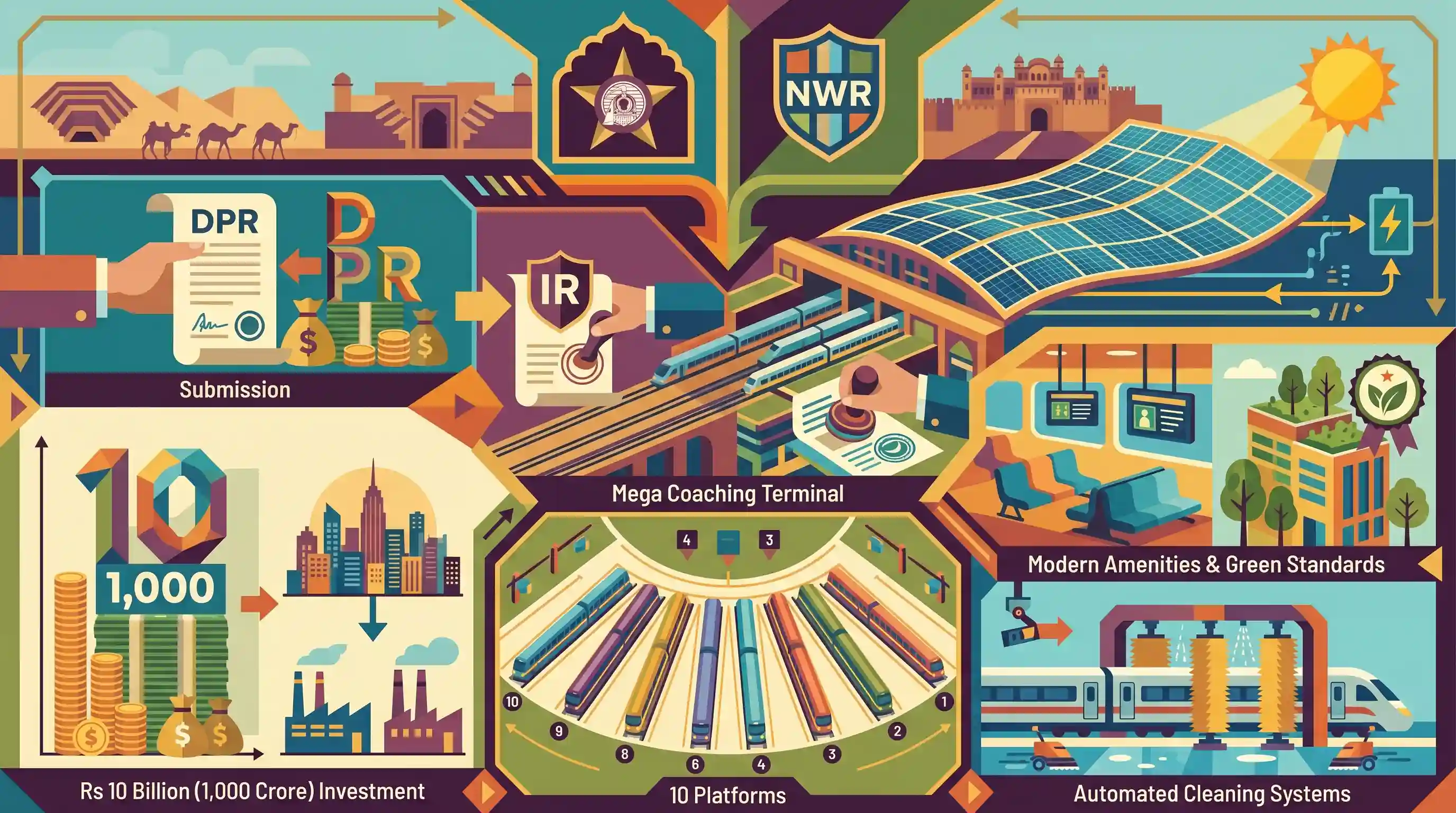
The North Western Railway (NWR) has submitted a Detailed Project Report (DPR) to Indian Railways for the approval of a Rs 10 billion (Rs 1,000 crore) Mega Coaching Terminal at Bhatton ki Gali railway station in Jahota, Jaipur. The proposed terminal aims to significantly upgrade regional rail infrastructure with 10 platforms, modern amenities, automated cleaning systems, solar power, and sustainable green building standards.
Key Points
- The North Western Railway (NWR) has submitted the Detailed Project Report (DPR) for the proposed Mega Coaching Terminal at Bhatton ki Gali railway station in the Jahota region of Jaipur to the Indian Railways for approval.
- The mega project is estimated to cost around Rs 10 billion (Rs 1,000 crore).
- The planned coaching terminal will feature approximately 10 platforms along with high-tech passenger amenities including modern waiting halls, digital displays, and advanced security/sanitation setups.
- The terminal is designed with green features, incorporating solar energy-based power systems, automated train and station cleaning mechanisms, and compliance with green building standards.
Important Terms
North Western Railway (NWR)

One of India's major railway zones, headquartered in Jaipur, Rajasthan. Established in 2002, it manages rail networks and transport logistics across Rajasthan, Gujarat, Haryana, and Punjab.
UPSC context
GS Paper III (Infrastructure: Railways); tests knowledge of regional rail zoning, transport logistics, and western India connectivity.
Indian Railways
A statutory body under the Ministry of Railways, Government of India, that operates the nation's railway system, representing one of the largest transport networks in the world.
UPSC context
GS Paper III (Infrastructure: Railways); tests understanding of public transport utilities, national connectivity networks, and capital expenditure policies.
Detailed Project Report (DPR)
A comprehensive plan outlining the operational, financial, and structural feasibility of a proposed infrastructure project, essential for securing technical appraisal, funding, and governmental approvals.
UPSC context
GS Paper III (Infrastructure, Investment Models); tests comprehension of project planning stages, financial feasibility, and public policy execution.
Mega Coaching Terminal
A high-capacity railway facility dedicated to passenger (coaching) trains, equipped with maintenance lines like pit and washing lines to ease congestion at major city stations.
UPSC context
GS Paper III (Infrastructure: Railways); tests understanding of capacity expansion, modernization of urban transport networks, and commuter decongestion.
Prelims Trap
Project Unigauge aims to convert all Indian railway tracks to Standard Gauge.
The project standardizes tracks specifically to Broad Gauge (1676 mm), not Standard Gauge (1435 mm), which is predominantly used for urban metro systems.
Static Concepts Connected
What are the primary railway track gauges in India and Project Unigauge?
- Track Gauges: Broad Gauge is 1.676m, Metre Gauge is 1.0m, and Narrow Gauge is 0.762m or 0.610m, determining speed and capacity.
- Project Unigauge: Launched in 1992 to convert metre/narrow gauge lines to broad gauge, reducing transshipment bottlenecks and unifying the national rail network.
What are the technical components of a railway maintenance terminal?
- Pit Lines: Concrete trenches built under tracks enabling technicians to inspect and repair coach undercarriages safely between train runs.
- Stabling Lines: Siding tracks utilized to park idle rakes securely, ensuring they do not block active mainline tracks.
- Sick Lines: Specialized maintenance tracks equipped with overhead cranes for undertaking major coach repairs or component replacements.
Cross-Topic Patterns
Green Buildings in Indian Railways
Integrating solar power and IGBC standards into rail terminals directly aligns with India's national goal of achieving Net Zero Carbon Emission by 2030.
Satellite Terminals and Urban Decongestion
Placing mega-coaching terminals outside main stations (like Jaipur) mirrors the transport-planning model used to de-clutter congested urban city centers.

The role of satellite coaching terminals and Project Unigauge's broad-gauge standardization likely to feature in upcoming infrastructure MCQs.
Linked PYQs · 2
Linked PYQs · 2
- 2021RPSC_PRELIMSGS1
'Green Energy Corridor' – Through which of the following districts will it pass in Rajasthan?
- 2025RPSC_PRELIMSGS1
The correct order of decreasing contribution of different sectors in Rajasthan’s Gross Fixed Capital Formation is
