DPIIT and GEAPP Partnership for Climate Tech Startups
Source:The Hindu ↗
Why It Matters
The partnership illustrates the growing synergy between state-led industrial promotion (DPIIT) and global climate finance (GEAPP) to achieve India's net-zero targets. It represents a practical mechanism to drive innovation in clean technology, addressing UPSC's focus on both entrepreneurship promotion and climate change mitigation strategies.
Summary
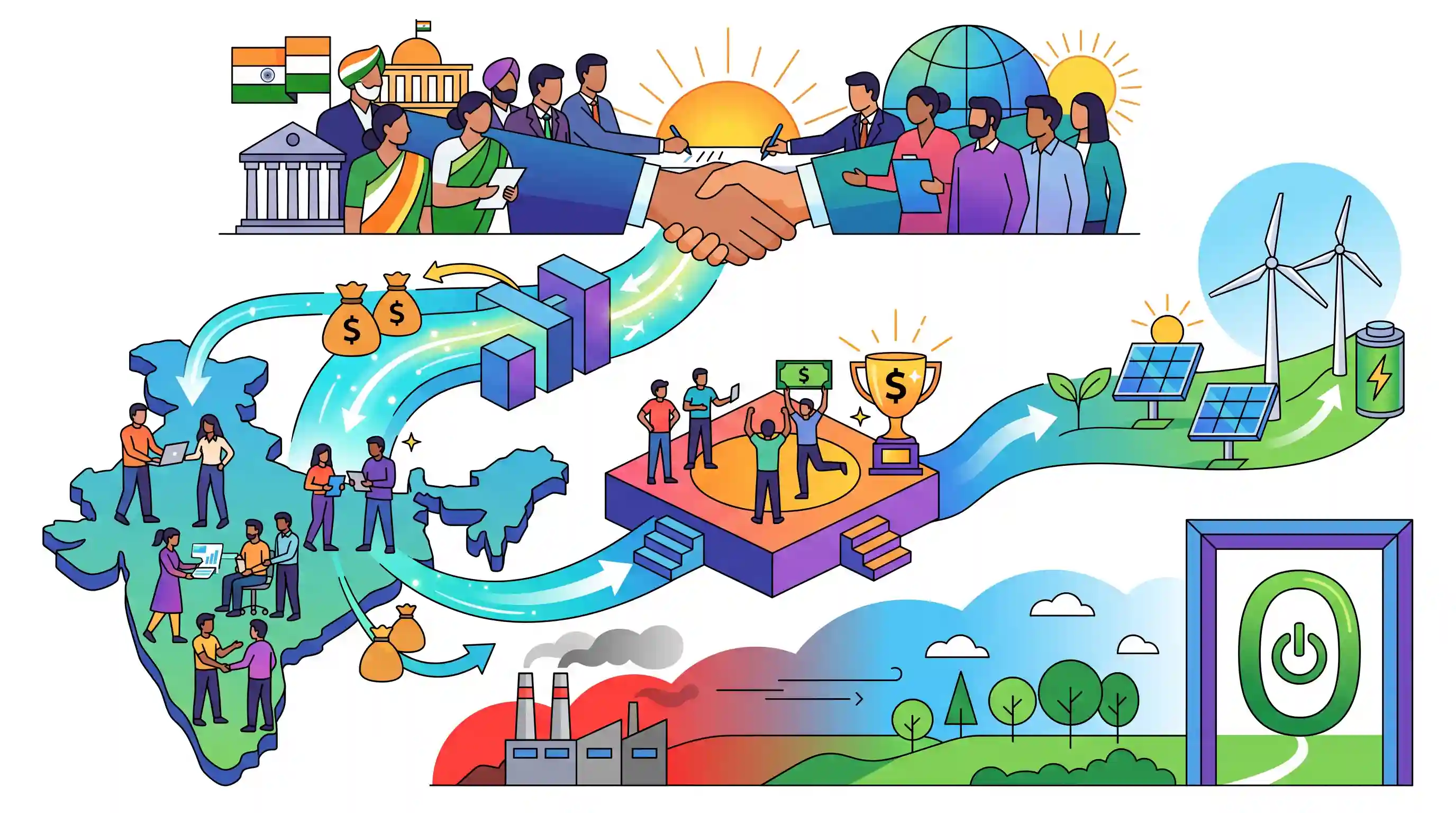
The Department for Promotion of Industry and Internal Trade (DPIIT) has signed an agreement with the Global Energy Alliance for People and Planet (GEAPP) to foster early-stage climate-tech startups in India. The collaboration focuses on providing crucial funding and mentorship to accelerate clean energy transitions in line with India's net-zero emissions targets. A key component of this partnership is the launch of the Energy Transitions Innovation Challenge (ENTICE) by GEAPP, which will award up to $500,000 to startups developing high-impact climate solutions. Investment partners like Spectrum Impact and Avana Capital are also involved to help facilitate capital deployment for the entrepreneurs.
Key Points
- The Department for Promotion of Industry and Internal Trade (DPIIT) has partnered with the Global Energy Alliance for People and Planet (GEAPP) to assist early-stage climate-tech startups.
- The alliance aims to support India's long-term net-zero objectives by funding scalable clean-technology solutions.
- GEAPP will launch the Energy Transitions Innovation Challenge (ENTICE), offering rewards up to $500,000 for high-impact climate innovations.
- Investment firms Spectrum Impact and Avana Capital will collaborate to facilitate access to funding for the selected startups.
Important Terms
Department for Promotion of Industry and Internal Trade (DPIIT)

A nodal department under the Ministry of Commerce and Industry responsible for industrial policy, investment promotion, and managing the 'Startup India' initiative to foster innovation.
UPSC context
GS Paper III: Economy/Industrial Policy. Tests knowledge of institutional frameworks driving India's startup ecosystem and industrial growth.
Global Energy Alliance for People and Planet (GEAPP)
A philanthropic alliance (launched at COP26 by foundations like Rockefeller and IKEA) that mobilizes capital and technology to accelerate clean energy transitions in emerging economies.
UPSC context
GS Paper III: Environment/Energy. Important for international collaborations in climate finance and renewable energy transition.
Energy Transitions Innovation Challenge (ENTICE)
GEAPP's flagship innovation platform in India that provides funding (up to $500,000), mentorship, and market linkages to early-stage climate-tech startups.
UPSC context
GS Paper III: S&T/Environment. Highlights specific initiatives aimed at bridging the funding gap for clean-energy innovation.
Climate-tech Startups
Startups developing hardware, software, or business model innovations specifically aimed at reducing greenhouse gas emissions or mitigating the effects of climate change.
UPSC context
GS Paper III: Environment. Relevant for discussing the role of technology and entrepreneurship in achieving sustainable development goals.
Spectrum Impact and Avana Capital
Impact investment partners that provide sector-specific expertise and capital deployment to help entrepreneurs scale clean-tech solutions under the ENTICE framework.
UPSC context
GS Paper III: Economy. Demonstrates the role of private impact capital in supporting public-interest climate initiatives.
Net-Zero Emissions Targets
The long-term goal of balancing greenhouse gas emissions with their removal from the atmosphere, which India has committed to achieve by the year 2070.
UPSC context
GS Paper III: Environment. Central to India's international climate commitments and domestic energy policy.
Prelims Trap
"GEAPP is a UN-led intergovernmental organization and the ENTICE challenge is administered by MNRE."
GEAPP is a philanthropic alliance (Rockefeller, IKEA, Bezos) launched at COP26, not a UN/World Bank body. Furthermore, the partnership is driven by DPIIT (Commerce), not MNRE.
Static Concepts Connected
What are the core targets of India's Panchamrit strategy?
- Capacity & Share: Achieve 500 GW of non-fossil energy capacity and meet 50% of energy requirements from renewables by 2030.
- Emission Cuts: Reduce total projected carbon emissions by one billion tonnes from now onwards till 2030.
- Carbon Intensity: Reduce the carbon intensity of the economy by more than 45% by 2030 (over 2005 levels).
- Net Zero: Achieve the target of net-zero emissions by the year 2070.
What is the role of DPIIT in the Indian startup ecosystem?
- Nodal Authority: Operates under the Ministry of Commerce and Industry as the nodal agency for implementing the 'Startup India' initiative.
- Tax Benefits: Grants the official 'Startup Recognition', which is mandatory for entities to claim income tax exemptions under Section 80-IAC.
- Capital Access: Oversees key capital pools including the Fund of Funds for Startups (FFS) and the Startup India Seed Fund Scheme (SISFS).
Cross-Topic Patterns
Rise of Philanthropic Climate Finance
UPSC increasingly tests non-state actors (e.g., RE100, EP100). GEAPP highlights the rise of blended finance, where philanthropic capital (Rockefeller, Bezos) de-risks early-stage climate tech for private investors.
Climate Action as Industrial Policy
DPIIT's involvement underscores a policy shift: viewing net-zero not just as an environmental compliance mandate (MoEFCC), but as a core driver for startup innovation, FDI, and industrial growth.

Expect a prelims question comparing climate alliances (GEAPP, ISA, CDRI), specifically testing their funding sources and state vs non-state status.
Linked PYQs · 3
Linked PYQs · 3
- 2025MainsGS3
How can India achieve energy independence through clean technology by 2047? How can biotechnology can play a crucial role in this endeavour?
- 2022MainsGS3
Do you think India will meet 50 percent of its energy needs from renewable energy by 2030 ? Justify your answer. How will the shift of subsidies from fossil fuels to renewables help achieve the above objective ? Explain.
- 2016PrelimsGS1
With reference to 'Stand Up India Scheme', which of the following statements is/are correct? 1. Its purpose is to promote entrepreneurship among SC/ST and women entrepreneurs. 2. It provides for refinance through SIDBI. Select the correct answer using the code given below.
