Digital Personal Data Protection Act Compliance Costs for Ed Tech
Source:The Hindu ↗
हे का महत्त्वाचे आहे
This issue illustrates the core governance challenge of balancing fundamental rights (such as privacy under Article 21) with economic dynamism and digital inclusion. Understanding the compliance bottlenecks of the DPDP Act for sectors like ed-tech is vital for analyzing Indian regulatory frameworks, the startup ecosystem, and state policies regulating children's digital safety.
सारांश
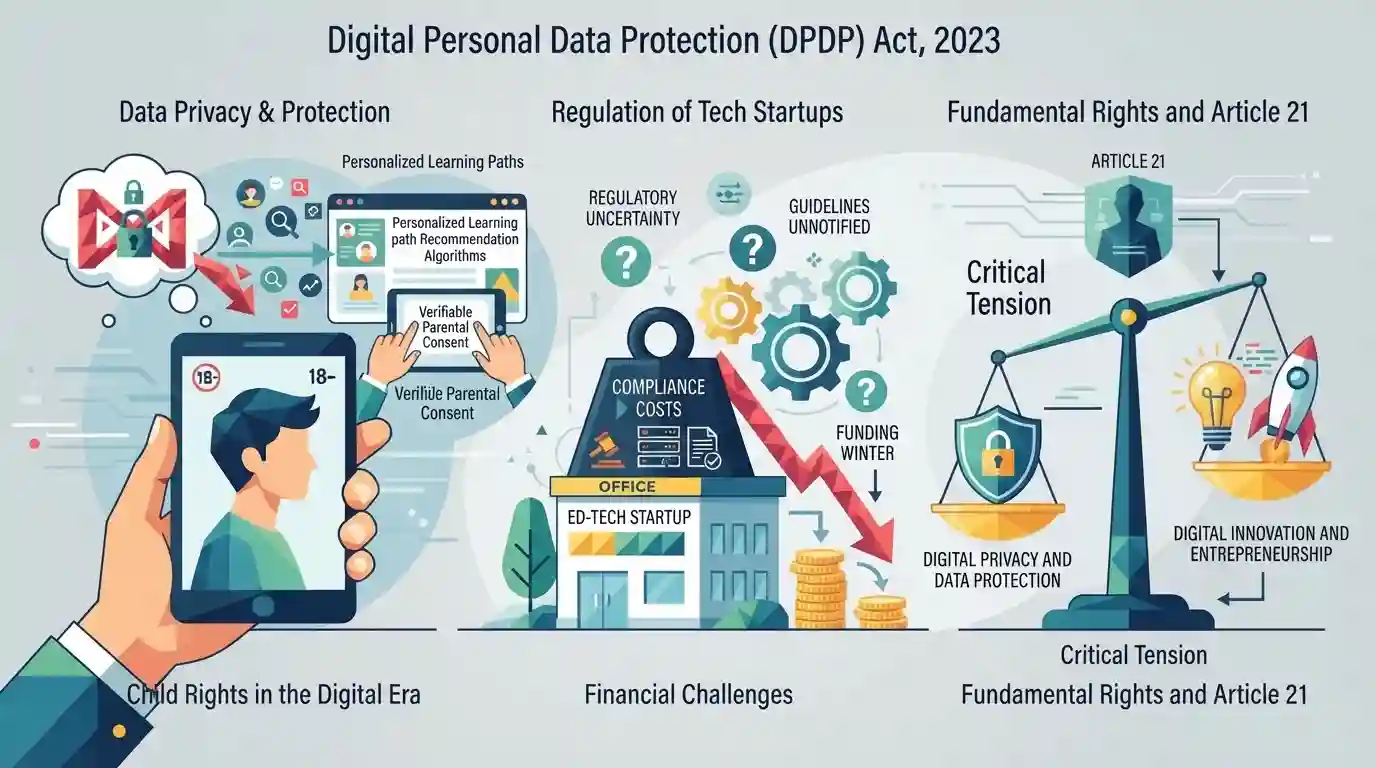
This article analyzes the profound operational and financial challenges the Digital Personal Data Protection (DPDP) Act, 2023 poses for India's ed-tech sector. The law's strict mandates—such as defining childhood up to age 18, requiring verifiable parental consent, and banning behavioral tracking—disrupt the customized learning features that drive ed-tech platforms. Startups, already reeling from a funding winter, face high compliance costs (legal, technical, and auditing) and regulatory uncertainty as detailed guidelines remain unnotified. This creates a critical tension between protecting children's fundamental right to digital privacy and fostering digital innovation and entrepreneurship.
मुख्य मुद्दे
- The Under-18 Consent Threshold: Unlike global standards like the USA's COPPA (under 13) and Europe's GDPR (13–16 years), India's DPDP Act, 2023, sets the threshold for childhood at 18. This places the entire K-12 consumer segment of the ed-tech market under strict consent regimes.
- Ban on Behavioral Tracking: The DPDP Act prohibits behavioral monitoring, tracking, or targeted advertising directed at children. Since many ed-tech platforms rely on algorithms to track progress and deliver personalized recommendations, this ban disrupts core educational technology models.
- The 'Double Privacy' Paradox: To obtain 'verifiable parental consent,' ed-tech companies may be forced to collect even more sensitive personal data (such as parent-child Aadhaar linking or government-issued IDs) to verify relationships, inadvertently increasing the risk of data breaches and violating data minimization principles.
- Prohibitive Compliance Costs: Adhering to the law requires appointing Data Protection Officers (DPOs), deploying consent-manager architectures, and conducting regular privacy audits. For bootstrapped and early-stage ed-tech startups struggling during the 'funding winter', these compliance costs are highly restrictive.
- Regulatory Uncertainty: While the DPDP Act was enacted in August 2023, the specific rules outlining the actual technical mechanism for obtaining 'verifiable consent' are still awaited, leaving businesses in a costly state of limbo and over-preparation.
- Market Consolidation and Innovation Risk: High barriers to entry and crushing compliance costs may stifle grassroot digital innovation, forcing smaller startups to shut down or merge, thereby concentrating market share in the hands of a few cash-rich, established players.
महत्त्वाच्या संज्ञा
Digital Personal Data Protection Act, 2023

A landmark Indian law regulating the processing of digital personal data. It balances individuals' right to protect their data (as Data Principals) with organizations' need to process it for lawful purposes (as Data Fiduciaries).
UPSC context
GS Paper II (Government Policies) & Paper III (Cybersecurity). Tests knowledge of digital privacy, individual rights, and regulatory challenges.
Data Protection Board of India (DPBI)
An independent, digital-first adjudicatory body established under the DPDP Act, 2023. It is responsible for handling user complaints, investigating data breaches, directing corrective actions, and imposing financial penalties for non-compliance.
UPSC context
GS Paper II (Statutory/Regulatory Bodies). Tests understanding of institutional mechanisms enforcing data protection and resolving user grievances.
General Data Protection Regulation (GDPR)
The European Union's comprehensive data privacy and security regulation. It sets a global standard by granting individuals broad rights over their personal data and imposing strict compliance obligations on global organizations.
UPSC context
GS Paper II (International Policies & Laws). Tests ability to comparatively analyze domestic legislation with global privacy benchmarks.
Ministry of Electronics and Information Technology (MeitY)
The nodal ministry of the Government of India responsible for formulating IT policies, electronics manufacturing, digital infrastructure, cybersecurity, and notifying detailed rules under the DPDP Act, 2023.
UPSC context
GS Paper II (Government Policies). Tests comprehension of the executive's role in digital governance and tech-sector policy administration.
National Commission for Protection of Child Rights (NCPCR)
An Indian statutory body established under the Commissions for Protection of Child Rights Act, 2005. It works under the Ministry of Women and Child Development to safeguard, promote, and defend child rights nationwide.
UPSC context
GS Paper II (Statutory Bodies/Vulnerable Sections). Tests knowledge of agencies safeguarding children's rights, including digital privacy and safety.
पूर्वपरीक्षा सापळा
DPDP Act permits profiling and behavioral tracking of children as long as verifiable parental consent is successfully obtained beforehand.
Section 9 of the DPDP Act imposes an absolute ban on tracking or profiling children; obtaining parental consent does not override this absolute prohibition.
संबंधित स्थिर संकल्पना
What is the 'Data Minimization' principle under data protection jurisprudence?
- Core definition: Limits personal data collection strictly to what is necessary and relevant for the declared purpose of processing.
- Judicial backing: Established as a key element of the proportionality test in the landmark Puttaswamy privacy judgment (2017).
- Current conflict: Clashes with DPDP age verification mandates, which require collecting extra personal identifiers to verify parental links.
What is the role of the Data Protection Board of India?
- Status and setup: Functioning as an independent, statutory adjudicatory body established directly under the DPDP Act, 2023.
- Core mandate: Empowered to investigate personal data breaches, resolve user grievances, and levy heavy financial penalties.
- Appellate mechanism: Orders of the DPBI are appealable before the Telecom Disputes Settlement and Appellate Tribunal (TDSAT).
आंतर-विषय नमुने
Privacy regulations vs. digital education access
Strict digital verification rules under DPDP could inadvertently exclude children lacking standard government IDs, creating a friction point with Article 21A rights.
Ease of doing business vs. tech regulation
High compliance costs and steep penalty structures risk driving startup consolidation, favoring deep-pocketed conglomerates and impacting digital market competitiveness.

Comparative analysis of DPDP, GDPR, and COPPA age thresholds and absolute bans on tracking is highly likely in upcoming Prelims.
संबंधित PYQ · 3
संबंधित PYQ · 3
- 2025MainsGS2
The National Commission for Protection of Child Rights has to address the challenges faced by children in the digital era. Examine the existing policies and suggest measures the Commission can initiate to tackle the issue.
- 2024MainsGS2
Right to privacy is intrinsic to life and personal liberty and is inherently protected under Article 21 of the constitution. Explain. In this reference discuss the law relating to D.N.A. testing of child in the womb to establish its paternity.
- 2024PrelimsGS1
Under which of the following Articles of the Constitution of India, has the Supreme Court of India placed the Right to Privacy ?
