Iran Macroeconomic Instability Spurs Nationwide Unrest
Source:Indian Express ↗
Why It Matters
Iran's domestic stability and geopolitical posture directly influence the stability of the Middle East, global energy markets, and India's strategic and economic interests in the region (including energy security and connectivity projects like Chabahar Port).
Summary
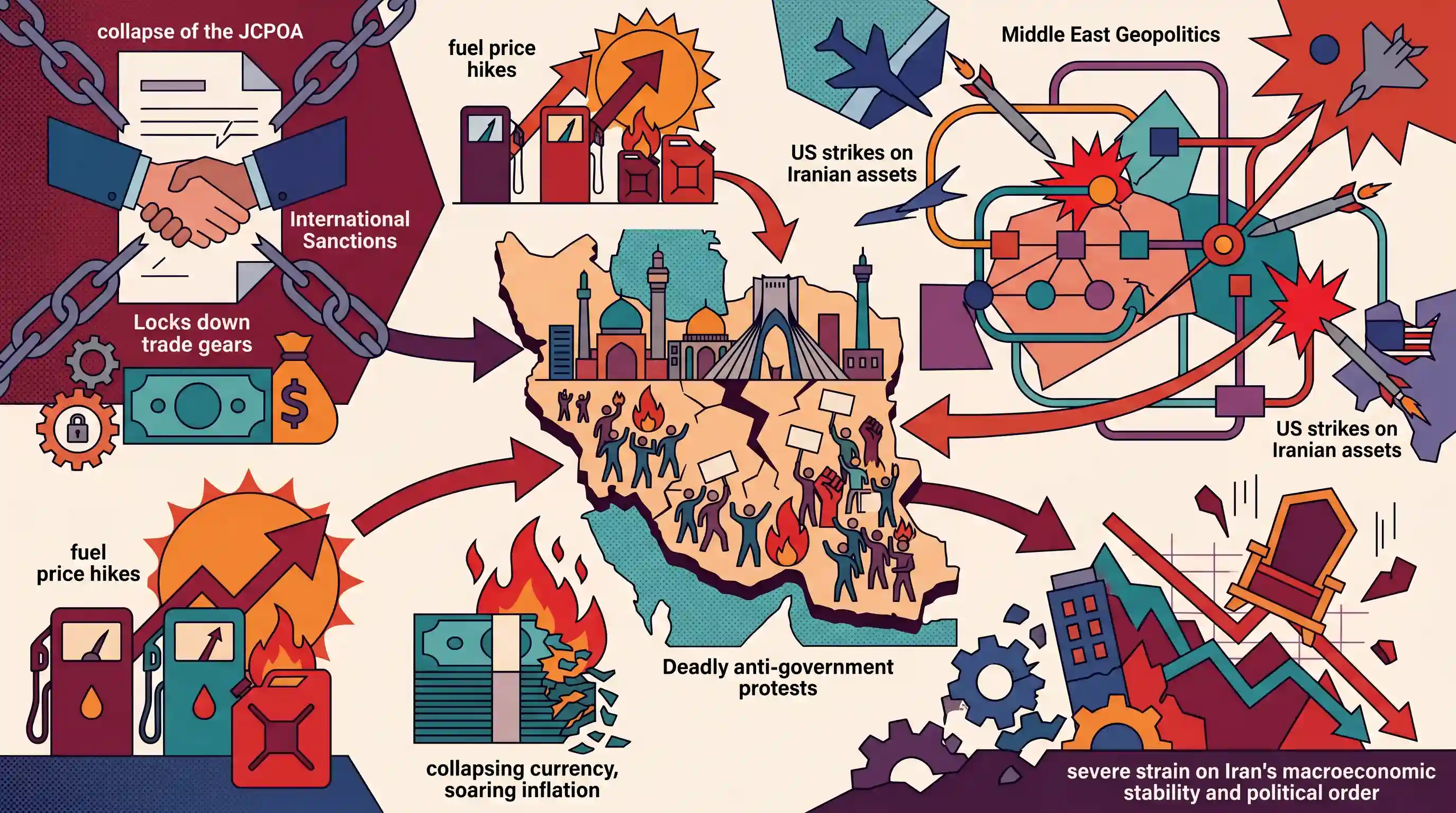
Deadly anti-government protests have erupted across Iran, driven by soaring inflation, fuel price hikes, and a collapsing currency. The economic crisis is deeply rooted in severe international and US sanctions, notably stemming from the collapse of the JCPOA. This domestic unrest is further aggravated by recent Middle Eastern geopolitical turmoil, including Israel's military actions against the Iran-backed 'Axis of Resistance' and US strikes on Iranian assets, severely straining Iran's macroeconomic stability and political order.
Key Points
- Over 50 people have died in anti-government protests in Iran, triggered by soaring fuel prices and severe economic hardship.
- The Iranian economy is grappling with high inflation and a plunging Rial, severely exacerbated by stringent US and international sanctions.
- Iran's domestic instability is compounded by recent regional geopolitical shocks, including Israel's conflicts with the 'Axis of Resistance' and recent US military strikes on Iranian targets.
- The crisis highlights the profound impact of international sanctions and geopolitical isolation on a nation's macroeconomic stability and domestic peace.
Important Terms
Joint Comprehensive Plan of Action (JCPOA)

A 2015 landmark agreement between Iran and the P5+1 (US, UK, France, Russia, China + Germany) to limit Iran's nuclear program in exchange for economic sanctions relief.
UPSC context
GS-II (International Relations); tests nuclear diplomacy, regional stability, and the impact of multilateral agreements on India’s energy security.
Axis of Resistance
An informal Iran-led coalition of militant and political groups (including Hezbollah, Hamas, and Houthis) aiming to counter Western and Israeli influence in the Middle East.
UPSC context
GS-II (West Asia Geopolitics); tests understanding of non-state actors, proxy warfare, and regional security dynamics affecting Indian interests.
Hezbollah
A Lebanese Shiite militant group and political party founded in 1982 with Iranian support; it is the most powerful non-state member of the Axis of Resistance.
UPSC context
GS-II (International Relations); tests knowledge of Middle Eastern security architecture and the role of ideological movements in regional conflict.
Hamas
A Palestinian Sunni Islamist organization that has governed the Gaza Strip since 2007; it receives significant financial and military support from Iran.
UPSC context
GS-II (International Relations); relevant for the Israel-Palestine conflict and its broader implications for regional peace and West Asian stability.
International Sanctions
Coercive economic measures, such as the US 'maximum pressure' campaign, used to isolate a country’s financial and energy sectors, leading to inflation and currency devaluation.
UPSC context
GS-II & GS-III (International Relations & Economy); tests understanding of coercive diplomacy and its macroeconomic impact on global trade.
Macroeconomic Stability
The resilience of an economy against shocks, characterized by low inflation, steady growth, and a stable currency—currently compromised in Iran due to sanctions and unrest.
UPSC context
GS-III (Economy); tests ability to link geopolitical events to domestic economic indicators like inflation and fiscal health.
Prelims Trap
"Iran's ongoing macroeconomic collapse is primarily driven by UN Security Council sanctions."
The UN lifted many sanctions under the 2015 JCPOA. The current crippling economic blockade is driven by unilateral US sanctions (like CAATSA) reinstated after 2018, not multilateral UN mandates.
Static Concepts Connected
What is the geographic and economic significance of the Strait of Hormuz?
- Location: It connects the Persian Gulf to the Gulf of Oman and Arabian Sea, separating Iran to the north from Oman (Musandam peninsula) to the south.
- Economic role: It facilitates approximately 20% of global petroleum trade and major LNG exports, making it an indispensable chokepoint for global energy security.
How do international sanctions trigger currency collapse and hyperinflation?
- Forex depletion: Sanctions restrict export earnings and freeze offshore assets, leading to a severe shortage of foreign exchange (like US dollars) within the targeted economy.
- Imported inflation: The severe scarcity of dollars causes the domestic currency to plunge. This makes imported essentials exponentially more expensive, driving runaway domestic inflation.
Cross-Topic Patterns
CAATSA + India's Energy Security
US withdrawal from JCPOA and CAATSA implementation forced India to halt cheap Iranian oil imports. This shifted India's energy diplomacy, leading to massive crude procurement from Russia in recent years.
Chokepoints + Axis of Resistance
Iran’s 'Axis of Resistance' strategy links proxy groups across the region, giving Tehran indirect leverage over multiple maritime chokepoints, including the Strait of Hormuz (Iran) and Bab el-Mandeb (Houthis).

Expect a Prelims map question pairing Middle East proxies (Houthis, Hezbollah) with their bordering seas or maritime chokepoints in 2026.
Linked PYQs · 4
Linked PYQs · 4
- 2025MainsGS2
"Energy security constitutes the dominant kingpin of India's foreign policy, and is linked with India's overarching influence in Middle Eastern countries.” How would you integrate energy security with India's foreign policy trajectories in the coming years?
- 2018MainsGS3
How would the recent phenomena of protectionism and currency manipulations in world trade affect macroeconomic stability of India?
- 2024PrelimsGS1
Consider the following statements : Statement-I : Sumed pipeline is a strategic route for Persian Gulf oil and natural gas shipments to Europe. Statement-II : Sumed pipeline connects the Red Sea with the Mediterranean Sea. Which one of the following is correct in respect of the above statements?
- 2018MainsGS2
“India’s relations with Israel have, of late, acquired a depth and diversity, which cannot be rolled back.” Discuss.
