Middle East Military Conflict and Global Crude Oil Price Shocks
Source:The Hindu ↗
Why It Matters
The Middle East is a vital region for global energy security and hosts a massive Indian diaspora. Escalations involving drone warfare and the targeting of critical infrastructure (like oil refineries and desalination plants) directly threaten global macroeconomic stability, push up crude oil prices, and pose serious geopolitical challenges for India's strategic calculations and energy imports.
Summary
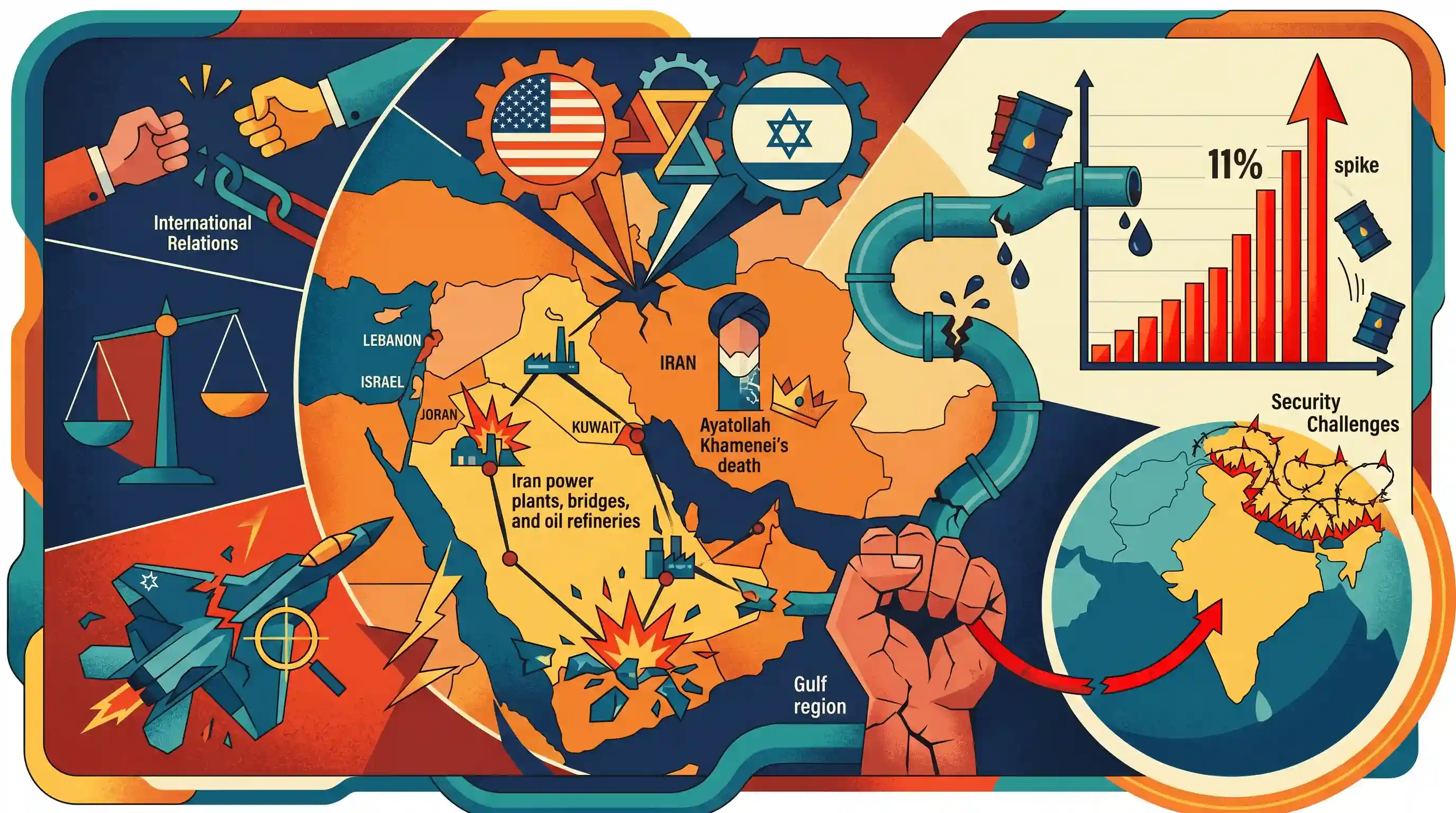
The intensifying military confrontation between the United States, Israel, and Iran has escalated into a regional crisis, marked by the downing of U.S. warplanes and a hunt for a missing American pilot. Widespread missile and drone strikes have targeted critical infrastructure across the Middle East, including power plants, bridges, and oil refineries in Iran, Kuwait, and Lebanon. The conflict has reportedly resulted in the death of Iran's Supreme Leader Ayatollah Ali Khamenei and has triggered a global energy crisis, causing a sharp 11% spike in global oil prices. The situation threatens to severely destabilize the Gulf region, heavily impacting global energy supply chains.
Key Points
- An escalating military confrontation between the US and Iran led to the downing of two American warplanes (an F-15E and an A-10 Warthog) and a search for a missing US pilot by the IRGC.
- The conflict has severely impacted regional critical infrastructure, including strikes on a Kuwaiti power and desalination plant, the Mina al-Ahmadi oil refinery, and the B1 bridge linking Tehran and Karaj.
- Aerial interceptions of missiles and drones have been reported across the Gulf and Levant, involving airspace over Dubai, Abu Dhabi, Saudi Arabia, and near Haifa, Israel.
- Global oil prices surged by 11% due to fears of an impending energy crisis and massive disruptions to Middle Eastern oil supply chains.
- The widespread violence has caused thousands of casualties, reportedly including Iran’s Supreme Leader Ayatollah Ali Khamenei, while Israel continues strikes against Hezbollah in Lebanon.
Important Terms
Islamic Revolutionary Guard Corps (IRGC)

A primary branch of Iran's Armed Forces, established in 1979 to protect the Islamic system. It operates independently of the regular military, controlling elite units and vast economic interests.
UPSC context
GS Paper II (International Relations); critical for understanding West Asian stability and India's energy security in the Gulf.
Hezbollah
A Lebanon-based Shia Islamist militant group and political party backed by Iran. Founded in 1982, it is a key member of the "Axis of Resistance" and a major regional paramilitary force.
UPSC context
GS Paper II (International Relations); essential for analyzing the Israel-Lebanon conflict and its impact on regional security.
Kuwait Petroleum Corp
Kuwait's state-owned national oil company responsible for managing the country's hydrocarbon resources, including exploration, production, and refining. It is a major player in global energy supply chains.
UPSC context
GS Paper III (Energy Security); vital as a primary source of crude oil and LNG for India's economy.
Red Crescent
The name used by the International Red Cross movement in Muslim countries. It provides humanitarian aid, disaster relief, and medical assistance during conflicts, adhering to the Geneva Conventions.
UPSC context
GS Paper II (International Issues); significant for international humanitarian law and disaster management in conflict-prone regions.
Prelims Trap
"The Levant region encompasses the countries bordering the Persian Gulf, including Kuwait and Iran."
The Levant historically refers to the Eastern Mediterranean shores (Lebanon, Syria, Israel, Jordan). The Persian Gulf is a distinct sub-region. UPSC often swaps these West Asian geographical groupings.
Static Concepts Connected
What are the key maritime chokepoints for Middle Eastern oil exports?
- Strait of Hormuz: Between Iran and Oman, connecting the Persian Gulf to the Arabian Sea. It is the world's most critical oil transit chokepoint.
- Bab el-Mandeb: Located between Yemen and Djibouti/Eritrea, linking the Red Sea to the Gulf of Aden and the Indian Ocean.
- Suez Canal: An artificial waterway in Egypt connecting the Red Sea to the Mediterranean Sea, crucial for European energy markets.
How do global crude oil price spikes impact India's macroeconomic stability?
- Widening CAD: India imports over 80% of its crude oil. Higher prices inflate the import bill, directly widening the Current Account Deficit (CAD).
- Imported Inflation: Elevated fuel prices increase transportation and logistics costs across the economy, driving up both wholesale and retail inflation.
- Rupee Depreciation: A higher import bill increases domestic demand for US dollars, putting downward pressure on the Indian Rupee.
Cross-Topic Patterns
Energy Security + Strategic Petroleum Reserves
Middle Eastern supply chain disruptions heavily underscore the urgent need to expand India's Strategic Petroleum Reserves (SPRs) to insulate the economy from sudden global energy shocks.
Asymmetric Warfare + Critical Infrastructure
The use of drones by state and non-state actors to disable Kuwaiti desalination plants highlights the modern vulnerability of civilian critical infrastructure to asymmetric warfare.

Expect a 2026 Prelims question linking West Asian map locations (Levant vs. Gulf) directly to India's macroeconomic indicators like CAD.
Linked PYQs · 5
Linked PYQs · 5
- 2025MainsGS2
"Energy security constitutes the dominant kingpin of India's foreign policy, and is linked with India's overarching influence in Middle Eastern countries.” How would you integrate energy security with India's foreign policy trajectories in the coming years?
- 2017MainsGS2
The question of India's Energy Security constitutes the most important part of India's economic progress. Analyze India's energy policy cooperation with West Asian countries.
- 2023MainsGS3
The use of unmanned aerial vehicles (UAVs) by our adversaries across the borders to ferry arms/ammunitions, drugs, etc., is a serious threat to the internal security. Comment on the measures being taken to tackle this threat.
- 2022PrelimsGS1
The term "Levant" often heard in the news roughly corresponds to which of the following regions?
- 2023PrelimsGS1
Consider the following pairs: Regions often mentioned in news Reason for being in news 1. North Kivu and Ituri : War between Armenia and Azerbaijan 2. Nagorno-Karabakh : Insurgency in Mozambique 3. Kherson and Zaporizhzhia : Dispute between Israel and Lebanon How many of the above pairs are correctly matched?
