New Delhi Hosts Seventh Colombo Security Conclave Meeting
Source:The Hindu ↗
Why It Matters
The Colombo Security Conclave is a critical component of India's maritime diplomacy and its 'SAGAR' vision. It aims to build a robust security architecture in the Indian Ocean Region against non-traditional threats while implicitly checking external strategic influences (like China's expanding footprint). Understanding its member composition and core pillars is important for both Prelims (IR groupings) and Mains (maritime security and neighborhood policy).
Summary
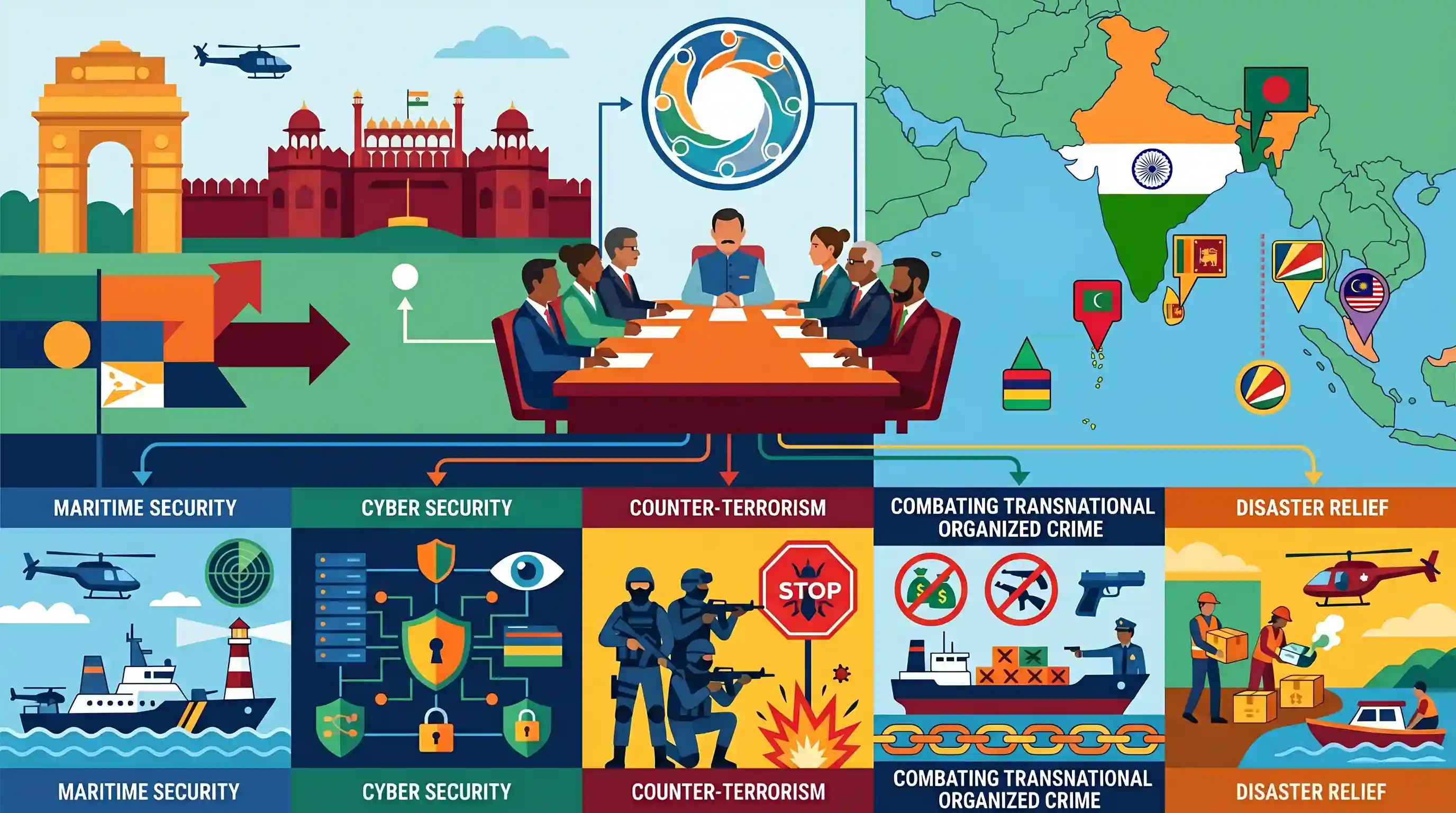
National Security Adviser Ajit Doval hosted the 7th NSA-level meeting of the Colombo Security Conclave (CSC) in New Delhi. The security grouping, which focuses on the Indian Ocean Region, welcomed Seychelles as its newest full member, bringing the total membership to six countries alongside India, Sri Lanka, Maldives, Mauritius, and Bangladesh. Malaysia also participated for the first time as a guest country. The discussions centered on enhancing regional cooperation across five core pillars, including maritime security, cyber security, counter-terrorism, combating transnational organized crime, and disaster relief. The expansion of the CSC highlights India's ongoing efforts to institutionalize regional security cooperation and cement its role as a net security provider in the Indian Ocean under the broader SAGAR vision.
Key Points
- The 7th NSA-level meeting of the Colombo Security Conclave (CSC) was held in New Delhi, hosted by India's NSA Ajit Doval.
- Seychelles joined the CSC as a full member, expanding the grouping to six member states (India, Sri Lanka, Maldives, Mauritius, Bangladesh, Seychelles), while Malaysia attended as a guest country.
- Discussions focused on assessing the security situation in the Indian Ocean Region and addressing shared security challenges.
- The member states prioritized collaboration across five pillars: maritime safety and security, counter-terrorism, combating transnational organized crime, cyber security, and humanitarian assistance and disaster relief (HADR).
Important Terms
Colombo Security Conclave (CSC)

A regional security grouping for the Indian Ocean (members: India, Sri Lanka, Maldives, Mauritius, Bangladesh, Seychelles) focusing on maritime safety, counter-terrorism, and cyber security.
UPSC context
GS-2: International Relations. Tests understanding of regional security architecture and India's neighborhood-first diplomacy.
SAGAR (Security and Growth for All in the Region)
India’s strategic vision for the Indian Ocean, emphasizing cooperative security, sustainable economic development, and protecting shared maritime interests through collective action and capacity building.
UPSC context
GS-2: International Relations. Crucial for questions on India's maritime strategy and diplomatic outreach.
Net Security Provider
A role India fulfills in the Indian Ocean, proactively addressing regional security concerns through military assistance, disaster relief, and infrastructure support for neighboring nations.
UPSC context
GS-2/GS-3: Security. Evaluates India's leadership capacity and strategic responsibility as a regional power.
Indian Ocean Region (IOR)
The strategic maritime space and its littoral states, vital for global trade, energy routes, and India's security interests against non-traditional threats.
UPSC context
GS-1: Geography; GS-2: International Relations. Key to analyzing global trade chokepoints and maritime geopolitics.
Transnational Organized Crime
Coordinated profit-driven criminal activities crossing national borders—such as drug trafficking and human smuggling—that require regional cooperation like the CSC to combat effectively.
UPSC context
GS-3: Internal Security. Tests awareness of non-traditional security challenges and international policing cooperation.
Maritime Security
The protection of maritime interests, including territorial integrity, marine resources, and the safety of shipping lanes from piracy, illegal fishing, and state aggression.
UPSC context
GS-3: Security. Relevant for India's coastal defense, blue economy, and international maritime law.
Prelims Trap
"The Colombo Security Conclave includes all Indian Ocean littoral states and is headquartered in New Delhi."
CSC is a targeted minilateral of six specific nations (India, Sri Lanka, Maldives, Mauritius, Bangladesh, Seychelles) with its permanent secretariat in Colombo, not New Delhi.
Static Concepts Connected
What does India's SAGAR doctrine signify for the Indian Ocean Region?
- Net Security Provider: Positions India as a credible first responder for regional crises, anti-piracy operations, and HADR missions.
- Capacity Building: Focuses on strengthening the coast guard and naval capabilities of island and littoral neighbors through training and hardware sharing.
- Economic Integration: Links maritime security directly with sustainable economic growth, trade connectivity, and blue economy initiatives across the IOR.
Which other major institutional frameworks govern Indian Ocean maritime security?
- IORA: The apex inter-governmental organization (23 member states) focused on broad regional economic and security cooperation.
- IONS (Naval Symposium): A voluntary, inclusive initiative that seeks to increase maritime cooperation and interoperability among the navies of IOR littoral states.
- IFC-IOR: Based in Gurugram, it serves as a regional hub coordinating maritime domain awareness and white shipping information sharing.
Cross-Topic Patterns
Shift towards issue-based minilaterals
CSC's expansion underscores India's shift from paralyzed regional bodies like SAARC to agile, issue-specific minilaterals that yield operational results in maritime security and intelligence sharing.
Undersea cables and cyber security
CSC's inclusion of cyber security as a core pillar highlights the growing intersection of maritime control and the protection of critical digital infrastructure, such as submarine internet cables.

A multi-statement Prelims question comparing the memberships, origins, and specific mandates of CSC, IORA, and IONS is highly probable in 2026.
Linked PYQs · 4
Linked PYQs · 4
- 2024MainsGS2
Discuss the geopolitical and geostrategic importance of Maldives for India with a focus on global trade and energy flows. Further also discuss how this relationship affects India's maritime security and regional stability amidst international competition ?
- 2023MainsGS2
‘Sea is an important Component of the Cosmos’ Discuss in the light of the above statement the role of the IMO (International Maritime Organisation) in protecting environment and enhancing maritime safety and security.
- 2022MainsGS3
Discuss the types of organised crimes. Describe the linkages between terrorists and organised crime that exist at the national and transnational levels.
- 2020MainsGS3
Discuss different types of cyber crimes and measures required to be taken to fight the menace.
