Indian Officials Visit China for SCO Security Meetings
Source:The Hindu ↗
Why It Matters
The article is crucial for tracking the trajectory of India-China relations post-LAC clashes, understanding the strategic utility of platforms like SCO and BRICS, and analyzing how Middle East conflicts (energy security, trade) shape the geopolitical calculations of Asian powers.
Summary
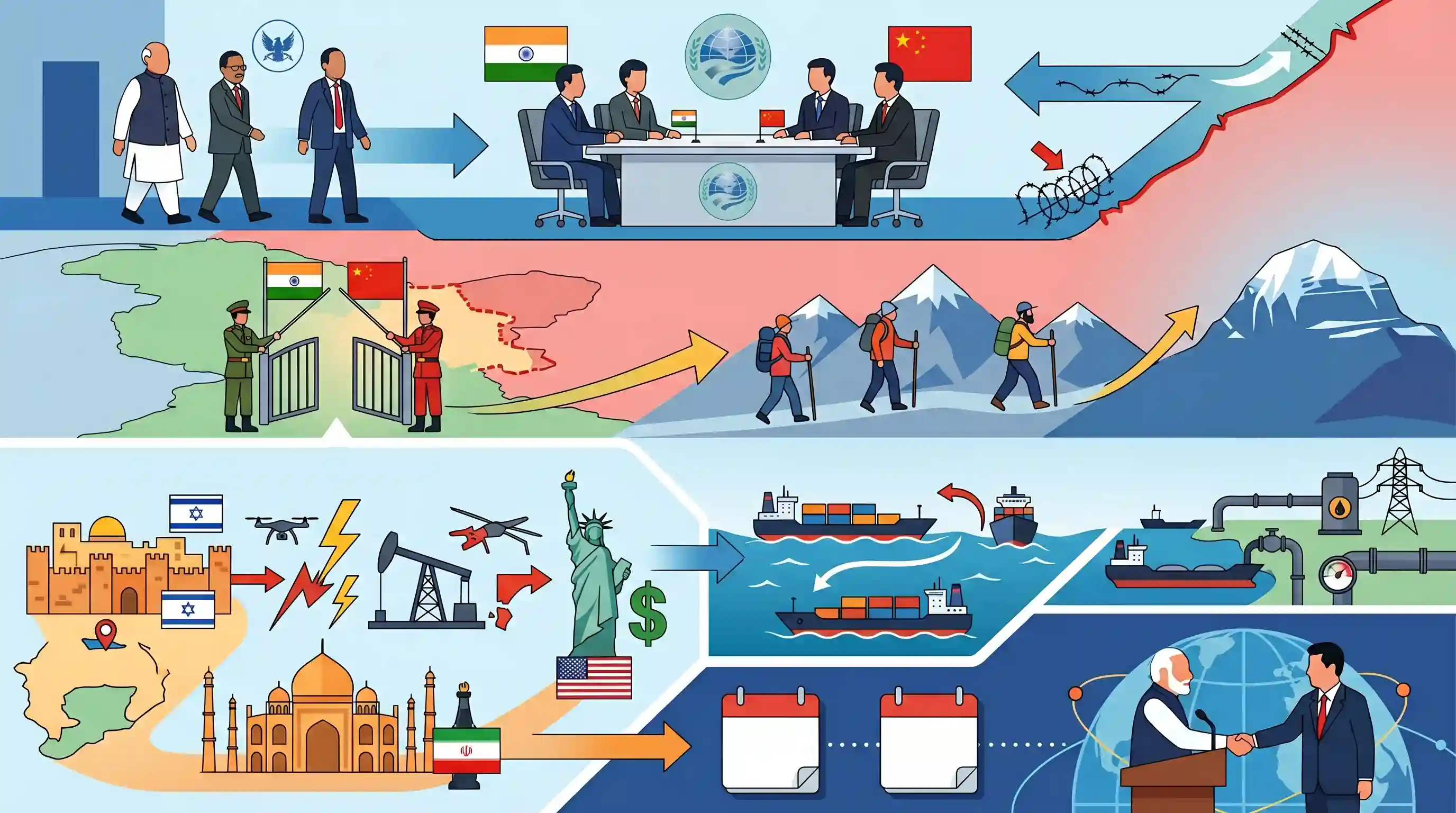
National Security Adviser Ajit Doval and Defence Minister Rajnath Singh are visiting China to participate in Shanghai Cooperation Organisation (SCO) meetings, marking a significant step in the normalisation of India-China bilateral relations. The easing of border tensions along the Line of Actual Control (LAC) has led to concrete developments, including the resumption of the Kailash Mansarovar Yatra via the Lipulekh and Nathu La passes after six years. The SCO agenda will navigate complex geopolitical issues, particularly the implications of the ongoing Middle East conflict (involving Israel, Iran, and the US) on global trade and energy security. This engagement sets the stage for potential bilateral interactions between Prime Minister Modi and President Xi Jinping at the upcoming BRICS and SCO summits.
Key Points
- NSA Ajit Doval and Defence Minister Rajnath Singh are undertaking significant visits to China for SCO meetings, signaling a high-level diplomatic re-engagement.
- The easing of India-China ties post-LAC standoff is further marked by the resumption of the Kailash Mansarovar Yatra through the Lipulekh and Nathu La passes after a six-year halt.
- The SCO meetings, encompassing the RATS mechanism, will deliberate on the geopolitical fallout of the recent Israel-US strikes on Iranian facilities and its impact on regional energy security and trade.
- Diplomatic momentum is expected to culminate in potential bilateral meetings between PM Modi and President Xi Jinping at the upcoming BRICS summit in Brazil and the SCO summit in Tianjin.
Important Terms
Shanghai Cooperation Organisation (SCO)

A permanent intergovernmental organization founded in 2001, comprising ten members including India, China, and Russia. It focuses on regional security, economic cooperation, and maintaining stability across the Eurasian landmass.
UPSC context
GS-II: Bilateral, regional and global groupings; tests India’s strategic autonomy and role in Eurasian security and counter-terrorism.
Line of Actual Control (LAC)
The de facto 3,488-km boundary separating Indian-controlled territory from Chinese-controlled territory. Divided into Western, Middle, and Eastern sectors, it remains undemarcated, leading to differing perceptions and periodic border tensions.
UPSC context
GS-II: India and its neighborhood-relations; crucial for understanding border management, sovereign claims, and bilateral diplomatic normalization.
BRICS
An informal group of major emerging economies (Brazil, Russia, India, China, South Africa, etc.) promoting South-South cooperation. As of 2026, it has 11 members including Iran, Saudi Arabia, and Indonesia.
UPSC context
GS-II: Global groupings affecting India’s interests; tests knowledge of shifting global governance, economic multipolarity, and the Global South narrative.
Regional Anti-Terrorist Structure (RATS)
A permanent organ of the SCO tasked with coordinating member states' efforts to combat the "three evils": terrorism, separatism, and religious extremism through intelligence sharing and joint exercises.
UPSC context
GS-II: Important International institutions; evaluates India’s participation in regional security frameworks to address cross-border terrorism.
Lipulekh Pass
A strategic Himalayan pass at the tri-junction of India, China, and Nepal in Uttarakhand. It is a vital route for the Kailash Mansarovar Yatra and border trade.
UPSC context
GS-I: Geography; GS-II: India-Nepal-China tri-junction disputes; tests knowledge of strategic infrastructure and historical treaties like the Sugauli Treaty.
Prelims Trap
"The Regional Anti-Terrorist Structure (RATS) is headquartered in Beijing along with the SCO Secretariat."
Aspirants often confuse the headquarters of SCO bodies. While the SCO Secretariat is in Beijing, the Executive Committee of RATS is located in Tashkent.
Static Concepts Connected
What is the Regional Anti-Terrorist Structure (RATS) under the SCO?
- Permanent Organ: It is a permanent organ of the Shanghai Cooperation Organisation (SCO), headquartered in Tashkent, Uzbekistan.
- Core Mandate: Its primary mandate is to facilitate cooperation among member states against the 'three evils' of terrorism, separatism, and extremism.
- Indian Participation: India actively participates in RATS exercises, using the platform to highlight cross-border terrorism and build counter-terrorism synergies in Eurasia.
Where are the Lipulekh and Nathu La passes located geographically?
- Lipulekh Pass: Located in Uttarakhand. It acts as a highly strategic tri-junction between India, Nepal, and the Tibet Autonomous Region of China.
- Nathu La Pass: Located in Sikkim. It connects India to the Chumbi Valley in Tibet and is one of the open trading border posts between India and China.
- Pilgrimage Routes: Both passes serve as the two primary, officially recognized routes for Indian pilgrims undertaking the Kailash Mansarovar Yatra.
Cross-Topic Patterns
The Bilateral-Multilateral Paradox
India and China's relationship showcases 'compartmentalization'—managing bilateral border hostilities (LAC) while simultaneously cooperating on global governance, de-dollarization, and security via BRICS and SCO.
Middle East spillover on Eurasian alignments
The SCO's focus on the Israel-Iran conflict highlights how Middle East energy security and trade route disruptions (e.g., Red Sea) force Eurasian terrestrial alignments to urgently reassess regional supply chains.

Expect a 2026 Prelims map question pairing Himalayan passes (Lipulekh/Nathu La) with borders, or a multi-statement question on SCO's RATS.
Linked PYQs · 4
Linked PYQs · 4
- 2014MainsGS2
With respect to the South China sea, maritime territorial disputes and rising tension affirm the need for safeguarding maritime security to ensure freedom of navigation and over flight throughout the region. In this context, discuss the bilateral issues between India and China.
- 2024MainsGS2
‘Terrorism has become a significant threat to global peace and security.’ Evaluate the effectiveness of the United Nations Security Council's Counter Terrorism Committee (CTC) and its associated bodies in addressing and mitigating this threat at the international level.
- 2025MainsGS2
"Energy security constitutes the dominant kingpin of India's foreign policy, and is linked with India's overarching influence in Middle Eastern countries.” How would you integrate energy security with India's foreign policy trajectories in the coming years?
- 2017MainsGS2
The question of India's Energy Security constitutes the most important part of India's economic progress. Analyze India's energy policy cooperation with West Asian countries.
