Supreme Court Grants Interim Relief to Visually Impaired Candidates
Source:Indian Express ↗
Why It Matters
The article is highly relevant for GS Paper 2 (Social Justice and Polity) as it illustrates the practical challenges in implementing the Rights of Persons with Disabilities Act, 2016. It provides a concrete case study on the concept of 'reasonable accommodation' and demonstrates the role of the judiciary in interpreting fundamental rights to ensure true equality and autonomy for vulnerable sections of society.
Summary
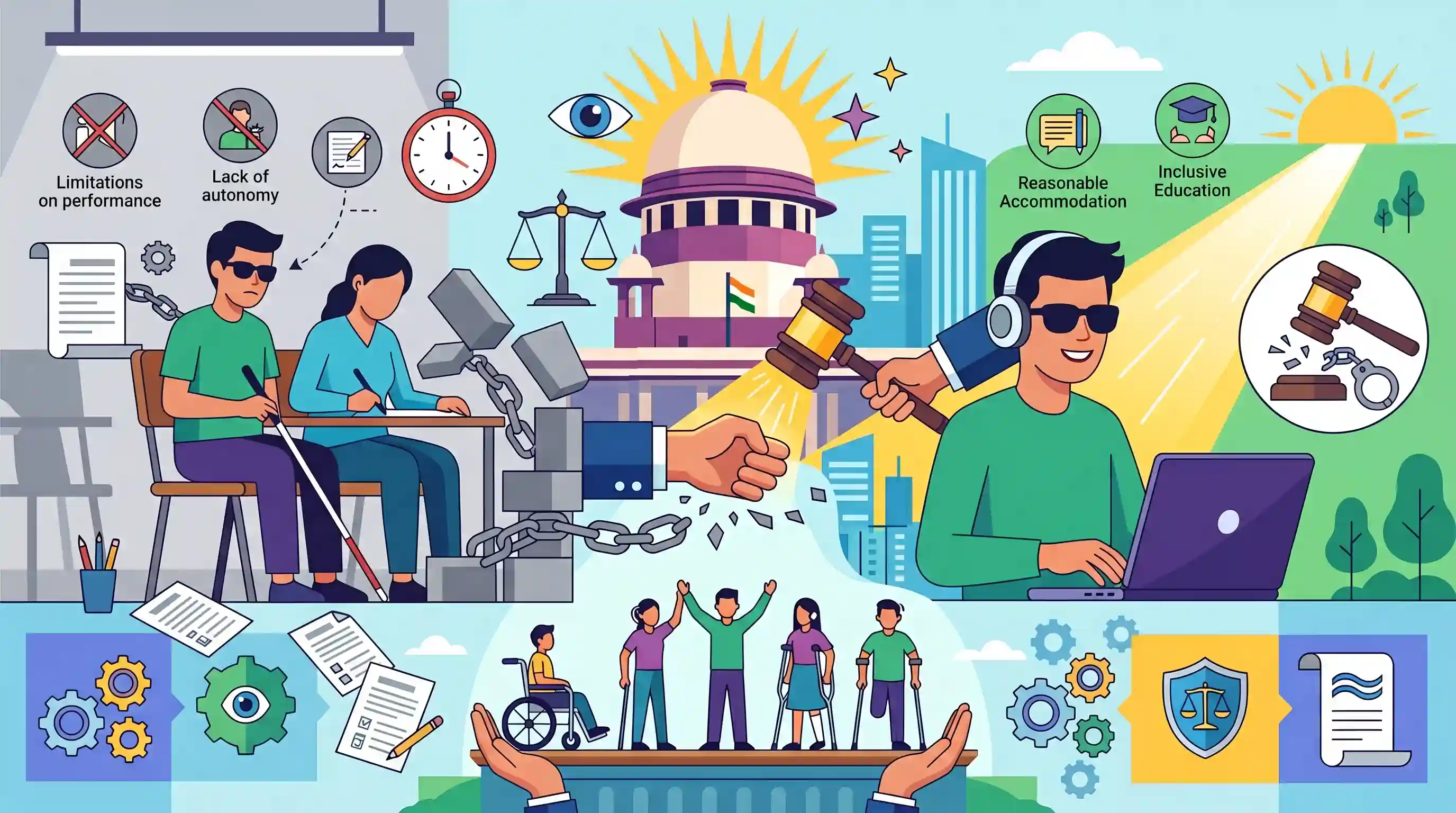
The Supreme Court of India granted interim relief to visually impaired law applicants who challenged the mandatory use of scribes during examinations. The applicants sought permission to use assistive technologies to write exams independently, arguing that reliance on another person impinges upon their autonomy and can negatively affect their performance. The apex court's intervention highlights the importance of providing 'reasonable accommodation' to persons with disabilities, aligning with the rights-based approach championed by the Rights of Persons with Disabilities (RPwD) Act, 2016, which guarantees equal opportunity and inclusive education.
Key Points
- Visually impaired law applicants approached the Supreme Court seeking to write their exams independently rather than being forced to rely on scribes.
- The applicants argued that using a scribe compromises their agency, precision, and performance, and advocated for the use of assistive technologies like computers and screen-reading software.
- The Supreme Court granted interim relief, recognizing the evolving interpretation of 'reasonable accommodation' and the right to autonomy for persons with disabilities.
- The case underscores the transition towards a rights-based framework mandated by the RPwD Act, 2016, which emphasizes equal opportunity, inclusivity, and empowerment over mere welfare.
Important Terms
Rights of Persons with Disabilities (RPwD) Act, 2016

A landmark law replacing the 1995 Act, increasing recognized disabilities from 7 to 21 and mandating 'reasonable accommodation' and reservation in education and employment.
UPSC context
GS II: Social Justice/Vulnerable Sections. Tests knowledge of rights-based legislative frameworks and their impact on inclusive governance.
Reasonable Accommodation
Defined under Section 2(y) of the RPwD Act as necessary modifications or adjustments to ensure persons with disabilities enjoy rights equally without 'undue burden' on the provider.
UPSC context
GS II & IV: Social Justice and Ethics. Tests the application of 'substantive equality' over formal equality in public services.
Interim Relief
A temporary judicial remedy granted to preserve the status quo or protect rights pending a final decision, preventing irreparable harm to the petitioner.
UPSC context
GS II: Judiciary. Relevant for understanding judicial process, writ jurisdiction, and the court's role as a protector of fundamental rights.
Inclusive Education
An educational system mandated by the RPwD Act where students with and without disabilities learn together, with adapted teaching methodologies to meet diverse needs.
UPSC context
GS II: Education/Social Justice. Refers to the shift from 'integration' to 'inclusion' in human resource development.
Assistive Technology
Devices or software (e.g., screen readers) used to increase, maintain, or improve the functional capabilities of persons with disabilities, promoting independent participation.
UPSC context
GS III: Science & Technology. Focuses on tech-led empowerment and its role in bridging the accessibility gap for vulnerable groups.
Supreme Court of India
The apex court and final interpreter of the Constitution, which uses its power under Article 32 to enforce fundamental rights, including equality (Article 14).
UPSC context
GS II: Polity. Tests the role of the judiciary in interpreting laws to protect minority and disabled rights.
Prelims Trap
"Reasonable accommodation under the RPwD Act is restricted solely to individuals meeting the 40% 'benchmark disability' threshold."
The SC ruled in Vikash Kumar v. UPSC (2021) that the fundamental right to reasonable accommodation extends broadly, not just to those meeting the 40% benchmark threshold.
Static Concepts Connected
What are the core paradigm shifts introduced by the RPwD Act 2016?
- Rights-based approach: Shifted from a medical/welfare model to a rights-based model, aligning Indian domestic law with the UN Convention on the Rights of Persons with Disabilities (UNCRPD).
- Expanded categories: Increased the number of recognized disabilities from 7 to 21, adding acid attack victims, specific learning disabilities, and dwarfism.
- Reasonable accommodation: Legally mandated affirmative adjustments (Section 2(y)) to level the playing field, making its denial a form of discrimination.
- Private sector inclusion: Obligates both public government bodies and private sector establishments to frame and publish an Equal Opportunity Policy.
How does Indian constitutional jurisprudence differentiate formal from substantive equality?
- Formal Equality: Treats everyone exactly the same under the law, ignoring historical, social, or physical disadvantages (blindness to difference).
- Substantive Equality: Recognizes inherent disparities and mandates affirmative action or reasonable accommodation to ensure equitable outcomes and level the playing field.
Cross-Topic Patterns
Assistive Tech as a Fundamental Right
The demand for screen-reading software elevates assistive technology from a mere administrative provision to a core requirement for realizing Article 21 (right to dignity) and Article 14 (substantive equality).
Evolution of the Vikash Kumar Precedent
This development builds directly on the 2021 Vikash Kumar v. UPSC judgment, evolving disability jurisprudence from demanding 'a scribe' (dependency) to demanding 'independent agency' via technology.

Expect a mains question linking Article 14's 'substantive equality' to the RPwD Act's 'reasonable accommodation' via tech interventions.
Linked PYQs · 1
Linked PYQs · 1
- 2017MainsGS2
Does the Rights of Persons with Disabilities Act, 2016 ensure effective mechanism for empowerment and inclusion of the intended beneficiaries in the society? Discuss.
