Legislative Budget Deadlocks and United States Government Shutdown
Source:Indian Express ↗
Why It Matters
The US government shutdown serves as a prime comparative case study for UPSC aspirants to understand the practical differences between the US Presidential system (where legislative budget deadlocks paralyze government functioning without removing the executive) and the Indian Parliamentary system (where a failure to pass the budget results in the fall of the government via loss of confidence). It also highlights the macroeconomic impacts of public expenditure management and policy gridlocks.
Summary
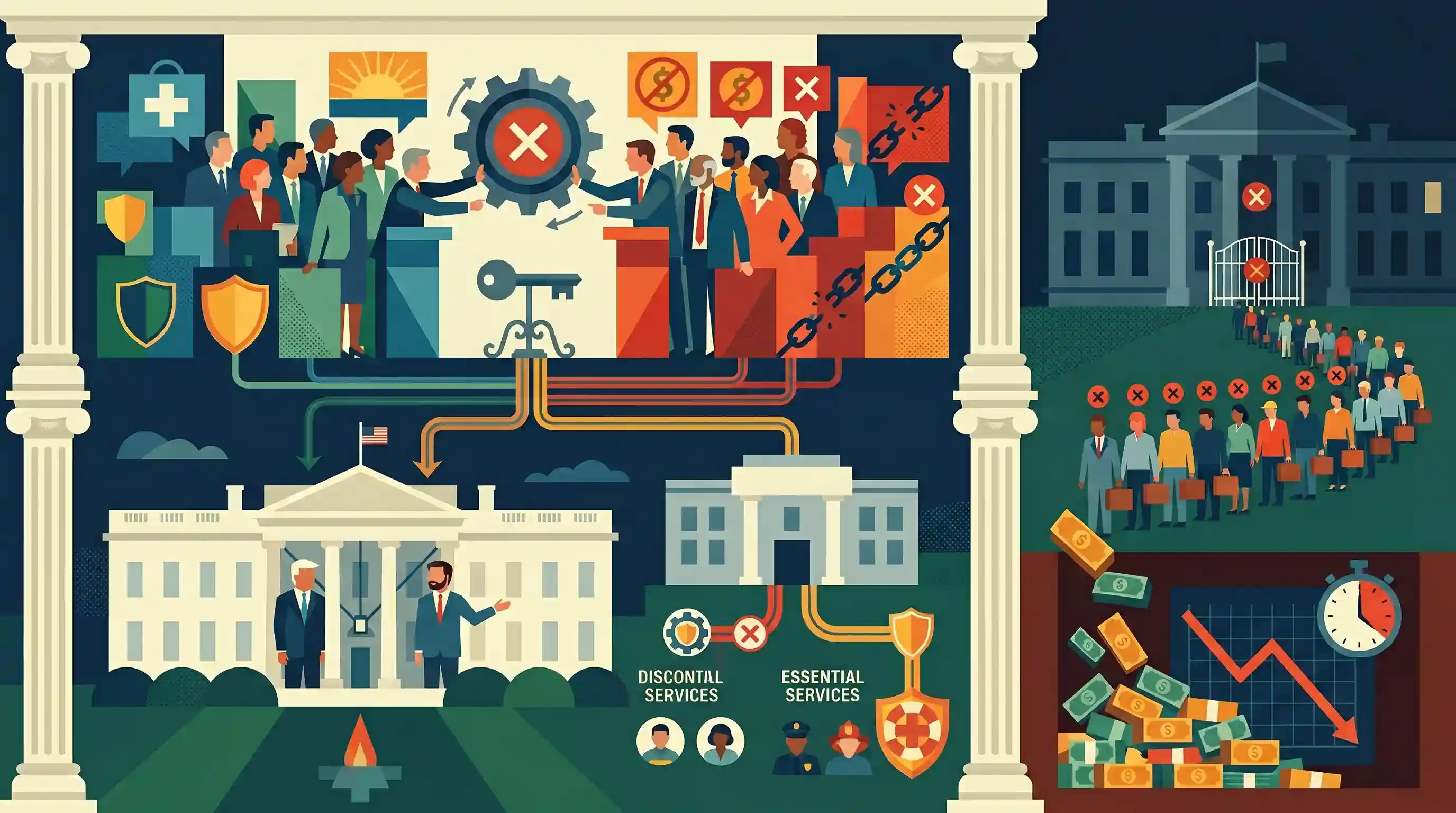
The US government is facing a potential shutdown due to a legislative deadlock over federal spending, specifically concerning the extension of Obamacare subsidies. While the White House Office of Management and Budget is preparing agencies for furloughs, Vice President JD Vance has emphasized that the administration wants to avoid laying off federal workers and intends to maintain essential services. The Congressional Budget Office estimates the shutdown could furlough 750,000 workers, costing the economy around $400 million daily.
Key Points
- US Vice President JD Vance stated the Trump administration seeks to keep essential services functional and avoid laying off federal workers during the looming US government shutdown.
- The Congressional Budget Office (CBO) estimates that approximately 750,000 federal employees will be furloughed daily, leading to an estimated economic cost of $400 million per day.
- The shutdown is the result of a legislative impasse over a spending bill, primarily due to disagreements over extending expiring Obamacare subsidies.
- The White House Office of Management and Budget (OMB) has formally advised federal agencies to prepare for potential workforce furloughs if the budget fails to pass.
Important Terms
Obamacare (Affordable Care Act)

A landmark 2010 health reform law (Affordable Care Act) aimed at increasing insurance coverage via Medicaid expansion and federal subsidies for low-to-middle-income citizens.
UPSC context
GS II (Social Justice/Health); tests understanding of welfare governance and comparative social security models in democratic countries.
Congressional Budget Office (CBO)
A non-partisan legislative agency that provides the US Congress with objective budget and economic analyses, including cost estimates for proposed legislation.
UPSC context
GS II (Executive Accountability); explores legislative oversight of public finance and checks/balances on executive spending.
US Congress
The bicameral legislative branch of the US federal government, comprising the House of Representatives and the Senate, responsible for lawmaking and budget approval.
UPSC context
GS II (Comparative Constitutions); analyzes structural differences between the US presidential system and the Indian parliamentary model.
White House Office of Management and Budget (OMB)
The executive office responsible for preparing the US President's budget proposal and overseeing the management and regulatory policies of federal agencies.
UPSC context
GS II (Executive Accountability); illustrates the mechanism of executive control over the administrative machinery and federal spending.
Prelims Trap
If the Budget fails, the President assumes direct control of the Consolidated Fund to prevent a shutdown.
The defeat of an Appropriation Bill or Budget in the Lok Sabha signifies a loss of confidence. The Prime Minister must resign; it does not lead to a 'shutdown' or Presidential financial takeover.
Static Concepts Connected
How does a budget failure differ between India and the US?
- US System: Strict separation of powers means a budget failure causes agency shutdowns, but the President's tenure remains unaffected.
- Indian System: Strict executive accountability means the defeat of the budget in the Lok Sabha forces the government to resign immediately.
What is a "Vote on Account" under Article 116?
- Purpose: An advance grant passed by the Lok Sabha to meet government expenses pending the passage of the regular budget.
- Expenditure Only: It strictly deals with the expenditure side of the government budget, ignoring taxation or revenue proposals.
- Duration: Typically passed for two months, allowing the government to function smoothly without triggering a shutdown scenario.
Cross-Topic Patterns
Power of the Purse vs Ordinance Rules
While the US shuts down over spending, India's Article 114 prevents withdrawing from the Consolidated Fund without law, meaning executive ordinance-making power cannot bypass parliamentary budget appropriation.
Social Welfare vs Fiscal Deadlocks
Legislative deadlocks over social spending (Obamacare subsidies) in the US parallel India's macroeconomic debates balancing welfare schemes (Ayushman Bharat) against fiscal prudence and FRBM Act targets.

Expect a comparative polity question contrasting the US separation of powers (shutdowns) with India's parliamentary accountability.
Linked PYQs · 3
Linked PYQs · 3
- 2018MainsGS2
India and USA are two large democracies. Examine the basic tenets on which the two political systems are based.
- 2021MainsGS2
To what extent, in your view, the Parliament is able to ensure accountability of the executive in India?
- 2019MainsGS3
The public expenditure management is a challenge to the Government of India in the context of budget making during the post-liberalization period. Clarify it.
