West Bengal Introduces Direct Land Purchase Policy for Industry
Source:Indian Express ↗
Why It Matters
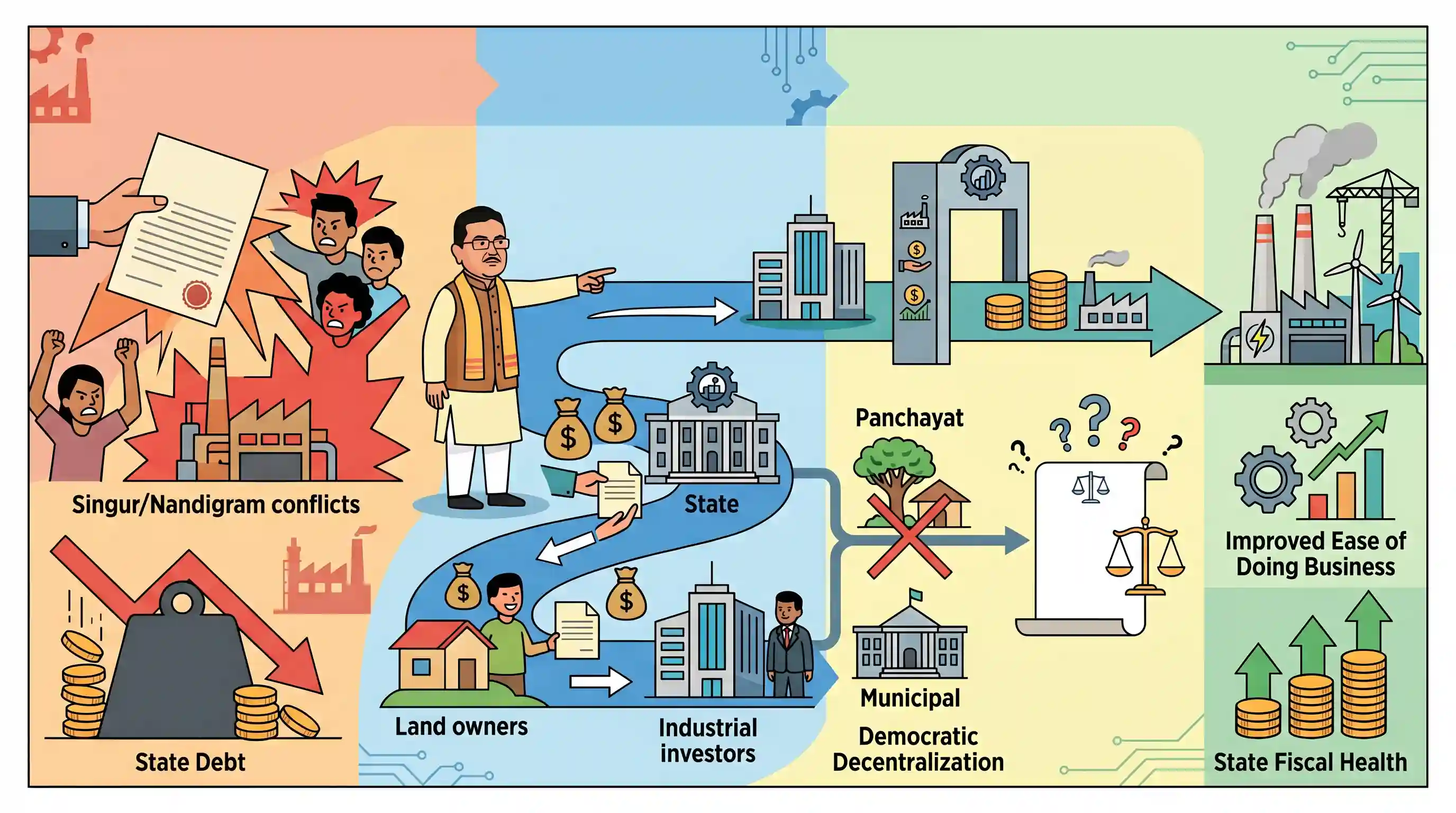
This article highlights a vital public policy dilemma: the trade-off between rapid industrialization/Ease of Doing Business and democratic decentralization/local self-governing autonomy. It demonstrates how historical conflicts (Singur/Nandigram) shape state-level land procurement strategies and serves as an excellent case study for Mains GS2 (Local Bodies) and GS3 (Land Reforms and Infrastructure).
Summary
West Bengal Chief Minister Suvendu Adhikari announced a policy shift to attract industrial investment and resolve historical land-related conflicts. To prevent repetitions of anti-land acquisition movements like those in Singur and Nandigram, the state government will adopt a Direct Land Purchase Policy for industrial needs. Under this framework, the state will directly purchase land from owners and transfer it to private investors, a strategy previously used for highways, airports, and railways. Additionally, the government will institute a single-window clearance system for investments of Rs 100 crore and above. Crucially, these proposals will bypass approvals from local bodies (panchayats and municipalities) and be processed directly through the West Bengal Industrial Development Corporation (WBIDC) and state departments. This measure is intended to streamline regulatory processes, improve the Ease of Doing Business, and address the state's escalating debt (which reached approximately Rs 8 lakh crore), though it raises constitutional questions regarding the devolution of powers to local self-governments under the 73rd and 74th Amendments.
Key Points
- West Bengal Chief Minister Suvendu Adhikari announced a major shift in the state's industrial policy by transitioning from traditional land acquisition to a 'Direct Land Purchase Policy' to avoid past socio-political conflicts like those in Singur and Nandigram.
- The Direct Land Purchase Policy, previously utilized for public infrastructure projects like railways, highways, new airports, and the BSF, will now be deployed to procure land directly from owners and hand it over to private industrial developers.
- The state will introduce a single-window clearance mechanism for investment proposals valued at Rs 100 crore and above, bypassing the requirement for approvals from local self-governments (panchayats, municipalities, municipal corporations, or zilla parishads).
- All land, environmental, and administrative clearances for these high-value investments will be processed centrally via the West Bengal Industrial Development Corporation (WBIDC) and relevant state departments to reduce corruption and delays.
- The economic imperative for attracting capital is highlighted by West Bengal’s mounting fiscal debt, which reportedly increased from Rs 2 lakh crore during the Left Front regime to nearly Rs 8 lakh crore under the previous TMC administration.
- The policy change highlights a critical governance tension between enhancing the 'Ease of Doing Business' through centralized single-window clearances and upholding the spirit of democratic decentralization mandated by the 73rd and 74th Constitutional Amendments.
Important Terms
Direct Land Purchase Policy

A policy mechanism where the state government directly purchases land from owners through negotiated market-rate compensation, bypassing prolonged and conflict-prone statutory land acquisition processes.
UPSC context
GS Paper 3: Land reforms & infrastructure. Tests knowledge of market-based alternatives to compulsory land acquisition under eminent domain.
73rd Constitutional Amendment Act
A landmark 1992 constitutional amendment that institutionalized the three-tier Panchayati Raj system, granting constitutional status and self-governing powers to rural local bodies.
UPSC context
GS Paper 2: Polity & Governance. Tests understanding of democratic decentralization and devolution of powers to panchayats.
74th Constitutional Amendment Act
A 1992 constitutional amendment that gave constitutional status and institutional frameworks to urban local bodies, mandating devolution of municipal powers and financial authorities.
UPSC context
GS Paper 2: Polity & Governance. Tests knowledge of urban local governance, municipalities, and federal power devolution challenges.
Right to Fair Compensation and Transparency in Land Acquisition, Rehabilitation and Resettlement Act (RFCTLARR), 2013
A central law regulating compulsory land acquisition, ensuring fair compensation, mandatory social impact assessments, rehabilitation, and resettlement to protect affected livelihoods.
UPSC context
GS Paper 3: Infrastructure development & land reforms. Tests familiarity with legal safeguards and guidelines for land acquisition.
West Bengal Industrial Development Corporation (WBIDC)
The premier agency of West Bengal responsible for industrial development, facilitating state investments, creating infrastructure, and executing single-window regulatory clearances.
UPSC context
GS Paper 3: Industrial policy & economic growth. Tests institutional mechanisms for easing business regulations and attracting investments.
Prelims Trap
The 73rd and 74th Amendments make the devolution of all 29 and 18 schedule subjects to local bodies constitutionally mandatory.
Articles 243G and 243W use discretionary language ('may, by law, endow'), leaving the actual devolution of these powers entirely to the discretion of State Legislatures.
Static Concepts Connected
How does Direct Land Purchase differ from the RFCTLARR Act, 2013?
- Consent Thresholds: LARR 2013 mandates 70% consent for PPP and 80% for private projects; direct purchase is a bipartite contract requiring 100% mutual consent of the seller.
- Social Impact Assessment: LARR 2013 legally requires a mandatory Social Impact Assessment (SIA); direct purchase bypasses the SIA process entirely, speeding up acquisition.
- R&R Obligations: Statutory Rehabilitation and Resettlement (R&R) packages are mandatory under LARR 2013, whereas direct purchase deals often settle via one-time negotiated cash compensation.
What are the constitutional limits on State borrowing under Article 293?
- Territorial Limits: Article 293(1) restricts State governments to borrowing only within the territory of India; they cannot directly borrow from external/foreign entities.
- Central Consent: Under Article 293(3), States cannot raise fresh loans without Central consent if they have any outstanding liabilities/loans owed to the Union government.
- Fiscal Controls: This article serves as the primary constitutional instrument for the Centre to enforce fiscal discipline and FRBM limits on sub-national borrowing.
Cross-Topic Patterns
Local Governance vs. Ease of Doing Business
Centralising clearances to bypass local panchayats highlights the systemic trade-off between democratic decentralisation (73rd Amendment) and competitive federalism strategies to attract rapid industrial investments.
Sub-National Debt + Article 293 Limits
Escalating state debt limits capital expenditure, forcing states to rely on regulatory easing (like bypassing local bodies) to attract private capital under the constraints of Article 293(3).

Multi-statement questions will likely test the voluntary nature of 11th/12th Schedule devolution alongside Article 293's central checks on state borrowing.
Linked PYQs · 3
Linked PYQs · 3
- 2014MainsGS3
The Right to Fair Compensation and Transparency in Land Acquisition, Rehabilitation and Resettlement Act, 2013 has come into effect from 1st January, 2014. What are the key issues which would get addressed with the Act in place? What implications would it have on industrialization and agriculture in India?
- 2023MainsGS2
“The states in India seem reluctant to empower urban local bodies both functionally as well as financially.” Comment.
- 2025PrelimsGS1
Consider the following statements : I. Panchayats at the intermediate level exist in all States. II. To be eligible to be a Member of a Panchayat at the intermediate level, a person should attain the age of thirty years. III. The Chief Minister of a State constitutes a commission to review the financial position of Panchayats at the intermediate levels and to make recommendations regarding the distribution of net proceeds of taxes and duties, leviable by the State, between the State and Panchayats at the intermediate level. Which of the statements given above are not correct?
