COP30 पर पेरिस समझौते के ढांचे को लेकर भारत का रुख
स्रोत:द हिंदू ↗
क्यों मायने रखता है
UNFCCC COP meetings and India's stance on climate justice (CBDR, climate finance) are perennial topics in both Prelims and Mains (GS3 Environment). Understanding the dynamics of blocs like BASIC and LMDC is also critical for GS2 International Relations, particularly in the context of the North-South divide in global climate governance.
सारांश
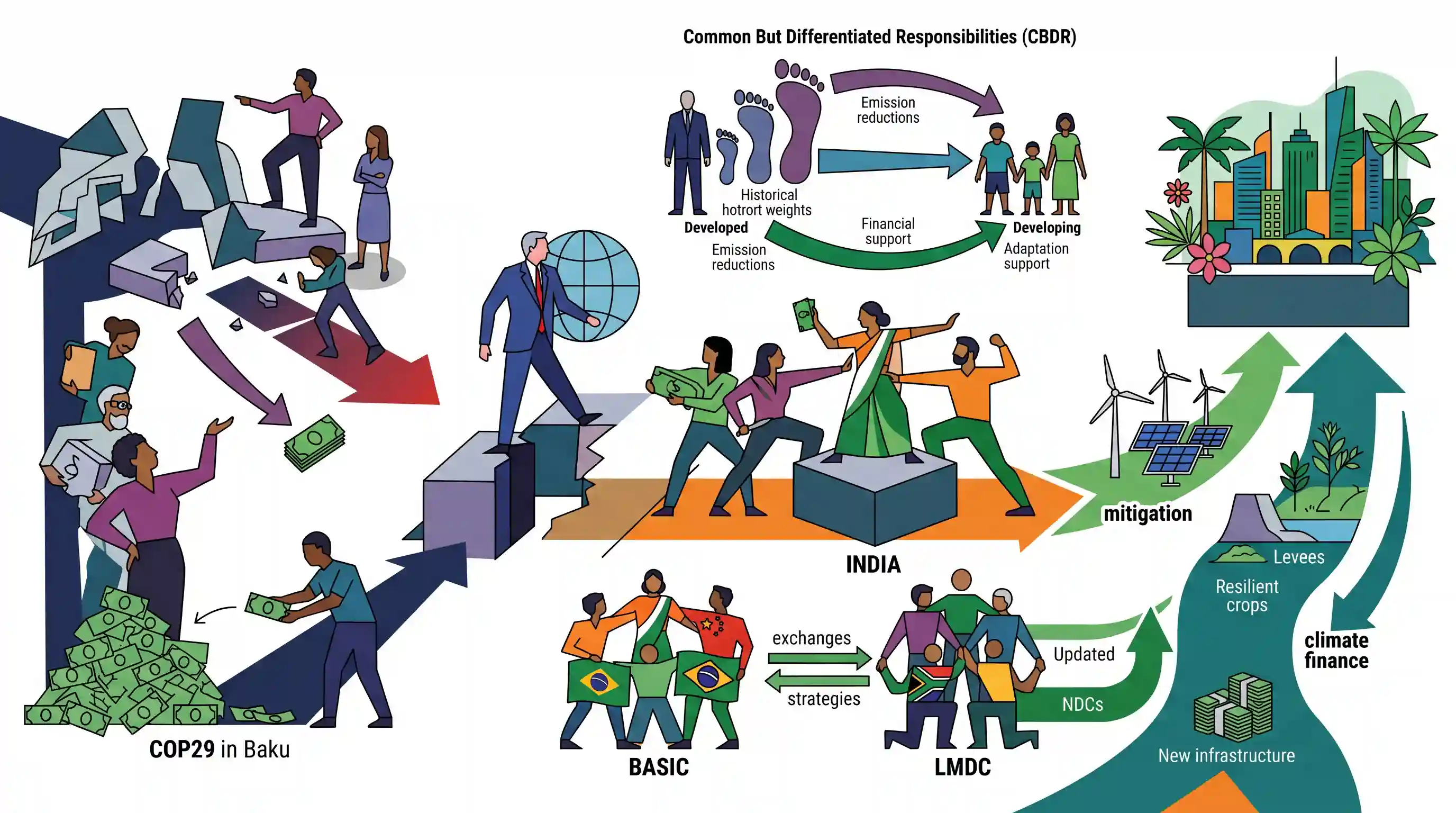
As preparations for COP30 in Belem, Brazil accelerate, India has strongly stated its intention to protect the original framework of the 2015 Paris Agreement against dilutions proposed by developed nations. The Indian government emphasized the crucial principle of Common But Differentiated Responsibilities (CBDR), which holds historically industrialized nations accountable for providing adequate climate finance and taking steeper emission cuts. India expressed dissatisfaction with the outcomes of COP29 in Baku, where developed nations committed only $300 billion against a demanded $1.35 trillion. Recognizing the geopolitical shifts, notably the expected withdrawal of the United States from the climate pact, India plans to solidify its negotiating stance by coordinating closely with the BASIC and LMDC blocs. The objective is to maintain a focus on adaptation and equitable climate finance, rather than succumbing to mitigation-centric pressure, as India updates its Nationally Determined Contributions (NDCs) and National Adaptation Plans ahead of COP30.
मुख्य बिंदु
- India firmly asserted it will resist attempts to alter the 'architecture' of the 2015 Paris Agreement at the upcoming COP30 in Belem, Brazil.
- The core principle being defended is Common But Differentiated Responsibilities (CBDR), which mandates developed nations to bear greater emission reduction burdens and provide climate finance.
- India criticized developed countries for shifting goalposts, highlighting their failure at COP29 (Baku) to agree to the $1.35 trillion climate finance demand, committing only $300 billion.
- India plans to leverage the BASIC (Brazil, South Africa, India, China) and LMDC (Like-Minded Developing Countries) groupings to counter pressure from developed nations, especially given the impending US withdrawal from the Paris Agreement.
- For COP30, India will focus on submitting updated Nationally Determined Contributions (NDCs) and finalizing its National Adaptation Plan, rather than accepting new mitigation-centric targets forced by richer nations.
महत्वपूर्ण शब्द
Paris Agreement

A legally binding 2015 international treaty aiming to limit global warming to well below 2°C. It utilizes a bottom-up approach where nations set voluntary targets for emission reductions and adaptation.
UPSC context
GS Paper 3: Environment. Essential for understanding global governance, the 'ratchet mechanism,' and India's international climate commitments.
Common But Differentiated Responsibilities (CBDR)
A principle acknowledging that all states share responsibility for the environment, but developed nations bear a greater burden due to historical emissions and superior financial and technological capacity.
UPSC context
GS Paper 3: पर्यावरण/नीतिशास्त्र। अंतर्राष्ट्रीय संबंधों और पर्यावरण कानून में समानता (equity) और जलवायु न्याय (climate justice) की समझ का परीक्षण करता है।
Nationally Determined Contributions (NDCs)
Self-defined climate action plans submitted every five years under the Paris Agreement. They outline a country’s targets for reducing greenhouse gas emissions and enhancing resilience to climate impacts.
UPSC context
GS Paper 3: Environment. Key for tracking India’s specific progress toward 'Panchamrit' goals and net-zero by 2070.
Like-Minded Developing Countries (LMDC)
A negotiating bloc of approximately 24 developing nations, including India and China. They represent over 50% of the world's population and advocate for equity, CBDR, and robust climate finance.
UPSC context
GS Paper 2: International Relations. Crucial for analyzing India’s leadership in the Global South and collective bargaining at COPs.
BASIC
A climate-focused alliance of four newly industrialized countries: Brazil, South Africa, India, and China. The group coordinates common positions on climate finance and emission reduction expectations.
UPSC context
GS Paper 2: International Relations. Relevant for studying emerging power blocs and their impact on multilateral climate negotiations.
National Adaptation Plans (NAPs)
A UNFCCC process established to help developing countries identify medium- and long-term adaptation needs. It focuses on integrating climate resilience into national development planning and sectoral policies.
UPSC context
GS Paper 3: Environment. Tests knowledge of domestic policy frameworks for building resilience against climate-induced disasters.
प्रारंभिक ट्रैप
The principle of Common But Differentiated Responsibilities (CBDR) was first introduced in the 2015 Paris Agreement.
CBDR was formalized earlier at the 1992 Earth Summit (Rio Declaration, Principle 7). The Paris Agreement merely reaffirmed it, making this a classic chronological trap.
संबंधित अवधारणाएँ
What are the key developing-nation negotiating blocs at the UNFCCC?
- BASIC: Formed in 2009 by Brazil, South Africa, India, and China to coordinate collective climate negotiation positions.
- LMDC: 20 से अधिक देशों (भारत और चीन सहित) का एक गठबंधन, जो जलवायु न्याय और न्यायसंगत वित्त की वकालत करता है।
- G77 + China: The largest intergovernmental organization of developing countries in the UN, acting as a broad umbrella bloc.
How do NDCs differ from National Adaptation Plans (NAPs)?
- NDCs: Post-2020 climate action plans, primarily mitigation-focused but including adaptation targets, pledged by countries under the Paris Agreement.
- NAPs: A specific UNFCCC process focused on identifying medium and long-term adaptation needs and integrating them into national strategies.
अंतर-विषय पैटर्न
Climate Finance vs. Trade Barriers
While developed nations resist the $1.35T NCQG demand, they simultaneously enact mitigation-centric trade barriers like the EU's CBAM, placing double burdens on developing economies.
US Withdrawal & Global South
The anticipated US exit from the Paris Agreement creates a diplomatic vacuum, elevating the strategic importance of BASIC and cementing India's leadership role in Global South negotiations.

Expect a 2026 prelims question linking the New Collective Quantified Goal (NCQG) to the historical origins of CBDR and BASIC.
संबद्ध PYQ · 4
संबद्ध PYQ · 4
- 2025MainsGS3
Write a review on India's climate commitments under the Paris Agreement (2015) and mention how these have been further strengthened in COP26 (2021). In this direction, how has the first Nationally Determined Contribution intended by India been updated in 2022?
- 2021MainsGS3
Describe the major outcomes of the 26th session of the Conference of the Parties (COP) to the United Nations Framework Convention on Climate Change (UNFCCC). What are the commitments made by India in this conference?
- 2025PrelimsGS1
Consider the following statements : Statement I: Article 6 of the Paris Agreement on climate change is frequently discussed in global discussions on sustainable development and climate change. Statement II: Article 6 of the Paris Agreement on climate change sets out the principles of carbon markets. Statement III : Article 6 of the Paris Agreement on climate change intends to promote inter-country non-market strategies to reach their climate targets. Which one of the following is correct in respect of the above statements?
- 2022PrelimsGS1
"Climate Action Tracker" which monitors the emission reduction pledges of different countries is a :
