Delimitation proposals require all-party consensus on federal concerns
Source:The Hindu ↗
Why It Matters
The impending delimitation exercise is one of the most sensitive federal challenges facing India. It touches upon the balance of power between northern and southern states, incentives for population control, and cooperative federalism, making it crucial for UPSC GS-2 preparation.
Summary
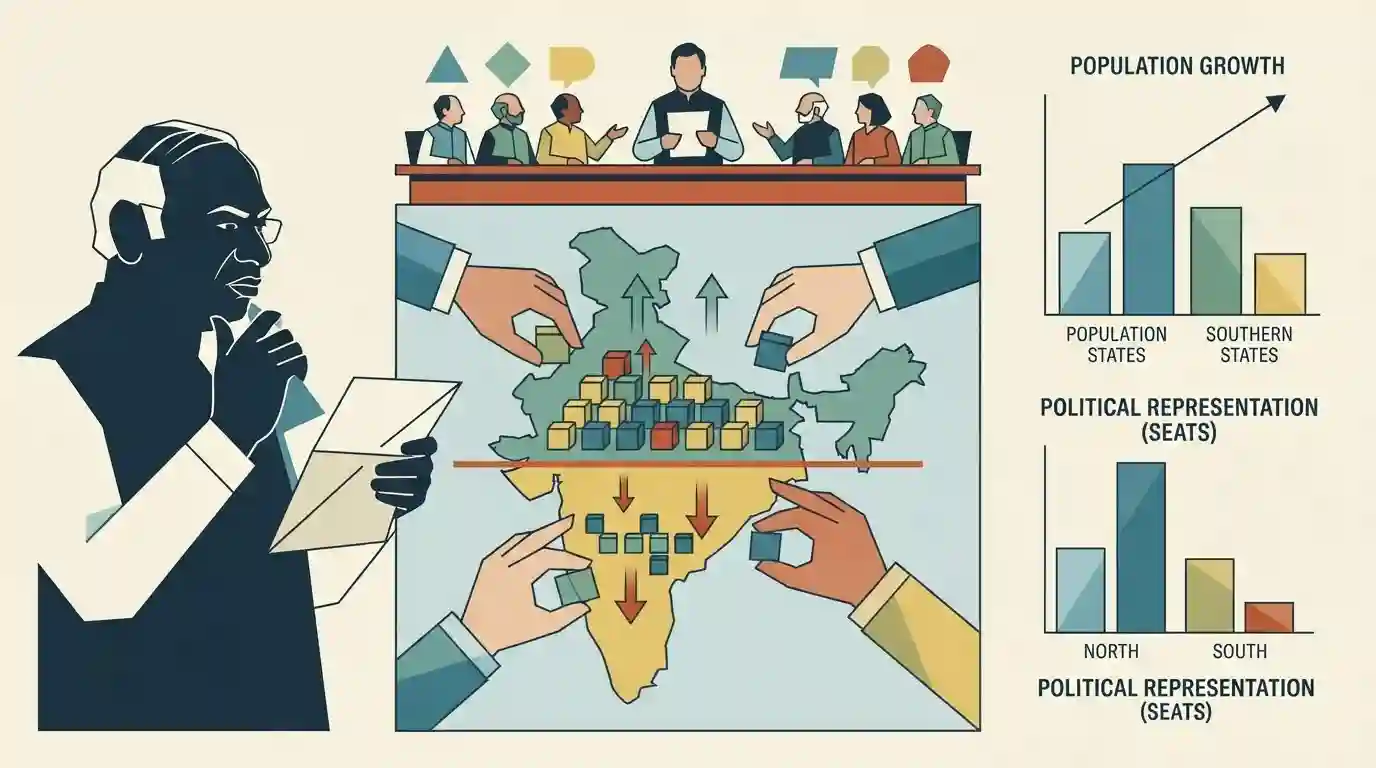
Congress President Mallikarjun Kharge wrote to Prime Minister Narendra Modi, demanding that the government avoid a unilateral approach to the upcoming delimitation exercise and instead call an all-party meeting. The letter highlights major federal concerns, particularly regarding the potential penalization of southern states that have successfully managed population growth, which could diminish their political weight in Parliament.
Key Points
- Mallikarjun Kharge wrote to Prime Minister Narendra Modi urging an all-party meeting to discuss upcoming delimitation proposals.
- Kharge raised concerns that southern and progressive states, which successfully controlled population growth, might face a reduction in parliamentary representation.
- The opposition has cautioned against a unilateral approach or "bulldozing" legislation on sensitive federal and democratic issues.
- Delimitation involves redrawing parliamentary and assembly constituency boundaries based on population data, which remains a deeply contentious issue between northern and southern states.
Important Terms
Delimitation Commission Act

A statutory mechanism enacted by Parliament to redraw boundaries of Lok Sabha and Assembly constituencies based on recent census data, ensuring equal representation across populations.
UPSC context
UPSC GS Paper II: Parliament and State Legislatures, federalism, and electoral reforms regarding representation of states.
Parliament
The supreme legislative body of India comprising the President, Lok Sabha, and Rajya Sabha, responsible for making laws and democratic representation.
UPSC context
UPSC GS Paper II: Structure, Functioning, and Conduct of Business of Parliament.
Prelims Trap
Delimitation Commission orders can be challenged in constitutional courts on grounds of federal imbalance.
Aspirants often believe Delimitation Commission orders can be legally challenged in High Courts or the Supreme Court if they violate federal principles. Under Article 82, they have the force of law and cannot be questioned in any court.
Static Concepts Connected
What are the constitutional provisions and legal status governing the Delimitation Commission in India?
- Constitutional Basis: Article 82 mandates Parliament to enact a Delimitation Act after every Census.
- Legal Finality: Established by the Central Government; its orders have the force of law and cannot be questioned in any court under Article 329/82.
- Composition: Comprises a retired Supreme Court judge, the Chief Election Commissioner, and respective State Election Commissioners.
- Seat Freeze: Frozen by the 84th Amendment Act 2002 until the first Census after 2026 to incentivize population control.
Cross-Topic Patterns
Delimitation vs. Fiscal Federalism (Finance Commission)
Delimitation shifts political power away from family-planning achievers, directly testing asymmetric federalism and resource distribution principles across northern and southern states.
Representative Democracy vs. Cooperative Federalism
Population-based seat allocation intersects with Article 356 and legislative representation debates, creating friction between majoritarian democracy and regional minority safeguarding.

Delimitation + 84th Amendment freeze (1971 census) + Article 82 binding judicial bar likely to feature as a multi-statement prelims question.
Linked PYQs · 2
Linked PYQs · 2
- 2024PrelimsGS1
How many Delimitation Commissions have been constituted by the Government of India till December 2023?
- 2012PrelimsGS1
With reference to the Delimitation Commission, consider the following statements: 1. The orders of the Delimitation Commission cannot be challenged in a Court of Law. 2. When the orders of the Delimitation Commission are laid before the Lok Sabha or State Legislative Assembly, they cannot effect any modifications in the orders. Which of the statements given above is/are correct?
