Krishna Delta Farmers Advised to Avoid Paddy Cultivation
Source:The Hindu ↗
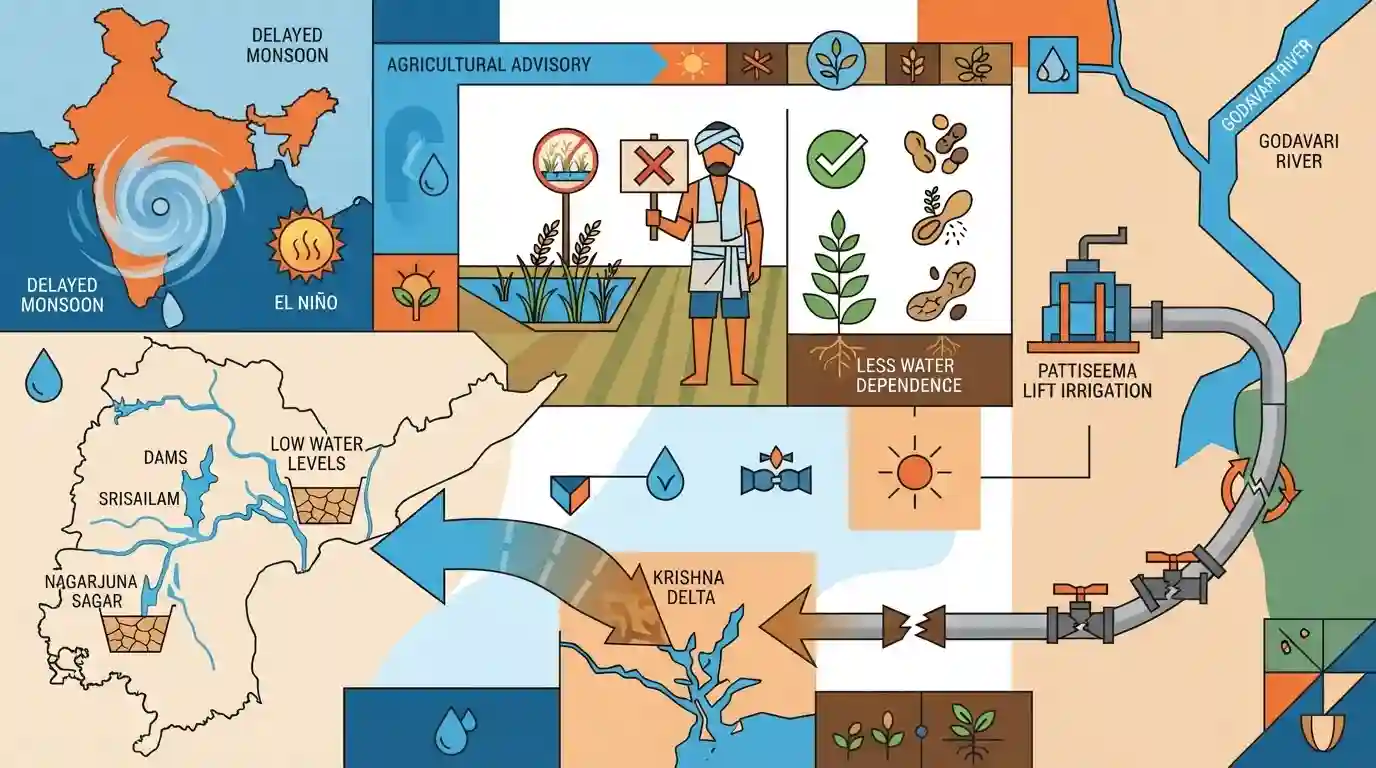
Why It Matters
Illustrates the direct impact of climate phenomena like El Niño on the Indian monsoon and agriculture. It highlights practical challenges in water resource management, river interlinking (Godavari-Krishna via Pattiseema), and the urgent need for crop diversification towards climate-resilient agriculture.
Summary
Amidst a severe water crunch driven by a delayed monsoon and El Niño conditions, the Andhra Pradesh government has urged farmers in the Krishna delta to suspend paddy cultivation for the current kharif season. Water levels in major Krishna river reservoirs, including Srisailam and Nagarjuna Sagar, are critically low. Authorities are prioritizing drinking water supply and advising a shift to less water-intensive dry crops. Efforts to divert water from the Godavari river via the Pattiseema Lift Irrigation scheme are facing challenges due to reduced inflows and unauthorized water extraction.
Key Points
- The Andhra Pradesh government has advised farmers in the Krishna delta to avoid cultivating water-intensive paddy during the kharif season due to a severe water crisis.
- Farmers are encouraged to switch to Irrigated Dry (ID) crops that consume less water.
- Key reservoirs on the Krishna river, including Srisailam and Nagarjuna Sagar, as well as upstream dams like Almatti and Jurala, are facing critical water shortages due to delayed monsoons driven by Super El Niño conditions.
- The government is prioritizing available water resources for drinking water needs over agricultural use.
- Efforts to supplement water through the Pattiseema Lift Irrigation Scheme by transferring Godavari water via the Polavaram Right Main Canal are hampered by falling inflows into the Godavari and unauthorized pumping by farmers.
Important Terms
Pattiseema Lift Irrigation Scheme

India's first operational river-linking project, designed to divert surplus water from the Godavari River to the water-deficit Krishna River basin in Andhra Pradesh.
UPSC context
GS Paper I (Geography - River Linking) and GS Paper III (Irrigation Infrastructure).
Polavaram Right Main Canal
A key canal of the Polavaram Project designed to facilitate the inter-basin transfer of Godavari river water to the Krishna basin, stabilizing delta irrigation.
UPSC context
GS Paper I (Geography) and GS Paper III (Irrigation and Water Resource Management).
Srisailam Dam
A major multipurpose concrete gravity dam built across the Krishna River in the Nallamala Hills, serving Andhra Pradesh and Telangana for hydropower and irrigation.
UPSC context
GS Paper I (Physical Geography - Rivers and Reservoirs) and GS Paper III (Energy infrastructure).
Nagarjuna Sagar Dam
One of the world's largest masonry dams, built across the Krishna River on the Telangana-Andhra Pradesh border, primarily used for irrigation and electricity.
UPSC context
GS Paper I (Geography - Drainage Systems) and GS Paper III (Agriculture and Irrigation).
Kharif Crops
Crops sown during the onset of the southwest monsoon (June-July) and harvested in autumn, requiring warm climate and abundant water, such as paddy.
UPSC context
GS Paper I (Geography) and GS Paper III (Cropping Patterns & Food Security).
Prelims Trap
"Under the National Water Policy, irrigation is given the highest priority for water allocation during droughts."
While agriculture consumes over 80% of India's freshwater, the National Water Policy explicitly assigns the highest priority to drinking water needs over irrigation and industrial uses.
Static Concepts Connected
Which are the major dams and reservoirs on the Krishna River system?
- Almatti & Narayanpur: Located upstream in Karnataka; crucial for upper basin irrigation.
- Srisailam & Nagarjuna Sagar: Situated downstream, forming the border between Telangana and Andhra Pradesh.
- Tungabhadra Dam: Major multi-purpose reservoir located on Krishna's largest tributary, the Tungabhadra river.
What is the geographic significance of the Pattiseema Lift Irrigation Scheme?
- Godavari-Krishna Link: It is India's first completed river-linking project, lifting surplus water from the Godavari to the Krishna basin.
- Polavaram Canal: It utilizes the Polavaram Right Main Canal to transport water, stabilizing agriculture in the water-deficit Krishna delta.
Cross-Topic Patterns
El Niño & Millet Mission
Recurring El Niño droughts force systemic shifts from water-intensive paddy to climate-resilient millets (Irrigated Dry crops), aligning organically with India's national push for Shree Anna (millets).
River linking & Interstate Disputes
Schemes like Pattiseema highlight state-led river linking, which alters basin hydrology and frequently triggers complex interstate water-sharing disputes (Article 262) with upstream riparian states.

Expect a 2026 prelims question mapping Krishna basin dams (Almatti, Srisailam) alongside National Water Policy's allocation priorities.
Linked PYQs · 5
Linked PYQs · 5
- 2019APPSC_PRELIMSGS1
Which one of the following pairs is not correctly matched ? Dam/Lake / River
- 2024APPSC_PRELIMSGS1
Within India, Ganga river basin has the largest catchment area. After that, following is the correct sequence in the decreasing order:
- 2019APPSC_PRELIMSGS1
El-Nino is a complex weather system that appears once every three to seven years. Consider the following statements in this regard : A. The appearance of warm currents off the Coast of Peru in the Eastern Pacific. B. The word El-Nino means 'Christ Child' because the current appears around Christmas in December. C. El-Nino was one of the reasons for the deficit rainfall in India (2014). Which of the statements given above is/are correct ?
- 2024APPSC_PRELIMSGS1
Identify the incorrect statement on Wheat crop cultivation in India :
- 2023APPSC_PRELIMSGS1
Match the following : | Methods of Agricultural Regionalisation | Agricultural Geographer | |---|---| | a. Crop combination | I. Weaver, Doi | | b. Crop diversification | II. Bhatia, Jasbir Singh | | c. Crop concentration | III. Chisholm, Bhatia | | d. Agricultural productivity | IV. Kendall, Majid Husain, Jasbir Singh | Choose the correct answer using the codes given below : Code: a b c d
