Artificial Intelligence Integration in the Judiciary and Ethics
Source:The Hindu ↗
Why It Matters
The integration of emerging technologies like AI into the justice delivery system brings profound administrative and ethical challenges. Concepts like 'digital social Darwinism,' algorithmic bias, and synthetic evidence are highly relevant for questions on technology ethics (GS4), science and tech implications (GS3), and judicial reforms/e-governance (GS2).
Summary
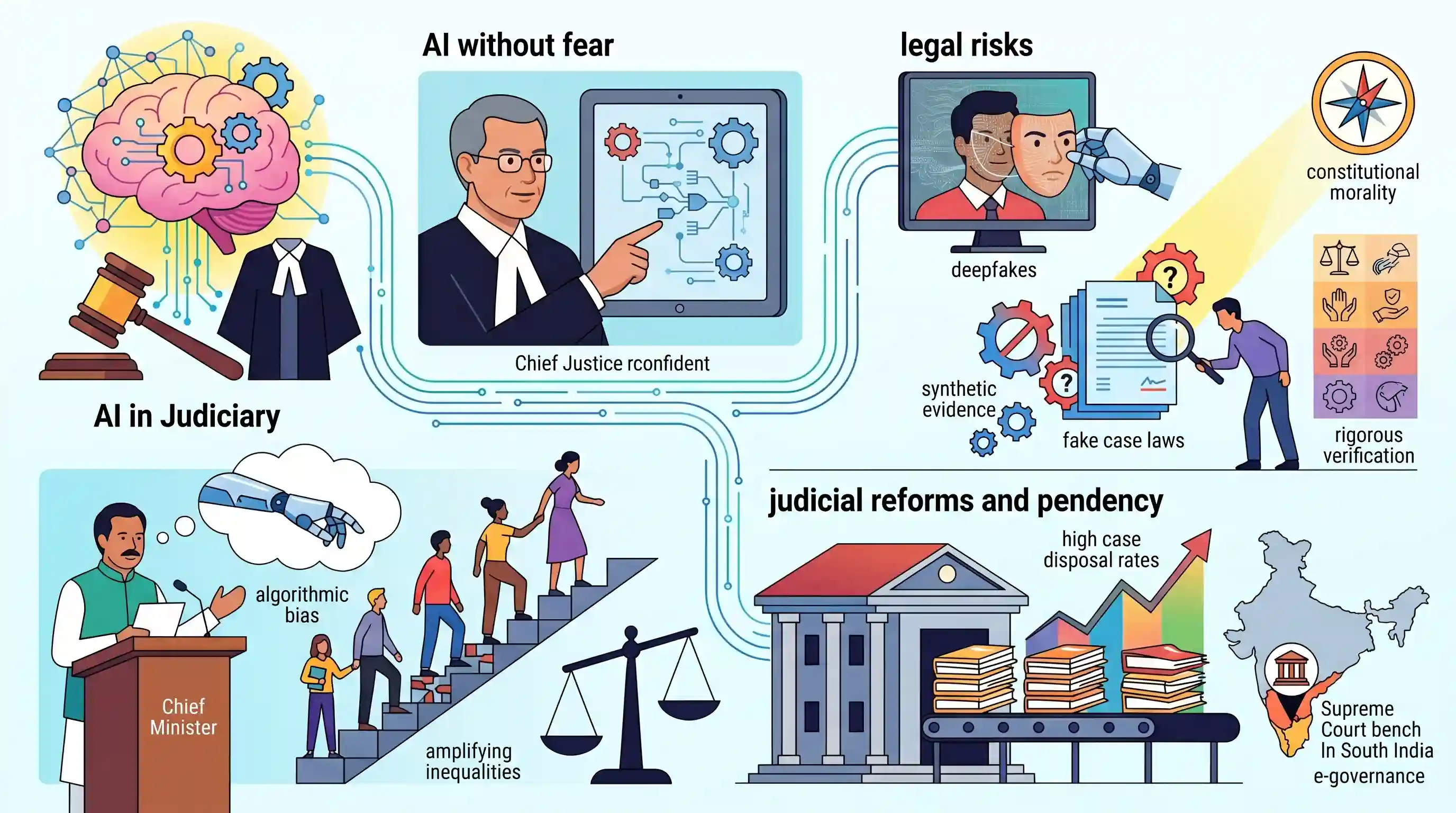
Chief Justice of India Surya Kant addressed judicial officers at a conference in Bengaluru, urging them to embrace Artificial Intelligence (AI) without fear, emphasizing that technology should augment rather than replace human judgment in the judiciary. While acknowledging AI's benefits, speakers like Karnataka Chief Minister Siddaramaiah raised ethical concerns, warning that algorithmic bias could lead to 'digital social Darwinism' and amplify caste and class inequalities. Supreme Court Justice B.V. Nagarathna pointed out legal risks such as AI-generated deepfakes, synthetic evidence, and fake case laws, stressing the need for rigorous verification and constitutional morality. Additionally, the CM reiterated the demand for a Supreme Court bench in South India, while praising Karnataka's district judiciary for leading the nation with a 95.45% case disposal rate.
Key Points
- Chief Justice of India Surya Kant urged judicial officers to embrace Artificial Intelligence (AI) as an augmentative tool while ensuring it does not compromise human judgment or judicial independence.
- Karnataka CM Siddaramaiah warned of 'digital social Darwinism' and algorithmic bias, cautioning that AI could exacerbate existing caste and class inequalities if not guided by constitutional morality.
- Justice B.V. Nagarathna highlighted the emerging challenges of AI in law, such as deepfakes, synthetic evidence, and fabricated case laws, which necessitate strict verification by advocates.
- The CM reiterated the long-standing demand for a Supreme Court bench in South India to improve access to justice.
- Karnataka's district judiciary was praised for achieving the highest case disposal rate in the country at 95.45%.
Important Terms
Digital Social Darwinism

Concept where technology exacerbates existing social inequalities (like caste or class) rather than bridging them, favoring the digitally privileged and further marginalizing vulnerable groups.
UPSC context
GS Paper IV (Ethics) and GS Paper I (Social Issues); tests understanding of technology's ethical and social impact.
Algorithmic Bias
Systematic and repeatable errors in AI systems that lead to unfair outcomes, often caused by training data that reflects human prejudices or historical inequities.
UPSC context
GS Paper II (Governance) and GS Paper IV (Ethics); crucial for questions on AI regulation and judicial fairness.
Regional Benches of the Supreme Court
Proposed permanent appellate divisions of the Supreme Court in different regions (e.g., South, West, East) to improve geographic and financial accessibility for litigants.
UPSC context
GS Paper II (Polity/Judiciary); tests knowledge of judicial reforms, access to justice, and Law Commission recommendations.
Article 130
A specific provision in the Indian Constitution that designates Delhi as the seat of the Supreme Court but empowers the CJI to hold sittings elsewhere.
UPSC context
GS Paper II (Polity); essential for understanding the constitutional basis for establishing regional Supreme Court benches.
Deepfakes
AI-generated synthetic media that convincingly mimics real people, creating legal risks through 'synthetic evidence' and challenging the traditional rules of admissibility in courts.
UPSC context
GS Paper III (Science & Tech/Internal Security); relevant for challenges posed by emerging technologies to the legal system.
SUPACE
An AI-driven portal (Supreme Court Portal for Assistance in Court Efficiency) designed to assist judges with legal research and case management without replacing human judgment.
UPSC context
GS Paper II (Judiciary/E-Governance); highlights India's specific technological initiatives for improving judicial efficiency and reducing pendency.
SUVAS
An AI-based translation tool (Supreme Court Vidhik Anuvaad Software) used to translate judicial documents and judgments into regional Indian languages to improve legal accessibility.
UPSC context
GS Paper II (Governance/Social Justice); demonstrates use of technology to bridge linguistic barriers in the justice system.
e-Courts Project (Phase III)
A major government initiative (Mission Mode Project) to digitize Indian courts; Phase III focuses on cloud infrastructure and integrating AI for smarter case scheduling.
UPSC context
GS Paper II (E-governance/Judiciary); the primary framework for judicial modernization and tech-driven reforms in India.
Prelims Trap
Parliament holds the sole authority to establish regional benches of the Supreme Court.
Under Article 130, the Chief Justice of India appoints other seats of the Supreme Court. This strictly requires the prior approval of the President, not Parliament.
Static Concepts Connected
What are the constitutional provisions for setting up a Supreme Court bench outside Delhi?
- Article 130: Declares that the Supreme Court shall sit in Delhi or in such other places as the Chief Justice of India may appoint.
- Presidential Approval: The Chief Justice of India cannot act alone; establishing regional benches strictly requires the prior approval of the President of India.
- Law Commission View: The 229th report previously recommended splitting the Supreme Court into a Constitutional Court in Delhi and regional Cassation Benches.
What existing Artificial Intelligence initiatives are currently deployed by the Indian Judiciary?
- SUPACE: Supreme Court Portal for Assistance in Courts Efficiency is an AI research tool that processes facts and laws, explicitly avoiding judicial decision-making.
- SUVAS: Supreme Court Vidhik Anuvaad Software is an AI-driven tool that translates judgments into multiple regional languages, promoting regional access to justice.
Cross-Topic Patterns
AI bias + Constitutional Morality
The concept of 'digital social Darwinism' links algorithmic bias to Articles 14/15. AI trained on flawed historical data can perpetuate systemic caste and class exclusion in state decision-making.
Judicial AI + e-Courts Phase III
AI integration in the subordinate judiciary aligns with the e-Courts Phase III goal of 'smart courts', though deepfakes introduce critical evidentiary challenges under the Indian Evidence Act (now BSA).

A 2026 Mains question will likely contrast AI efficiency in courts (SUPACE) against constitutional risks like algorithmic bias and deepfakes.
Linked PYQs · 3
Linked PYQs · 3
- 2023MainsGS3
Introduce the concept of Artificial Intelligence (AI). How does Al help clinical diagnosis? Do you perceive any threat to privacy of the individual in the use of Al in healthcare?
- 2024MainsGS4
The application of Artificial Intelligence as a dependable source of input for administrative rational decision-making is a debatable issue. Critically examine the statement from the ethical point of view.
- 2024MainsGS2
e-governance is not just about the routine application of digital technology in service delivery process. It is as much about multifarious interactions for ensuring transparency and accountability. In this context evaluate the role of the 'Interactive Service Model' of e-governance.
