Maa Baglamukhi Temple Donation Racket Probe Ordered
Source:The Hindu ↗
Why It Matters
Understanding the location of major religious and heritage sites (like Maa Baglamukhi Temple in Nalkheda and Ram Raja Temple in Orchha) is a core syllabus point for MPPSC Prelims. Additionally, state measures for administering religious institutions (audits, digital systems) reflect key aspects of local governance and state policy.
Summary
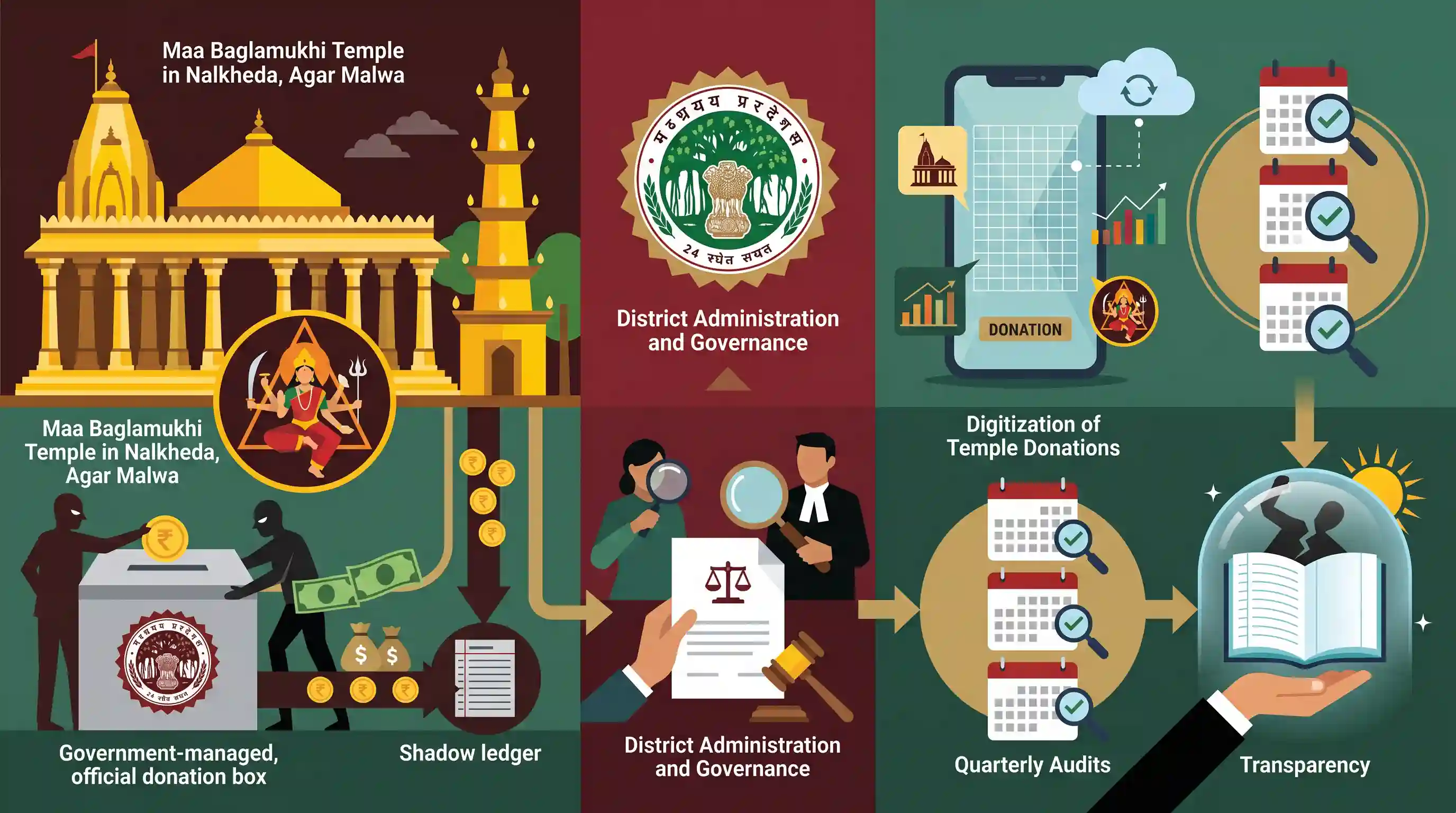
An official investigation has been ordered into an alleged financial and parallel donation racket at the government-managed Maa Baglamukhi Temple in Nalkheda, Agar Malwa district, Madhya Pradesh. In response to these financial irregularities, the MP Government announced plans to digitize temple donations and mandated quarterly audits of all state-managed temples to ensure transparency.
Key Points
- The District Administration of Agar Malwa ordered a high-level inquiry into an alleged parallel donation and financial racket at the state-managed Maa Baglamukhi Temple in Nalkheda, Madhya Pradesh.
- An unauthorized private committee was reportedly collecting donations (cash and ornaments) using fake receipts and private bank accounts instead of depositing them in the official government-managed accounts.
- District Collector Preeti Yadav constituted a three-member investigation committee headed by Zila Panchayat CEO B. S. Solanki to probe the irregularities.
- In response to the allegations, Madhya Pradesh Culture Minister (Independent Charge) Dharmendra Singh Lodhi announced that all state-administered temples will undergo mandatory quarterly audits (every three months).
- The state government plans to transition to a completely digital donation system in public temples to ensure absolute transparency and prevent financial fraud.
- The issue sparked political debates, referencing previous allegations of missing ornaments at other prominent state temples such as the Raja Ram Sarkar Temple in Orchha (Niwari district).
Important Terms
Maa Baglamukhi Temple (Nalkheda)

A highly revered Siddh Peeth dedicated to Goddess Baglamukhi, located in Agar Malwa, Madhya Pradesh. Dating back to the Mahabharata era, it is a prominent centre for Shakti and Tantric worship.
UPSC context
GS Paper I: Temple Architecture and Art Culture. Tests understanding of regional heritage sites and pilgrimage centers.
Department of Religious Trusts and Endowments, Madhya Pradesh
The state department responsible for administering public religious trusts, state-managed temples, and pilgrimage schemes, ensuring financial transparency, and regulating charitable endowments in Madhya Pradesh.
UPSC context
GS Paper II: Governance. Tests knowledge of state regulation of religious institutions and administrative accountability.
District Administration, Agar Malwa
The administrative machinery of Agar Malwa district, headed by the District Collector, responsible for maintaining law and order, revenue administration, and overseeing government-appointed local temple management committees.
UPSC context
GS Paper II: District Administration. Tests knowledge of District Collectors' roles in local governance, statutory oversight, and crisis management.
Zila Panchayat, Agar Malwa
The top-tier local self-governing body under the Panchayati Raj system in Agar Malwa. Its Chief Executive Officer coordinates rural development and possesses executive powers to lead district-level administrative probes.
UPSC context
GS Paper II: Panchayati Raj. Tests understanding of local self-government, decentralised governance, and executive powers in local bodies.
Madhya Pradesh Culture Department
The state department tasked with preserving and promoting the cultural heritage, literature, and fine arts of Madhya Pradesh. It manages several autonomous cultural academies, museums, and historical initiatives.
UPSC context
GS Paper I: Indian Culture. Tests familiarity with state-level institutional frameworks for heritage conservation and cultural promotion.
Prelims Trap
The Ram Raja Temple in Orchha is built in classical Dravidian temple architecture where Lord Ram is worshipped exclusively as a spiritual deity.
The temple is structurally a 16th-century palace exhibiting regional Bundela (Rajput-Mughal syncretic) architecture, and Lord Ram is uniquely worshipped as a reigning secular king, complete with a police guard of honor.
Static Concepts Connected
What are the prominent characteristics of the Bundela school of architecture?
- Syncretic style: Blends traditional Rajput styles with Mughal architectural elements like domes, arches, and high gateways.
- Key structures: Features massive fort-palaces, chhatris (cenotaphs) on river banks, and structures adorned with vivid Bundelkhandi wall paintings.
- Material used: Utilizes local sandstone and lime plaster, combining structural resilience with delicate, intricate decorative carvings.
What is the statutory role of a District Collector in public trust management?
- Registrar role: Acts as the Registrar of Public Trusts under state-specific trust legislations to supervise public charitable institutions.
- Audit authority: Empowered to direct mandatory audits, inspect physical assets, and investigate allegations of financial diversion.
- Inquiry powers: Authorized to conduct quasi-judicial inquiries to determine the public or private character of religious trusts.
Cross-Topic Patterns
State Temple Control vs Secularism
State management of temple finances tests the limits of Article 25 and 26, balancing administrative transparency with the freedom of religious practice.
Bundela Architecture & Syncretic Culture
Orchha's architectural heritage showcases the fusion of Rajput and Mughal design, reflecting medieval geopolitical alliances through religious and palace structures.

Bundela architecture's syncretic features and the statutory role of District Collectors under Public Trust Acts could merge in GS-1 and GS-2.
Linked PYQs · 1
Linked PYQs · 1
- 2025MPPSC_PRELIMSGS1
Where is the Matangeshwar temple located in Madhya Pradesh?
