US Tariff Policies and Bilateral Trade Agreements
Source:The Hindu ↗
Why It Matters
The article illustrates a major shift in global geopolitics and economics, as the U.S. dismantles multilateral trade norms in favor of aggressive protectionism. For UPSC aspirants, it is crucial for understanding the direct challenges to India's macroeconomic stability and foreign policy, particularly how India must navigate trade frictions and strategic pressures (like those concerning Russia and BRICS) from its largest trading partner.
Summary
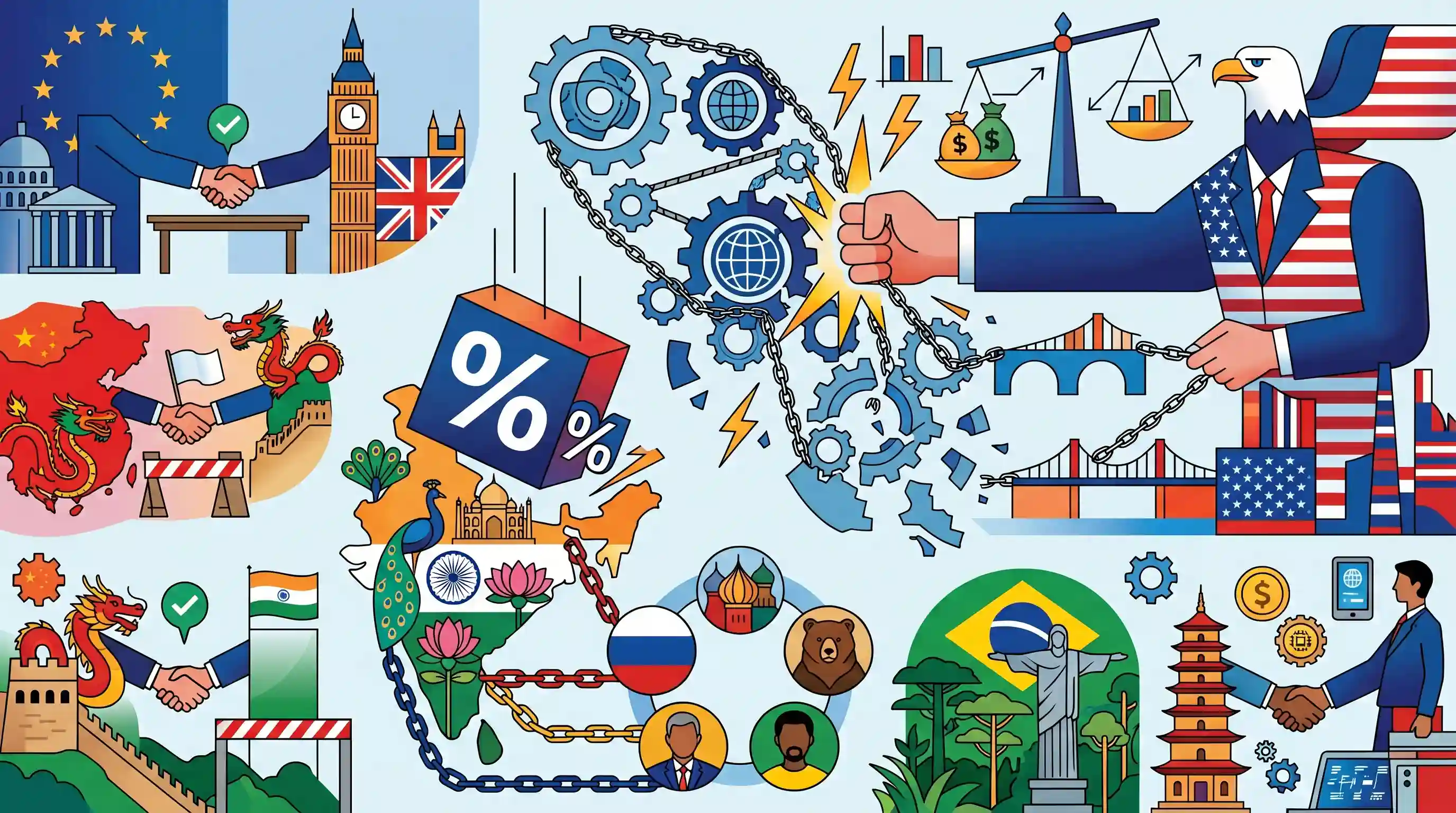
The U.S. administration under President Donald Trump is accelerating its shift toward a protectionist, bilateral trade policy, announcing a sweeping series of tariffs and conditional trade agreements globally. Targeting major economies, the U.S. imposed a 25% tariff on Indian imports, coupled with penalties explicitly linked to India's ties with Russia and its BRICS membership. The U.S. has also struck varying deals or truces with China, the EU, the UK, Brazil, and several Asian nations. This approach signifies a profound departure from multilateral trade frameworks in favor of aggressive, transactional bilateralism aimed at reducing the U.S. trade deficit.
Key Points
- The U.S. has announced a 25% tariff on Indian imports, along with extra penalties citing India's energy and military trade with Russia, its BRICS membership, and its own domestic tariff barriers.
- A temporary tariff truce has been reached with China in exchange for Chinese commitments to purchase U.S. agricultural goods and restrict fentanyl precursor exports.
- The U.S. has leveraged the threat of tariffs to enforce new bilateral trade terms worldwide, including 15% tariffs on the EU and South Korea, 50% on Brazil, and conditional agreements with the UK, Japan, and several ASEAN nations.
- This transactional, tariff-heavy trade policy marks a definitive U.S. shift away from multilateralism and WTO frameworks towards aggressive protectionism and bilateralism.
Important Terms
Reciprocal Trade Act

A U.S. policy framework allowing the President to impose "mirror" tariffs on countries whose duties on American goods exceed U.S. levels, aiming for trade reciprocity.
UPSC context
GS Paper II/III; tests trade war impacts, protectionist trends, and bilateral pressure on Indian exports like automobiles and steel.
BRICS
An intergovernmental organization of major emerging economies (Brazil, Russia, India, China, South Africa, etc.) focused on reforming global governance and promoting de-dollarization.
UPSC context
GS Paper II; crucial for understanding multipolarity, India's strategic autonomy, and emerging challenges to Western-led financial systems.
World Trade Organization (WTO)
The global body regulating international trade; its relevance is currently challenged by unilateral tariffs and the paralysis of its dispute settlement mechanism.
UPSC context
GS Paper II/III; tests knowledge of multilateral trade rules, the MFN principle, and the crisis of global economic institutions.
Bilateralism
A trade strategy prioritizing agreements between two nations over multilateral frameworks, often using direct leverage to secure transactional gains and reduce deficits.
UPSC context
GS Paper II; examines the shift in global diplomacy from rules-based multilateralism to power-based economic statecraft.
Most-Favored-Nation (MFN)
A non-discrimination principle requiring a WTO member to treat all other members equally; it is undermined by specific bilateral tariff "deals" or penalties.
UPSC context
GS Paper III; tests technical understanding of international trade law and the economic consequences of its erosion.
Prelims Trap
"The WTO explicitly allows members to unilaterally impose punitive tariffs based on geopolitical affiliations or alliance memberships."
Unilateral tariffs violate the WTO's Most-Favored-Nation (MFN) principle. Though nations misuse 'national security' exceptions, explicitly punishing political alignments fundamentally contravenes standard WTO rules.
Static Concepts Connected
What is the Most-Favored-Nation (MFN) principle under the WTO?
- Non-discrimination: A core WTO principle requiring a country to provide any concession, privilege, or immunity granted to one nation to all other WTO member nations.
- Exceptions: Exceptions exist for Free Trade Agreements (FTAs), customs unions, and special access schemes for developing nations (like the Generalized System of Preferences).
- Violation & Loopholes: Unilateral tariffs imposed outside these exceptions (e.g., purely for transactional leverage) violate MFN, though countries increasingly cite 'national security' (Article XXI) as a loophole.
What defines "Strategic Autonomy" in Indian Foreign Policy?
- Definition: The ability to make independent foreign policy and security decisions free from the constraints of formal military alliances or external pressure.
- Evolution: It represents a shift from Cold War 'Non-Alignment' to modern 'Multi-Alignment', actively engaging with multiple global poles (e.g., Quad and BRICS simultaneously).
- Current Challenges: Incidents like US tariffs linked to Russia ties highlight the increasing economic and diplomatic costs India must bear to sustain an independent geopolitical stance.
Cross-Topic Patterns
Tariff wars & BRICS De-dollarization
US tariffs explicitly penalizing BRICS membership will likely accelerate the Global South's push for alternative payment systems and de-dollarization to bypass US economic leverage.
Export competitiveness & Rupee volatility
A 25% tariff shock on Indian exports directly threatens the Current Account Deficit (CAD), risking imported inflation and forcing the RBI to actively manage rupee depreciation.

Expect a 2026 multi-statement question linking unilateral trade tariffs to WTO's MFN clauses and the economic costs of Strategic Autonomy.
Linked PYQs · 3
Linked PYQs · 3
- 2025MainsGS3
What are the challenges before the Indian economy when the world is moving away from free trade and multilateralism to protectionism and bilateralism? How can these challenges be met?
- 2018MainsGS3
How would the recent phenomena of protectionism and currency manipulations in world trade affect macroeconomic stability of India?
- 2019MainsGS2
‘What introduces friction into the ties between India and the United States is that Washington is still unable to find for India a position in its global strategy, which would satisfy India's national self-esteem and ambitions.’ Explain with suitable examples.
