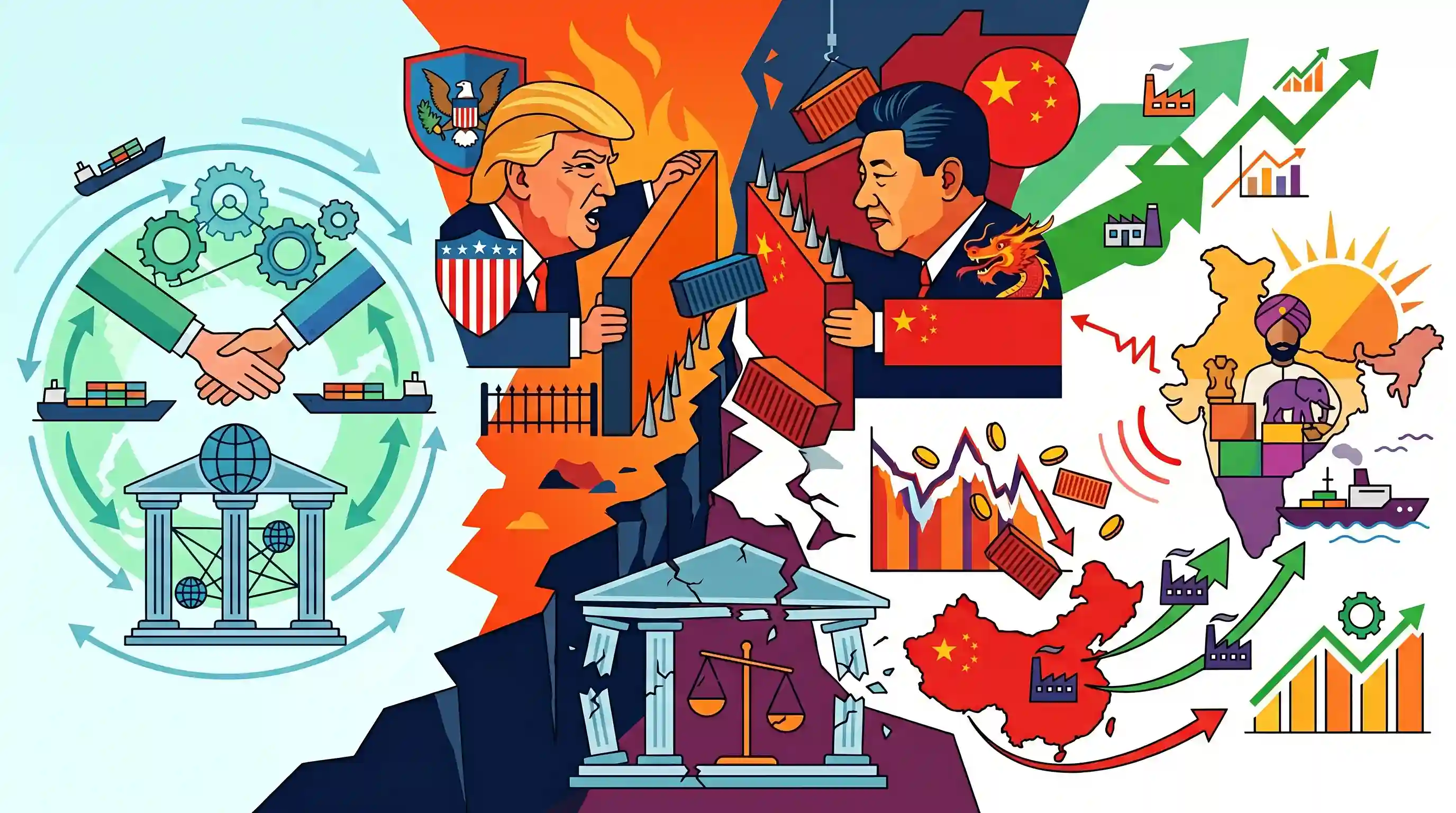
US China trade war erosion of WTO norms and impact on India
Source:Indian Express ↗
Why It Matters
Highlights the macroeconomic challenges and strategic imperatives for the Indian economy as the global trade order pivots away from free trade towards sovereign nationalism and protectionism.
Summary
The article discusses the shift in global trade dynamics from a rules-based multilateral system to unilateral protectionism, highlighted by the US-China trade war. Driven by the aggressive trade tactics of leaders like Donald Trump and Xi Jinping, this erosion of institutional norms like those of the WTO threatens global economic stability. For India, navigating this transition requires robust policy measures to mitigate macroeconomic risks while capitalizing on strategic opportunities like global supply chain realignments.
Key Points
- The global trade paradigm is shifting from a multilateral, rules-based system (anchored by the WTO) to unilateral actions and protectionist policies.
- The US-China trade war, characterized by the 'alpha male tactics' of leaders like Donald Trump and Xi Jinping, exemplifies the erosion of institutional trade norms.
- The decline of global multilateralism poses a threat to macroeconomic stability, raising tariff barriers and disrupting established supply chains.
- The Indian economy faces challenges from this protectionist trend but can also leverage geopolitical shifts (like the 'China Plus One' strategy) by enhancing its manufacturing and export competitiveness.
Important Terms
World Trade Organization (WTO)

The only global international organization dealing with rules of trade between nations. It facilitates negotiations, settles trade disputes, and monitors trade policies to ensure predictable and free trade.
UPSC context
GS Paper 2 & 3. Crucial for understanding global trade governance, its challenges, and India's role in multilateral negotiations.
Protectionism
Economic policy of restricting imports through tariffs, quotas, and subsidies to shield domestic industries and workers from foreign competition. It is the opposite of free trade.
UPSC context
GS Paper 3. Evaluates understanding of trade barriers, their impact on globalization, and recent shifts in global economic policy.
Rules-based International Order
A global governance framework where sovereign states commit to follow established laws, norms, and institutions to ensure stability and predictable international interactions.
UPSC context
GS Paper 2. Essential for analyzing shifting global power dynamics, international law, and threats to the post-WWII multilateral system.
Multilateralism
A process of organizing relations between three or more states based on shared principles and international institutions like the UN or WTO.
UPSC context
GS Paper 2. Tests knowledge of global cooperation versus regionalism and the ongoing crisis in global governance institutions.
China Plus One Strategy
A business strategy to diversify manufacturing by establishing operations in countries other than China to mitigate supply chain risks and geopolitical vulnerabilities.
UPSC context
GS Paper 3. Highly relevant for India's manufacturing ambitions, PLI schemes, and positioning in global value chains.
Unilateralism
An approach in international relations where a state acts independently, often disregarding international agreements or the interests of other nations.
UPSC context
GS Paper 2. Important for discussing aggressive trade tactics, "America First" policies, and the erosion of international norms.
Prelims Trap
"The WTO's dispute settlement mechanism has been officially abolished due to the US-China trade war."
The mechanism isn't abolished; its Appellate Body is paralyzed because the US blocked judge appointments since 2019. Initial panel-level rulings still occur, though appeals fall into a void.
Static Concepts Connected
What are the primary trade defense instruments permitted under the WTO?
- Anti-dumping Duties (ADD): Levied on imported goods that are priced below their fair market value in the exporting country, threatening domestic industries.
- Countervailing Duties (CVD): Imposed to neutralize the negative effects of trade-distorting financial subsidies provided by the exporting country's government.
- Safeguard Measures: Temporary import restrictions enacted to protect a domestic industry from a sudden, unforeseen, and damaging surge in imports.
How does the WTO Dispute Settlement Mechanism function?
- Consultation Phase: Parties attempt to resolve the dispute amicably through negotiations before formally escalating to adjudication.
- Panel Stage: If consultations fail, an ad hoc panel assesses the case and issues a ruling based on WTO agreements.
- Appellate Body: Reviews appeals on points of law. Currently paralyzed due to a lack of quorum as the US blocked new judge appointments.
Cross-Topic Patterns
WTO paralysis and the rise of minilateralism
As the WTO falters, mega-regional trade pacts like RCEP and minilateral economic frameworks like IPEF dominate, shifting global trade from universal consensus-based rules to fragmented, interest-based blocks.
Geopolitics reshaping domestic industrial policy
The US-China trade war directly catalyses India's domestic macroeconomic strategy; PLI schemes act as a fiscal magnet to absorb the 'China Plus One' global supply chain exodus.

Expect a GS2/GS3 Mains question linking WTO Appellate Body paralysis to the rise of protectionism, IPEF, and India's China Plus One gains.
Linked PYQs · 4
Linked PYQs · 4
- 2025MainsGS3
What are the challenges before the Indian economy when the world is moving away from free trade and multilateralism to protectionism and bilateralism? How can these challenges be met?
- 2018MainsGS2
What are the key areas of reform if the WTO has to survive in the present context of "Trade War', especially keeping in mind the interest of India?
- 2018MainsGS3
How would the recent phenomena of protectionism and currency manipulations in world trade affect macroeconomic stability of India?
- 2025MainsGS2
"With the waning of globalization, post-Cold War world is becoming a site of sovereign nationalism.” Elucidate.
