Beijing Summit Between US and China Addresses Taiwan and Chips
Source:Indian Express ↗
Why It Matters
The intersection of geopolitical rivalry in the Taiwan Strait and technological dependence on semiconductor supply chains is a defining issue in global affairs. For UPSC aspirants, this highlights how major power relations (US-China) impact strategic stability in the Indo-Pacific and underscores the necessity of India's efforts, such as the India Semiconductor Mission, to achieve self-reliance in critical technologies.
Summary
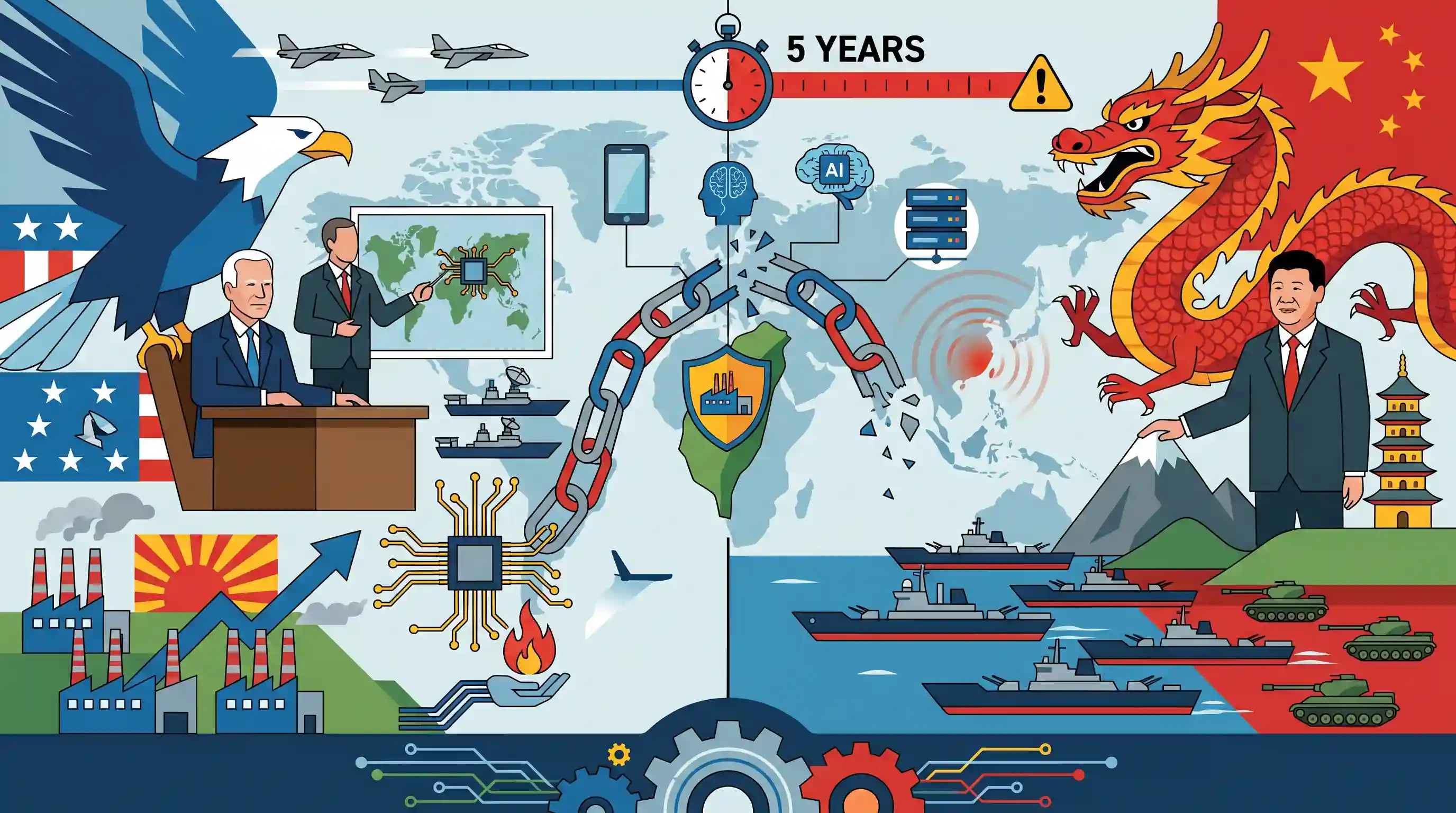
A recent summit in Beijing between US President Donald Trump and Chinese President Xi Jinping brought the intersecting issues of Taiwan's security and global semiconductor supply chains to the forefront. According to reports, US advisers harbor deep concerns that China may invade Taiwan within five years, a move that would severely disrupt the global supply of advanced AI chips before the US can achieve supply chain independence. While Xi warned that the Taiwan issue could spark conflict, Taiwan's President Lai Ching-te stood firm on maintaining the island's democratic sovereignty and relying on US security guarantees. The summit underscored the fragile balance in the Indo-Pacific and the vulnerability of the global tech economy to great power rivalry.
Key Points
- US President Donald Trump and Chinese President Xi Jinping recently held a summit in Beijing, highlighting major geopolitical fault lines including Taiwan and technological decoupling.
- Trump's advisers reportedly fear that China may attempt to invade Taiwan within the next five years, jeopardizing global access to advanced AI chips and semiconductors.
- Xi Jinping warned that mishandling the Taiwan issue could lead to clashes and asserted China's status as an equal global power to the United States.
- Taiwanese President Lai Ching-te responded firmly that Taiwan will not surrender its sovereignty or be "sacrificed or traded," emphasizing the ongoing need for US security commitments.
- The discussions underscored the vulnerability of the US economy to supply chain shocks, as domestic manufacturing cannot currently replace Taiwan's critical role in semiconductor production.
Important Terms
Indo-Pacific

A vast maritime region encompassing the Indian and Pacific Oceans, serving as the global center for trade, energy routes, and strategic competition.
UPSC context
GS Paper 2: International Relations; crucial for understanding regional security (QUAD), maritime trade, and India's 'Act East' policy.
One China Policy
A diplomatic acknowledgement of China's position that there is only one Chinese government, with Taiwan as an inalienable part of it.
UPSC context
GS Paper 2: International Relations; essential for analyzing Sino-US tensions and India's nuanced diplomatic engagement with Taiwan.
Taiwan Strait
A 180-km wide waterway separating mainland China from Taiwan, serving as a critical global shipping route and a geostrategic flashpoint.
UPSC context
GS Paper 2: International Relations/Geography; tests knowledge of maritime chokepoints and the security of global supply chains.
Semiconductor Supply Chain
The global network of design, fabrication, and assembly for microchips, currently characterized by high geographic concentration in East Asia.
UPSC context
GS Paper 3: Economy/Science & Tech; relevant to the India Semiconductor Mission (ISM) and tech-based national security.
Strategic Autonomy
A state's capacity to pursue its national interests and foreign policy independently, without being coerced by other powers or dependencies.
UPSC context
GS Paper 2: Foreign Policy; core concept for India's multi-alignment strategy and managing great power rivalries.
AI Chips
Highly specialized microchips designed to process the complex computations required for artificial intelligence and machine learning.
UPSC context
GS Paper 3: Science & Technology; relevant to emerging technologies, indigenization, and the Fourth Industrial Revolution.
Prelims Trap
India officially endorses the 'One China Principle' and maintains no economic or diplomatic ties with Taiwan.
India follows the nuanced 'One China Policy'—not Beijing's absolute 'Principle'—and maintains robust unofficial economic, tech, and cultural ties with Taipei.
Static Concepts Connected
What are the core components of the India Semiconductor Mission (ISM)?
- Fiscal Support: Offers up to 50% of the project cost on a pari-passu basis to eligible applicants for setting up semiconductor and display fabrication units.
- Design Linked Incentive: Provides financial incentives and infrastructure support across various stages of semiconductor design, aiming to nurture domestic startups and MSMEs.
- Nodal Agency: Operates as an independent business division within the Digital India Corporation to build a vibrant domestic semiconductor ecosystem.
What is the geographical and strategic significance of the Taiwan Strait?
- Strategic Location: It forms a critical maritime corridor that connects the South China Sea in the south to the East China Sea in the north.
- Trade Chokepoint: It carries a massive volume of global container ships; a blockade would paralyze supply chains and crucial energy imports to Northeast Asia.
Cross-Topic Patterns
Chips, critical minerals, and the Quad
Vulnerability in Taiwan's chip foundries pushes Quad nations to map critical mineral supply chains—especially gallium and germanium controlled by China—to secure future AI hardware production.
Taiwan Strait blockades and global inflation
A Taiwan contingency directly impacts macroeconomics. Disruptions in the strait would trigger severe supply-side stagflation and disrupt global tech hardware, dwarfing the recent Red Sea shipping crisis.

Expect a multi-statement question in 2026 interlinking Taiwan's geography, semiconductor reliance, and India's 'One China Policy'.
Linked PYQs · 2
Linked PYQs · 2
- 2021MainsGS2
The newly tri-nation partnership AUKUS is aimed at countering China's ambitions in the Indo-Pacific region. Is it going to supersede the existing partnerships in the region? Discuss the strength and impact of AUKUS in the present scenario.
- 2025MainsGS3
India aims to become a semiconductor manufacturing hub. What are the challenges faced by the semiconductor industry in India? Mention the salient features of the India Semiconductor Mission.
