US Iran Regime Change Policy and Geopolitical Implications
Source:Indian Express ↗
Why It Matters
The stability of West Asia is critical for India's energy security, the safety of its large diaspora, and its strategic connectivity projects like Chabahar Port and INSTC. Understanding the implications of US policy shifts toward Iran is essential for answering questions on international relations and geopolitics.
Summary
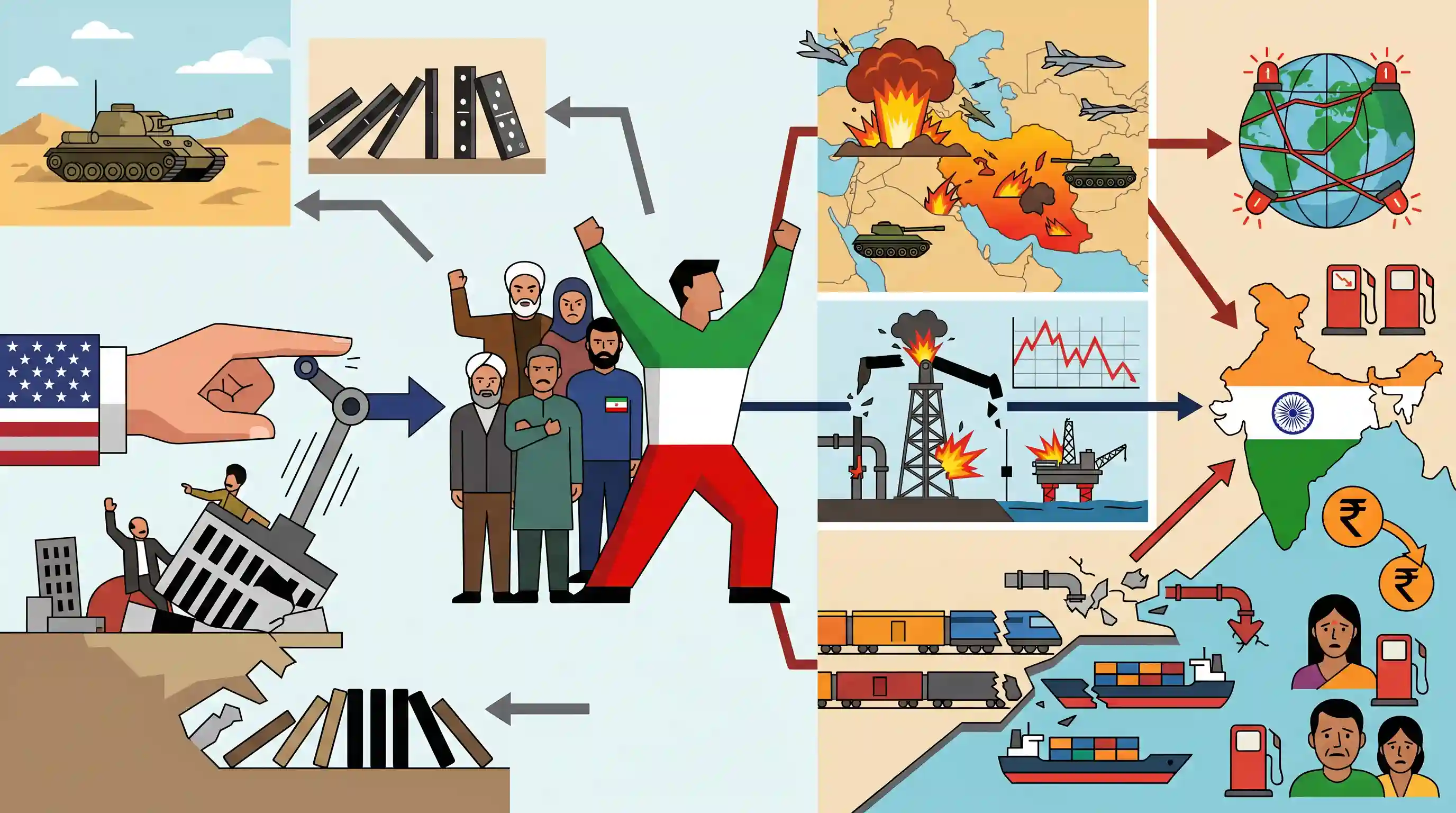
The article analyzes the potential consequences of Donald Trump's apparent push for regime change in Iran, arguing that historical precedents strongly advise against such an approach. Past US interventions in the region, including the 1953 Iranian coup and the Iraq war, have led to prolonged instability and unintended geopolitical consequences. While Iran's current government faces significant internal dissatisfaction, external threats typically allow the regime to leverage nationalism to its advantage. Any attempt to forcefully topple the Iranian government risks igniting a massive regional war, disrupting global energy markets, and severely complicating the strategic and economic interests of countries like India, which relies on regional stability for energy security and connectivity projects like the Chabahar port.
Key Points
- Donald Trump's policy towards Iran leans heavily on 'maximum pressure' and rhetoric suggesting a desire for regime change.
- Historical attempts at US-engineered regime change in the Middle East, such as the 1953 coup in Iran or the 2003 invasion of Iraq, have frequently resulted in long-term instability and anti-American blowback.
- Although the Iranian clerical regime faces domestic protests and economic hardship, overt foreign intervention often enables the state to rally nationalist sentiment and consolidate power.
- A push for regime change risks triggering a broader regional conflict involving Iranian proxies (like Hezbollah and the Houthis), directly threatening global energy security through choke points like the Strait of Hormuz.
- For India, escalating US-Iran tensions jeopardize energy security, the strategic Chabahar Port project, and the broader International North-South Transport Corridor (INSTC).
Important Terms
Joint Comprehensive Plan of Action (JCPOA)

A 2015 landmark agreement between Iran and the P5+1 powers to restrict Iran’s nuclear program in exchange for lifting international economic sanctions.
UPSC context
GS II (International Relations). Tests knowledge of nuclear non-proliferation treaties and West Asian geopolitical stability.
International North-South Transport Corridor (INSTC)
A 7,200-km multi-modal transit network connecting India to Russia and Europe via Iran, significantly reducing travel time and costs compared to the Suez Canal.
UPSC context
GS II (Connectivity Projects). Vital for evaluating India’s 'Connect Central Asia' policy and trade diversification.
Chabahar Port
Iran's only oceanic port, developed with Indian partnership to provide a strategic trade gateway to Afghanistan and Central Asia that bypasses Pakistan.
UPSC context
GS II (Bilateral Relations). Essential for understanding regional influence, maritime security, and countering China’s Gwadar Port.
Strategic Autonomy
India's core foreign policy principle of making independent sovereign decisions based on national interests without being constrained by formal military alliances or external pressures.
UPSC context
GS II (Foreign Policy). Tests analysis of multi-alignment and India's balancing act between global powers like the US and Russia.
Islamic Republic of Iran
A unique political system established in 1979 combining theocracy and democracy, where an unelected Supreme Leader holds ultimate authority over the elected President and Parliament.
UPSC context
GS II (Political Systems). Important for analyzing the internal drivers of Iran's foreign policy and regional behavior.
Operation Ajax (1953 Iranian Coup)
A 1953 covert operation orchestrated by the CIA and British intelligence to overthrow democratically elected Prime Minister Mohammad Mosaddegh after he nationalized Iran’s oil industry.
UPSC context
GS I/II (World History/IR). Explains the historical roots of anti-Western sentiment in the region and risks of regime change.
Prelims Trap
"Chabahar Port is located in the Persian Gulf and requires transit through the Strait of Hormuz."
Chabahar is strategically located on the Gulf of Oman, explicitly bypassing the Strait of Hormuz. This bypass is its primary strategic value for securing Indian maritime access.
Static Concepts Connected
What is the strategic geography of the Strait of Hormuz?
- Location: Connects the oil-rich Persian Gulf to the Gulf of Oman and the broader Arabian Sea.
- Bordering states: Bounded by Iran to the north and the Musandam Peninsula (shared by Oman and the UAE) to the south.
- Strategic value: A critical maritime chokepoint handling over 20% of global oil trade; its blockade would severely disrupt India's energy security.
How does CAATSA affect India's foreign policy?
- Core mandate: A US federal law that mandates secondary sanctions on countries doing significant business with Iran, North Korea, or Russia.
- Energy impact: It historically coerced India into zeroing out its Iranian crude oil imports to avoid being frozen out of the US financial system.
- Strategic autonomy: It challenges India's multi-aligned posture, requiring intense diplomatic lobbying for presidential waivers to pursue defense and connectivity projects.
Cross-Topic Patterns
INSTC vs. US Sanctions Regime
India's Eurasian connectivity ambitions through the INSTC continually clash with US secondary sanctions on Iran, forcing New Delhi to balance Western strategic ties with continental access to Central Asia.
Sectarian vs. Strategic Proxy Networks
Iran's 'Axis of Resistance' defies simple sectarian binaries, uniting Shia groups like Hezbollah and Houthis with Sunni Hamas under shared anti-Western and anti-Israel strategic objectives.

Expect a 2026 map-based Prelims question integrating West Asian ports (Chabahar, Jask, Duqm) with global trade corridors (INSTC, IMEC).
Linked PYQs · 3
Linked PYQs · 3
- 2018MainsGS2
In what ways would the ongoing US-Iran Nuclear Pact Controversy affect the national interest of India? How should India respond to this situation?
- 2025MainsGS2
"Energy security constitutes the dominant kingpin of India's foreign policy, and is linked with India's overarching influence in Middle Eastern countries.” How would you integrate energy security with India's foreign policy trajectories in the coming years?
- 2025PrelimsGS1
India is one of the founding members of the International North-South Transport Corridor (INSTC), a multimodal transportation corridor, which will connect
