US Russia Relations and Implications for India Strategic Autonomy
Source:Indian Express ↗
Why It Matters
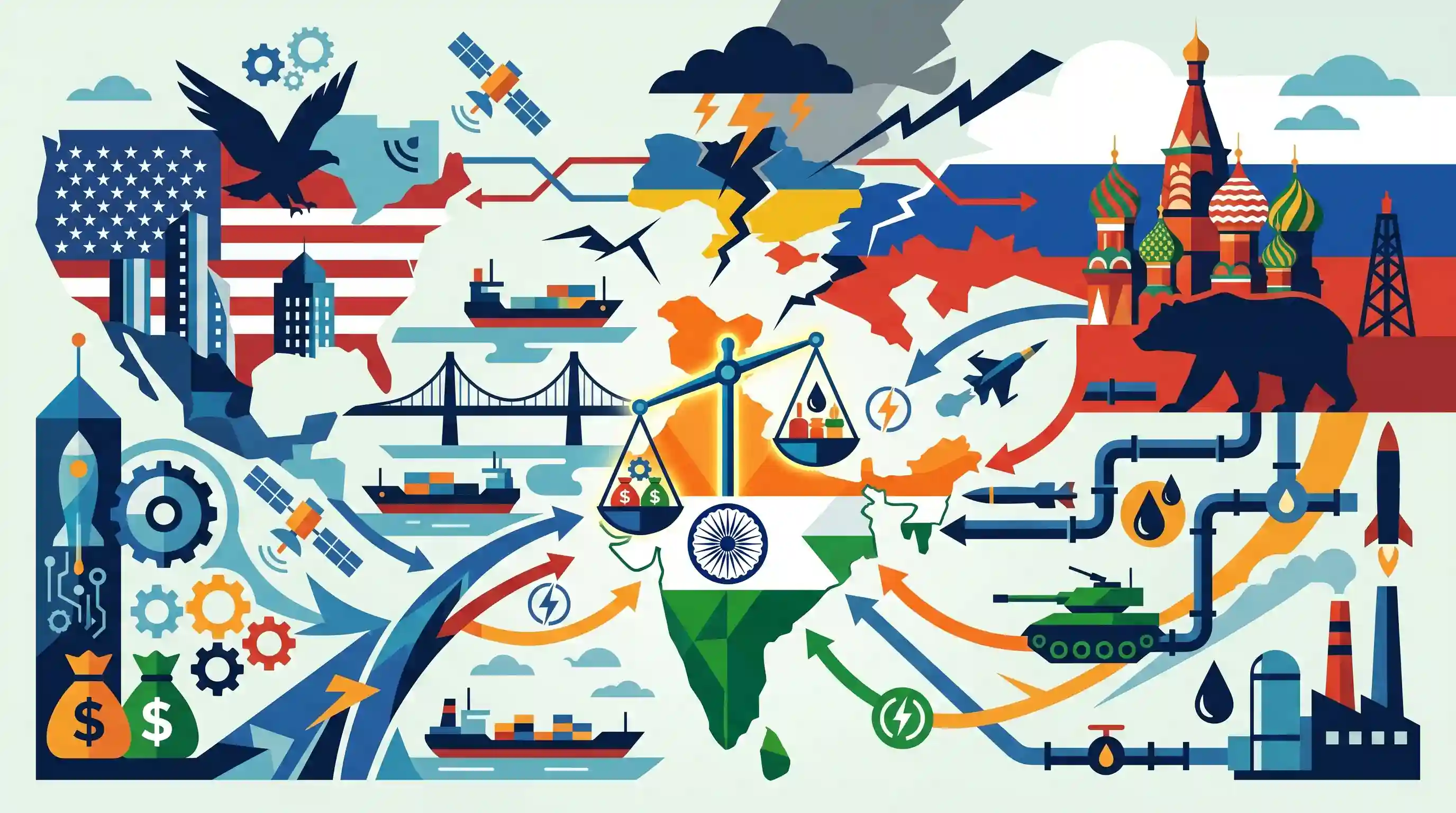
Navigating the complex triangular relationship between the US, Russia, and India is central to understanding India's contemporary foreign policy, particularly its pursuit of strategic autonomy, energy security, and defense modernization.
Summary
The article examines the evolving US-Russia bilateral ties under Presidents Donald Trump and Vladimir Putin, particularly focusing on the lack of a definitive peace deal in the Russia-Ukraine war and unresolved diplomatic dialogues. It underscores the profound implications for India, noting that New Delhi's foreign policy choices extend far beyond navigating potential US tariffs on Russian oil imports. Ultimately, the piece highlights India's ongoing challenge to maintain its strategic autonomy and energy security while balancing crucial partnerships with both Washington and Moscow amidst shifting global geopolitical realities.
Key Points
- Analyzes the diplomatic dynamics between US President Donald Trump and Russian President Vladimir Putin regarding the Russia-Ukraine war, highlighting the lack of a comprehensive peace agreement.
- References 'unfinished Alaska talks' as a symbol of unresolved strategic and diplomatic issues in the US-Russia bilateral relationship.
- Examines India's complex foreign policy choices in balancing its vital energy and defense ties with Russia against its deepening strategic partnership with the United States.
- Highlights that the challenges for New Delhi extend beyond potential US tariffs or pressures on Russian oil imports, impacting its broader strategic autonomy and energy security.
Important Terms
Strategic Autonomy

India’s doctrine of exercising independent foreign policy and making decisions based on national interest without being coerced by global powers or formal military alliances.
UPSC context
GS Paper II (IR); fundamental concept for analyzing India’s 'balancing act' between the US and Russia during global conflicts.
Energy Security
The uninterrupted availability of energy sources at an affordable price, vital for India’s economic development and managing domestic inflation.
UPSC context
GS Paper II & III; key driver of India’s continued oil imports from Russia despite Western diplomatic pressure.
CAATSA
A 2017 US law used to impose sanctions on nations engaging in 'significant transactions' with the defense or intelligence sectors of Russia, Iran, and North Korea.
UPSC context
GS Paper II (IR); tested in the context of India’s S-400 deal and potential waivers from American sanctions.
Secondary Sanctions
Economic penalties imposed by a country on third-party nations or entities to prevent them from trading with a primarily sanctioned state.
UPSC context
GS Paper II; critical for understanding the legal tools the US uses to pressure India regarding Russian oil imports.
Anchorage Understanding
An informal framework or potential peace roadmap established during the August 2025 summit in Anchorage to resolve the Russia-Ukraine conflict.
UPSC context
GS Paper II; highlights evolving US-Russia diplomatic dynamics and their implications for regional stability and Indian interests.
Multi-alignment
A foreign policy strategy of simultaneously engaging with multiple competing global powers to safeguard diverse national interests and maintain geopolitical flexibility.
UPSC context
GS Paper II; the modern evolution of Non-Alignment, relevant to India’s roles in Quad, BRICS, and SCO.
Prelims Trap
India eventually suspended its Russian crude oil imports due to the severe 50% penal tariffs imposed by the US government.
India never halted imports. In fact, Washington was forced to issue temporary sanctions waivers to Indian refiners to prevent global oil price spikes caused by Strait of Hormuz disruptions.
Static Concepts Connected
How does India's 'Strategic Autonomy' fundamentally differ from historical 'Non-Alignment'?
- Non-Alignment: Focuses on avoiding formal military blocs and maintaining equidistant neutrality between superpowers, heavily utilized during the Cold War.
- Strategic Autonomy: Focuses on issue-based partnerships. It involves actively aligning with multiple powers simultaneously (e.g., US for defense tech, Russia for oil) to maximize national interests.
What is CAATSA and how do its waiver mechanisms operate?
- CAATSA Framework: Countering America's Adversaries Through Sanctions Act (2017) is a US federal law imposing sanctions on nations conducting significant defense or energy transactions with Russia, Iran, or North Korea.
- Waiver Authority: The US President can grant temporary or modified waivers if it serves US national security interests or if the target country is actively reducing its reliance on the sanctioned state.
Cross-Topic Patterns
Chokepoints dictating sanction enforceability
The linkage between Strait of Hormuz shipping restrictions and US sanctions waivers highlights how maritime chokepoints directly dictate the enforceability of major power sanctions and global oil prices.
Trade tariffs as geopolitical weapons
The US deploying 50% penal tariffs on Indian exports to enforce a Russian oil boycott signals a growing trend of weaponizing global trade mechanisms to achieve geopolitical compliance.

India's strategic autonomy under the dual pressure of US penal tariffs and Russian oil reliance is prime for a 2026 GS-2 Mains question.
Linked PYQs · 3
Linked PYQs · 3
- 2025MainsGS2
"Energy security constitutes the dominant kingpin of India's foreign policy, and is linked with India's overarching influence in Middle Eastern countries.” How would you integrate energy security with India's foreign policy trajectories in the coming years?
- 2020MainsGS2
What is the significance of Indo-US defence deals over Indo-Russian defence deals? Discuss with reference to stability in the Indo-Pacific region.
- 2019MainsGS2
‘What introduces friction into the ties between India and the United States is that Washington is still unable to find for India a position in its global strategy, which would satisfy India's national self-esteem and ambitions.’ Explain with suitable examples.
