Russia nuclear weapons testing preparations and global arms race
Source:Indian Express ↗
Why It Matters
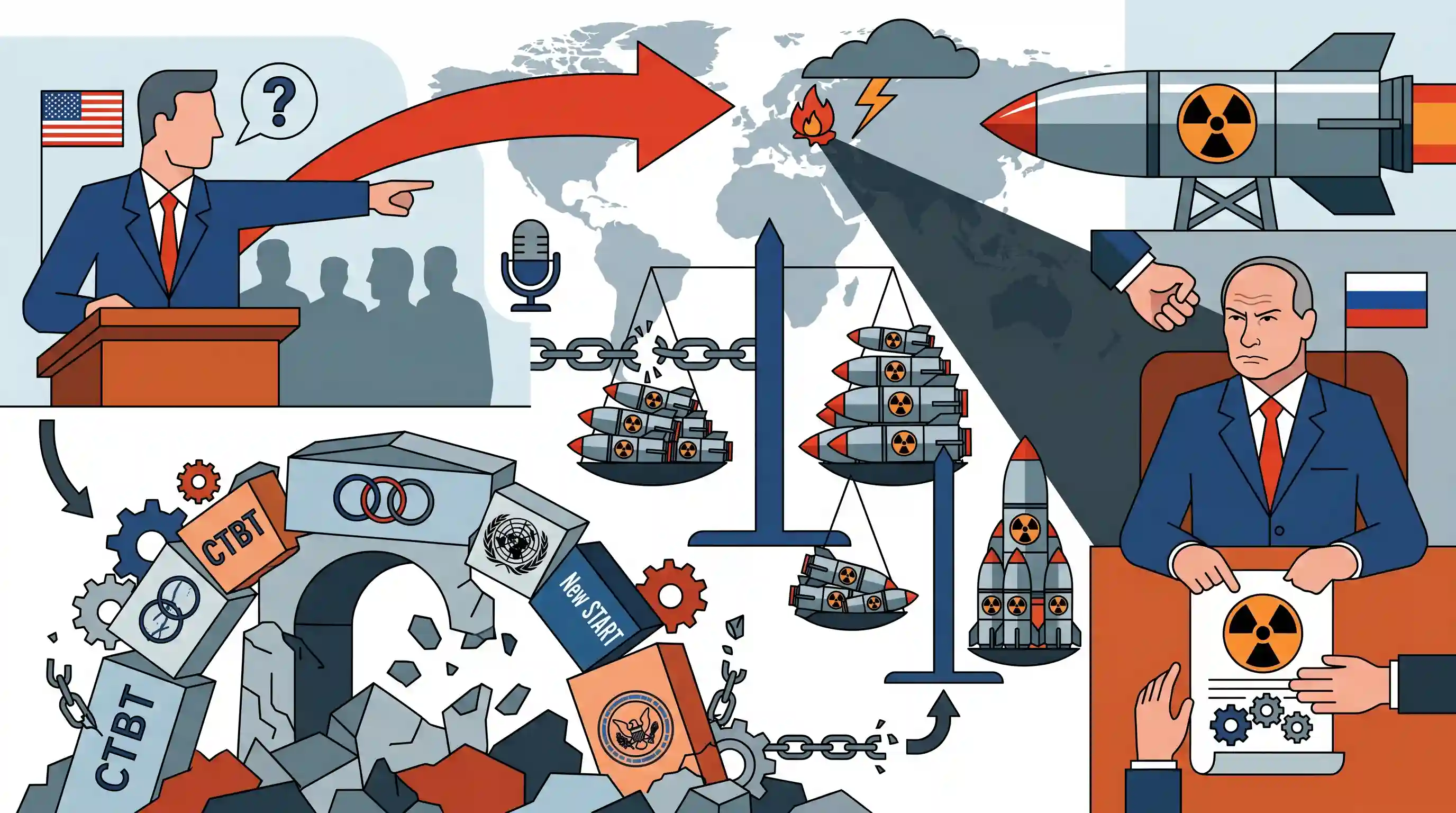
This marks a critical juncture in global nuclear politics, highlighting the unraveling of cold-war era arms control frameworks like New START and CTBT. It sets a dangerous precedent for the resumption of nuclear testing, increasing risks of a renewed global arms race and nuclear escalation.
Summary
Russian President Vladimir Putin has ordered officials to draft proposals for a potential resumption of nuclear weapons testing. This directive comes in response to statements by US President Donald Trump about the US resuming its own nuclear tests, based on claims that other nations are secretly doing the same. Russia, which suspended its participation in the New START treaty and revoked its ratification of the Comprehensive Nuclear-Test-Ban Treaty (CTBT) in 2023, boasts the world's largest nuclear arsenal alongside the US. The move signals an intensifying nuclear arms race and a collapse of global non-proliferation architecture against the backdrop of the Ukraine conflict.
Key Points
- President Putin has instructed Russian officials to prepare for nuclear weapons tests, framing it as a reaction to President Trump's stated readiness to resume US nuclear testing.
- Russia and the US control approximately 88% of the global nuclear weapons inventory, with Russia possessing 5,580 warheads and the US possessing 5,044.
- Nine countries currently possess nuclear weapons: the US, Russia, China, France, the UK, India, Pakistan, North Korea, and Israel (which maintains strategic ambiguity).
- Russia is developing next-generation strategic weapons, including the nuclear-powered Burevestnik cruise missile and the nuclear-armed Poseidon super-torpedo.
- The developments highlight the ongoing breakdown of bilateral arms control agreements, following Russia's 2023 suspension of the New START treaty and de-ratification of the CTBT.
Important Terms
New START treaty

A bilateral (US-Russia) treaty limiting deployed strategic nuclear warheads (1,550) and delivery systems. It expired in February 2026, marking the first time in decades without legally binding caps on the world’s largest nuclear arsenals.
UPSC context
GS Paper II: Bilateral Agreements. Tests understanding of the US-Russia arms control architecture and global strategic stability.
Comprehensive Nuclear-Test-Ban Treaty (CTBT)
A multilateral treaty banning all nuclear explosions for military or civilian purposes. Adopted in 1996, it requires ratification by 44 specific 'Annex 2' nations (including India and the US) to enter force; nine remain outstanding.
UPSC context
GS Paper II: Multilateral Agreements. Tests India's stand on 'discriminatory' treaties and requirements for global disarmament.
Treaty on the Non-Proliferation of Nuclear Weapons (NPT)
A 1968 treaty aimed at preventing the spread of nuclear weapons and promoting peaceful nuclear energy. It recognizes five nuclear-weapon states (P5) while requiring others to remain non-nuclear. India is a non-signatory.
UPSC context
GS Paper II: Global Institutions. Tests knowledge of the 'nuclear haves/have-nots' divide and India’s nuclear doctrine.
Vertical Proliferation
An increase in the number or modernization of nuclear weapons and delivery systems within existing nuclear-weapon states, often signaling a renewed arms race despite disarmament pledges.
UPSC context
GS Paper III: Security. Critical for evaluating contemporary global security threats and the collapse of arms control frameworks.
Annex 2 Countries
A list of 44 specific states that participated in the CTBT’s 1996 negotiations and possessed nuclear reactors. The treaty cannot legally enter into force until all 44 countries have ratified it.
UPSC context
GS Paper II: International Relations. Tests technical knowledge of treaty enforcement and barriers to global nuclear non-proliferation.
Prelims Trap
"The CTBT is a globally binding treaty currently in force."
The CTBT has never entered into force. It legally requires ratification by all 44 specific 'Annex 2' states. Eight, including the US, China, and India, haven't ratified it.
Static Concepts Connected
Why does India refuse to sign the NPT and CTBT?
- Discriminatory nature: The NPT arbitrarily divides the world into nuclear 'haves' and 'have-nots' based on whether they tested a device before January 1, 1967.
- No disarmament link: India argues the CTBT focuses merely on test bans without committing existing nuclear-weapon states to a time-bound, universal disarmament framework.
- Security imperatives: Surrounded by nuclear-armed neighbors (China and Pakistan), India maintains that retaining a nuclear option is essential for a credible minimum deterrent.
What are the major US-Russia nuclear arms control agreements?
- New START: Signed in 2010, it capped deployed strategic nuclear warheads and launchers. Russia unilaterally suspended its participation in 2023.
- INF Treaty: Banned all ground-launched ballistic and cruise missiles with ranges of 500 to 5,500 kilometers. It collapsed in 2019 after both nations withdrew.
- ABM Treaty: Limited anti-ballistic missile systems used in defending areas against nuclear-armed missiles. The US unilaterally withdrew in 2002.
Cross-Topic Patterns
Next-gen weapons evading missile defense
Systems like the nuclear-powered Burevestnik missile and Poseidon torpedo reflect a shift toward unconventional delivery mechanisms designed specifically to bypass and render obsolete traditional ballistic missile defense grids.
Multipolar nuclear arms race
The collapse of US-Russia bilateral treaties paves the way for an unregulated three-way arms race involving China's expanding arsenal, heavily impacting India's strategic calculations and nuclear posture.

A 2026 Prelims question is highly likely to pair CTBT's 'Annex 2' enforcement conditions with India's refusal to sign the NPT/CTBT.
Linked PYQs · 3
Linked PYQs · 3
- 2015PrelimsGS1
Consider the following countries: 1. China 2. France 3. India 4. Israel 5. Pakistan Which among the above are Nuclear Weapons States as recognized by the Treaty on the Non-Proliferation of Nuclear Weapons, commonly known as Nuclear Non-Proliferation Treaty (NPT)?
- 2018PrelimsGS1
What is/are the consequence/consequences of a country becoming the member of the 'Nuclear Suppliers Group'? 1. It will have access to the latest and most efficient nuclear technologies. 2. It automatically becomes a member of "The Treaty on the Non-Proliferation of Nuclear Weapons (NPT)". Which of the statements given above is/are correct?
- 2011PrelimsGS1
The "New START" treaty was in the news. What is this treaty?
