US Russia Summit in Alaska and Geopolitical Implications
Source:Indian Express ↗
Why It Matters
The direct engagement between the US and Russia under a new US administration is a pivotal event in global geopolitics. Understanding its implications is crucial for civil services aspirants to analyze how major power shifts affect India's foreign policy, defense relationships, and global economic stability.
Summary
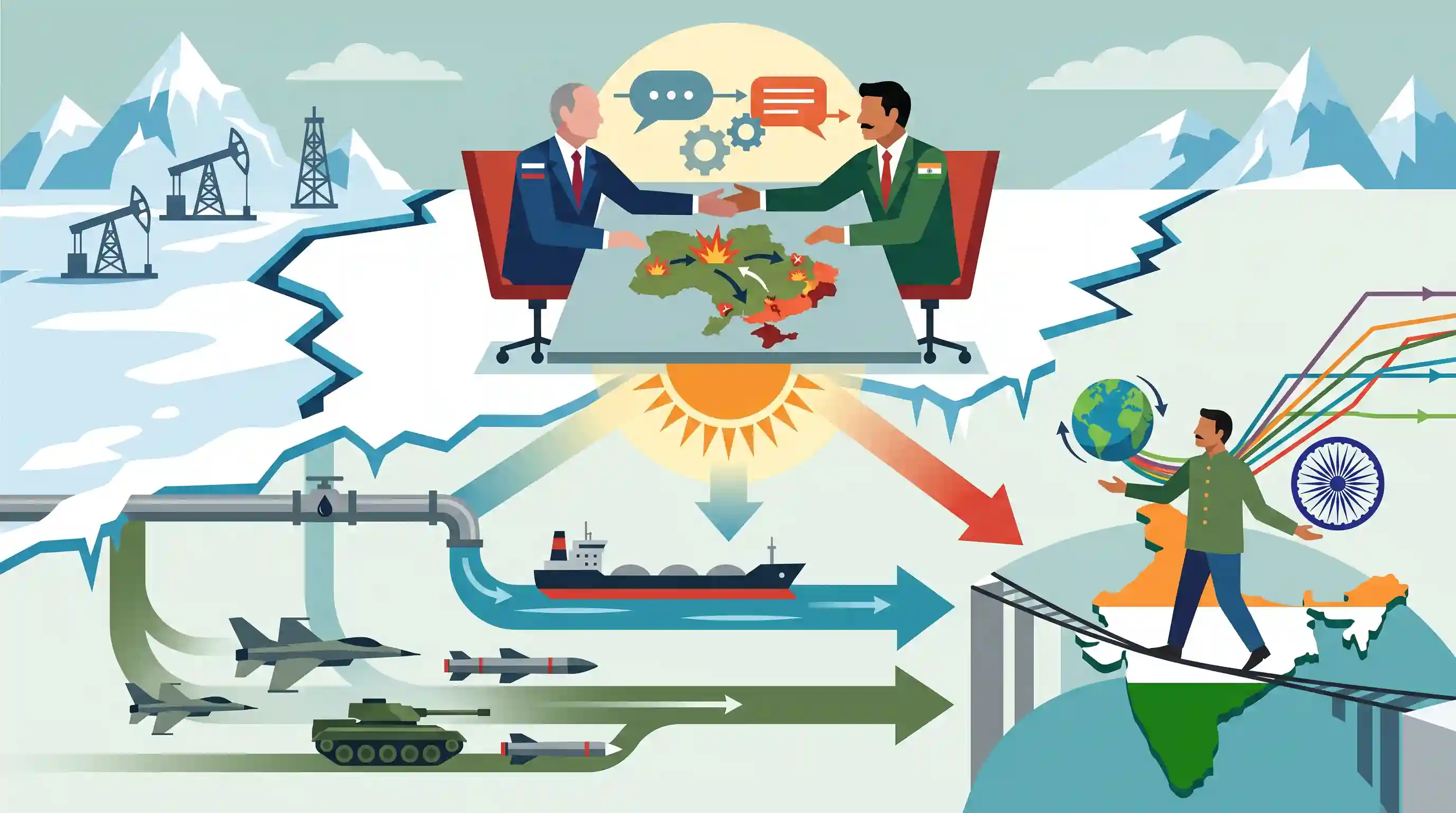
The article presents a 'report card' on the Alaska Summit between US President Donald Trump and Russian President Vladimir Putin, focusing on their dialogue regarding the Ukraine War. It assesses the potential for a negotiated settlement between the two powers and the broader geopolitical implications. For India, the summit is of critical importance, as a thaw in US-Russia relations could positively impact its defense procurement, energy security, and strategy of multi-alignment, easing the diplomatic tightrope New Delhi has walked since the outbreak of the conflict.
Key Points
- The article evaluates the outcomes of the historic Alaska Summit between US President Donald Trump and Russian President Vladimir Putin.
- A major agenda of the bilateral talks was addressing the ongoing Ukraine War and exploring potential frameworks for a ceasefire or a long-term settlement.
- The summit holds significant stakes for India, as a de-escalation between Washington and Moscow could ease global inflationary pressures, stabilize energy markets, and secure defense supply chains.
- India's diplomatic strategy of maintaining strategic autonomy while engaging with both the US and Russia is tested and potentially validated by direct US-Russia negotiations.
Important Terms
NATO (North Atlantic Treaty Organization)

A 32-member political and military alliance of European and North American countries committed to collective defense; its eastward expansion is a core point of contention in the Russia-Ukraine conflict.
UPSC context
GS Paper 2: International Relations; critical for understanding global security architectures and the root causes of the Ukraine crisis.
Strategic Autonomy
The foreign policy doctrine where a nation makes independent decisions based on national interest without being constrained by external powers or binding military alliances.
UPSC context
GS Paper 2: Fundamental concept of Indian foreign policy; tests ability to analyze India's balancing act between rival global powers.
Multi-alignment
The modern evolution of non-alignment where India seeks issue-based partnerships with multiple global powers (e.g., USA, Russia, China) simultaneously to diversify strategic options and safeguard interests.
UPSC context
GS Paper 2: Contemporary Indian diplomacy; relevant for discussing shifts in global power distribution and India's pragmatic engagement.
CAATSA
A 2017 US federal law that imposes sanctions on countries conducting 'significant transactions' with the Russian, Iranian, or North Korean defense and intelligence sectors.
UPSC context
GS Paper 2: Effect of policies of developed countries on India's interests; highlights diplomatic friction in India-US-Russia defense ties.
S-400 Triumf
Russia's most advanced mobile, long-range surface-to-air missile system; India's acquisition of it is a primary trigger for potential US sanctions under CAATSA.
UPSC context
GS Paper 3: Internal Security/Defense; essential for questions on defense modernization and India's reliance on legacy Russian equipment.
Summitry
A diplomatic strategy focusing on face-to-face meetings between heads of state to resolve complex geopolitical issues, often emphasizing personal chemistry over institutional processes.
UPSC context
GS Paper 2: Foreign Policy tools; useful for analyzing the effectiveness and limitations of high-profile bilateral meetings.
Prelims Trap
CAATSA is a UN-mandated global sanctions regime targeting Russia.
CAATSA is a United States federal law, not a UN mandate. Furthermore, it explicitly targets three countries: Iran, North Korea, and Russia.
Static Concepts Connected
What is the Countering America's Adversaries Through Sanctions Act (CAATSA)?
- US Federal Law: Enacted in 2017 to impose punitive measures against Iran, North Korea, and Russia.
- Secondary Sanctions: Penalizes third-party countries engaging in significant transactions with the defense or intelligence sectors of the targeted nations.
- India's S-400 Context: India's acquisition of the Russian S-400 missile system risks CAATSA sanctions, necessitating a complex US Presidential waiver.
How does 'Strategic Autonomy' differ from 'Non-Alignment'?
- Non-Alignment: Historically focused on maintaining equidistance from Cold War superpower blocs and avoiding formal military alliances (NAM).
- Strategic Autonomy: A proactive, issue-based "multi-alignment" strategy where India partners with competing powers simultaneously (e.g., Quad and BRICS/SCO) to maximize national interest.
Cross-Topic Patterns
UN Deadlock & Great Power Diplomacy
Direct US-Russia negotiations bypass the UN Security Council, reflecting a broader syllabus theme of the UN's structural deadlock and the shift towards ad-hoc minilateralism or bilateral conflict resolution.
Black Sea & Eastern Europe Mapping
Peace settlements solidify or alter boundaries. Geopolitically volatile zones like Donbas, Crimea, and nations bordering the Black Sea remain high-probability targets for Prelims map-based questions.

A GS-2 Mains question in 2026 will likely test how US-Russia de-escalation expands India's strategic space, easing CAATSA constraints.
Linked PYQs · 4
Linked PYQs · 4
- 2020MainsGS2
What is the significance of Indo-US defence deals over Indo-Russian defence deals? Discuss with reference to stability in the Indo-Pacific region.
- 2023PrelimsGS1
Consider the following countries: 1. Bulgaria 2. Czech Republic 3. Hungary 4. Latvia 5. Lithuania 6. Romania How many of the above-mentioned countries share a land border with Ukraine?
- 2023PrelimsGS1
Consider the following pairs: Area of conflict mentioned in news Country where it is located 1. Donbas : Syria 2. Kachin : Ethiopia 3. Tigray : North Yemen How many of the above pairs are correctly matched?
- 2025MainsGS2
"The reform process in the United Nations remains unresolved, because of the delicate imbalance of East and West and entanglement of the USA vs. Russo-Chinese alliance.” Examine and critically evaluate the East-West policy confrontations in this regard.
